Abebe Abush T, Adewumi Adeyinka S, Adebayo Moses Adeolu, Shaahu Aondover, Mushoriwa Hapson, Alabi Tunrayo, Derera John, Agbona Afolabi, Chigeza Godfree
International Institute of Tropical Agriculture, Ibadan, Nigeria.
Department of Crop and Animal Science, Ajayi Crowther University, Oyo Town, Nigeria.
Heliyon. 2024 Sep 18;10(19):e38097. doi: 10.1016/j.heliyon.2024.e38097. eCollection 2024 Oct 15.
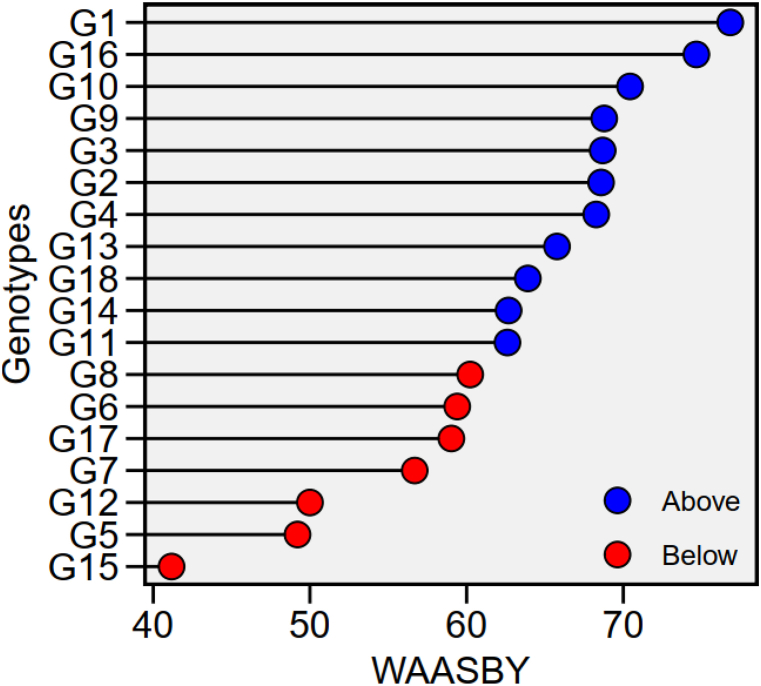
Genotype × environment interaction (GEI) poses a critical challenge to plant breeders by complicating the identification of stable variety (ies) for performance across diverse environments. GGE biplot and AMMI analyses have been identified as the most effective and appropriate statistical techniques for identifying stable and high-performing genotypes across diverse environments. The objective of this study was to identify widely adapted and high-yielding soybean genotypes from Multi-Locational Trials (MLTs) using GGE and AMMI biplot analyses. Fifteen IITA-bred elite soybean lines and three standard checks were evaluated for stability of performance in a 3 × 6 alpha lattice design with three replications across seven locations in Nigeria. Significant (p < 0.001) differences were detected among genotypes, environments, and GEI for grain yield, which ranged between 979.8 kg ha and 3645 kg ha with a mean of 2324 kg ha. To assess the stability of genotypes, analyses were conducted using the general linear method, GGE, and the Additive Main Effect and Multiplicative Interaction (AMMI) approach, as well as WAAS and ASV rank indices. In the GGE biplot model, the first two principal components accounted for 67.4 % of the total variation, while in the AMMI model, the first two Interaction Principal Component Axes (IPCA1 and IPCA2) explained 73.20 % and 11.40 % of the variation attributed to genotype by environment interaction, respectively. GGE biplot identified G10 and G16 as the most stable and productive genotypes, while WAASB index revealed G16, G10, G9, G4 and G2 as the most adaptive, stable and productive genotypes across locations, and ASV identified G9, G13, G4, G14 and G10 as the most stable and productive. Consequently, genotypes G2, G4, G9, G10 and G16 displayed outstanding and stable grain yield performance across the test locations and are, therefore, recommended for release as new soybean varieties suitable for cultivation in the respective mega environment where they performed best. More importantly, the two genotypes are recommended for recycling as sources of high-yield and yield stability genes, and as parental lines for high-yield and stable performance for future breeding and genomic selection.
基因型×环境互作(GEI)给植物育种者带来了严峻挑战,因为它使在不同环境中鉴定表现稳定的品种变得复杂。GGE双标图分析和AMMI分析已被确定为在不同环境中鉴定稳定且高产基因型的最有效和合适的统计技术。本研究的目的是使用GGE和AMMI双标图分析,从多点试验(MLT)中鉴定出适应性广且高产的大豆基因型。在尼日利亚的7个地点,采用3×6α格子设计,三次重复,对15个国际热带农业研究所培育的优良大豆品系和3个标准对照进行了性能稳定性评估。在籽粒产量方面,基因型、环境和GEI之间存在显著(p<0.001)差异,产量范围在979.8公斤/公顷至3645公斤/公顷之间,平均为2324公斤/公顷。为了评估基因型的稳定性,使用一般线性方法、GGE、加性主效应和乘性互作(AMMI)方法以及WAAS和ASV排名指数进行了分析。在GGE双标图模型中,前两个主成分占总变异的67.4%,而在AMMI模型中,前两个互作主成分轴(IPCA1和IPCA2)分别解释了基因型与环境互作所导致变异的73.20%和11.40%。GGE双标图将G10和G16鉴定为最稳定且高产的基因型,而WAASB指数显示G16、G10、G9、G4和G2是各地最具适应性、最稳定且高产的基因型,ASV则将G9、G十三、G4、G十四和G10鉴定为最稳定且高产的基因型。因此,基因型G二、G4、G9、G10和G16在各试验地点均表现出优异且稳定的籽粒产量性能,因此建议将其作为适合在各自表现最佳的大环境中种植的新大豆品种予以发布。更重要的是,推荐这两个基因型作为高产和产量稳定性基因的来源进行轮回选择,并作为未来育种和基因组选择中高产且性能稳定的亲本系。