Department of Radiological Sciences, College of Applied Medical Sciences, King Khalid University, Abha, 62529, Saudi Arabia.
Department of Diagnostic Radiology Technology, College of Applied Medical Sciences, Taibah University, Al-Madinah, Saudi Arabia.
BMC Musculoskelet Disord. 2023 Jun 7;24(1):468. doi: 10.1186/s12891-023-06596-3.
Musculoskeletal disorders are common health problems worldwide. Several factors cause these symptoms, including ergonomics and other individual considerations. Computer users are prone to repetitive strain injuries that increase the risk of developing musculoskeletal symptoms (MSS). Radiologists are susceptible to developing MSS because they work long hours analysing medical images on computers in an increasingly digitalised field. This study aimed to identify the prevalence of MSS among Saudi radiologists and the associated risk factors.
This study was a cross-sectional, non-interventional, self-administered online survey. The study was conducted on 814 Saudi radiologists from various regions in Saudi Arabia. The study's outcome was the presence of MSS in any body region that limited participation in routine activities over the previous 12 months. The results were descriptively examined using binary logistic regression analysis to estimate the odds ratio (OR) of participants who had disabling MSS in the previous 12 months. All university, public, and private radiologists received an online survey containing questions about work surroundings, workload (e.g., spent at a computer workstation), and demographic characteristics.
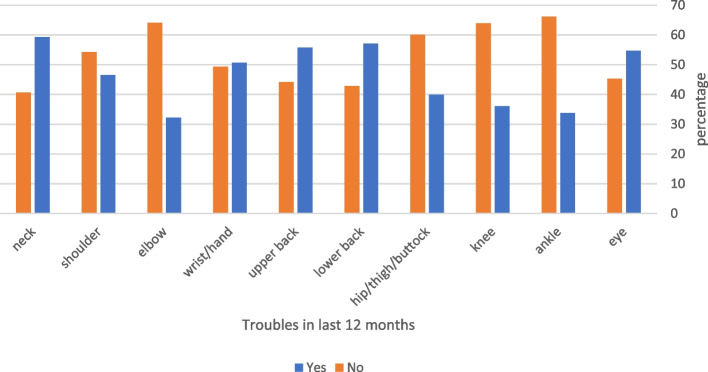
The prevalence of MSS among the radiologists was 87.7%. Most of the participants (82%) were younger than 40 years of age. Radiography and computed tomography were the most common imaging modalities that caused MSS (53.4% and 26.8%, respectively). The most common symptoms were neck pain (59.3%) and lower back pain (57.1%). After adjustment, age, years of experience, and part-time employment were significantly associated with increased MSS (OR = .219, 95% CI = .057-.836; OR = .235, 95% CI = 087-.634; and OR = 2.673, 95% CI = 1.434-4.981, respectively). Women were more likely to report MSS than males (OR = 2.12, 95% CI = 1.327-3.377).
MSS are common among Saudi radiologists, with neck pain and lower back pain being the most frequently reported symptoms. Gender, age, years of experience, type of imaging modality, and employment status were the most common associated risk factors for developing MSS. These findings are vital for the development of interventional plans to reduce the prevalence of musculoskeletal complaints in clinical radiologists.
肌肉骨骼疾病是全球常见的健康问题。导致这些症状的因素有很多,包括人体工程学和其他个体因素。计算机用户容易患上重复性劳损,从而增加患上肌肉骨骼症状(MSS)的风险。放射科医生由于在日益数字化的领域中长时间分析计算机上的医学图像,因此容易患上 MSS。本研究旨在确定沙特放射科医生中 MSS 的患病率以及相关的危险因素。
这是一项横断面、非干预性、自我管理的在线调查研究。研究对象为沙特阿拉伯各地的 814 名沙特放射科医生。研究的结果是在过去 12 个月中任何身体部位出现限制日常活动的 MSS。使用二元逻辑回归分析对研究结果进行描述性检查,以估计在过去 12 个月中患有致残性 MSS 的参与者的优势比(OR)。所有大学、公立和私立放射科医生都收到了一份在线调查,其中包含有关工作环境、工作量(例如,在计算机工作站上花费的时间)和人口统计学特征的问题。
放射科医生中 MSS 的患病率为 87.7%。大多数参与者(82%)年龄小于 40 岁。放射摄影和计算机断层扫描是最常见引起 MSS 的影像学检查方法(分别为 53.4%和 26.8%)。最常见的症状是颈部疼痛(59.3%)和下背部疼痛(57.1%)。调整后,年龄、工作年限和兼职工作与 MSS 显著相关(OR=0.219,95%CI=0.057-0.836;OR=0.235,95%CI=0.087-0.634;OR=2.673,95%CI=1.434-4.981)。女性比男性更容易报告 MSS(OR=2.12,95%CI=1.327-3.377)。
MSS 在沙特放射科医生中很常见,颈部疼痛和下背部疼痛是最常见的报告症状。性别、年龄、工作年限、影像学检查类型和就业状况是 MSS 发生的最常见相关危险因素。这些发现对于制定干预计划以减少临床放射科医生肌肉骨骼投诉的发生率至关重要。