Department of Medicine, University of California San Francisco, San Francisco, CA.
Department of Epidemiology and Biostatistics, University of California San Francisco, San Francisco, CA.
Transplantation. 2023 Oct 1;107(10):2255-2261. doi: 10.1097/TP.0000000000004672. Epub 2023 Jun 8.
After lung transplantation, both frailty and chronic lung allograft dysfunction (CLAD) commonly develop, and when they do, are associated with poorer outcomes. Given their potential shared mechanisms, we sought to explore the temporal relationship between frailty and CLAD onset.
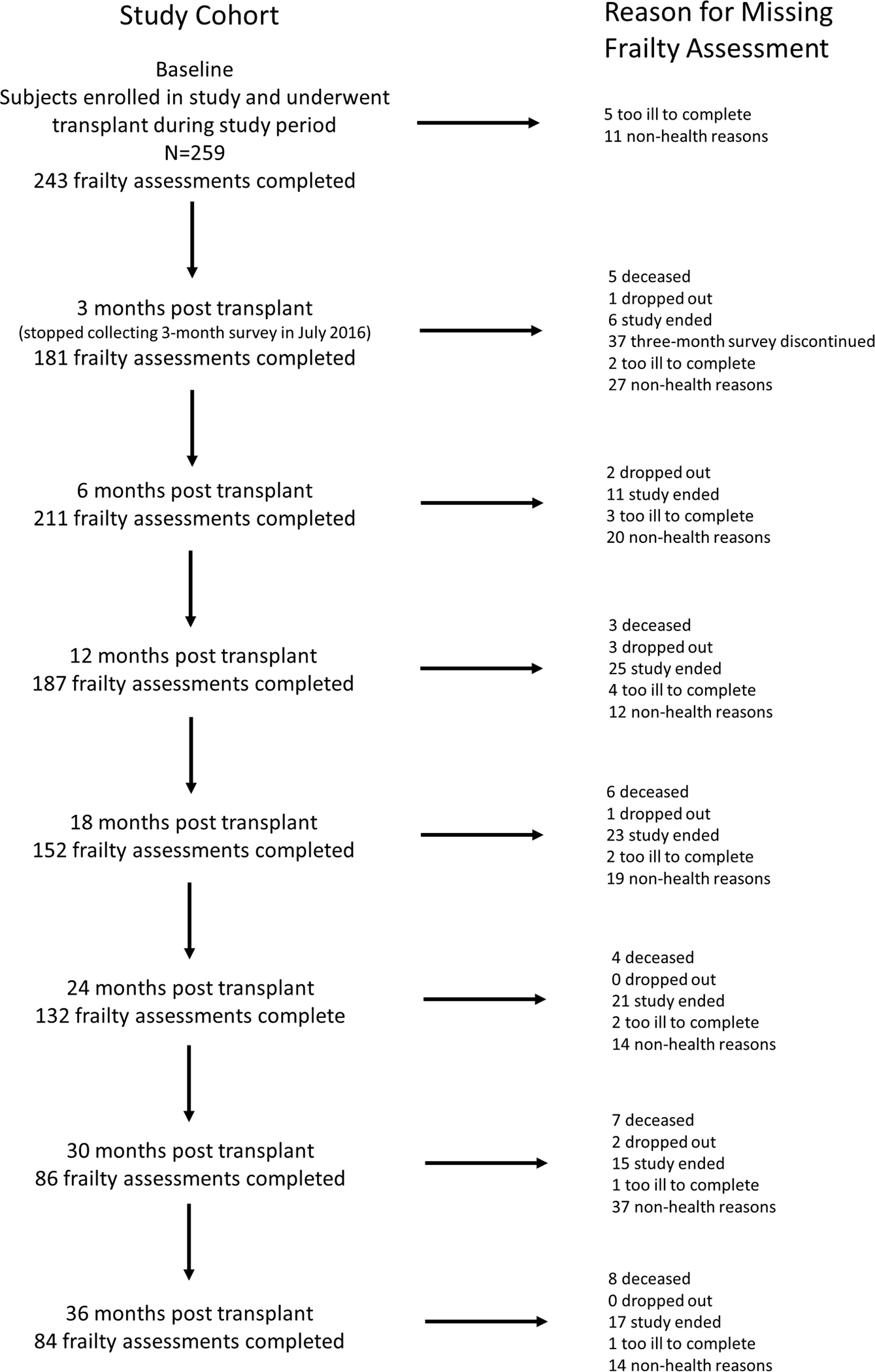
In a single center, we prospectively measured frailty by the short physical performance battery (SPPB) repeatedly after transplant. Because of the nature of the relationship between frailty and CLAD is unknown, we tested the association between frailty, modeled as a time-dependent predictor, and CLAD development as well as CLAD development, modeled as a time-dependent predictor, and frailty development. To do so, we used Cox proportional cause-specific hazards and conditional logistic regression models adjusted for age, sex, race, diagnosis, cytomegalovirus serostatus, posttransplant body mass index, and acute cellular rejection episodes as time-dependent covariates. We tested SPPB frailty as a binary (≤9 points) and continuous predictor (12-point scale); as an outcome, we defined frailty as SPPB ≤9.
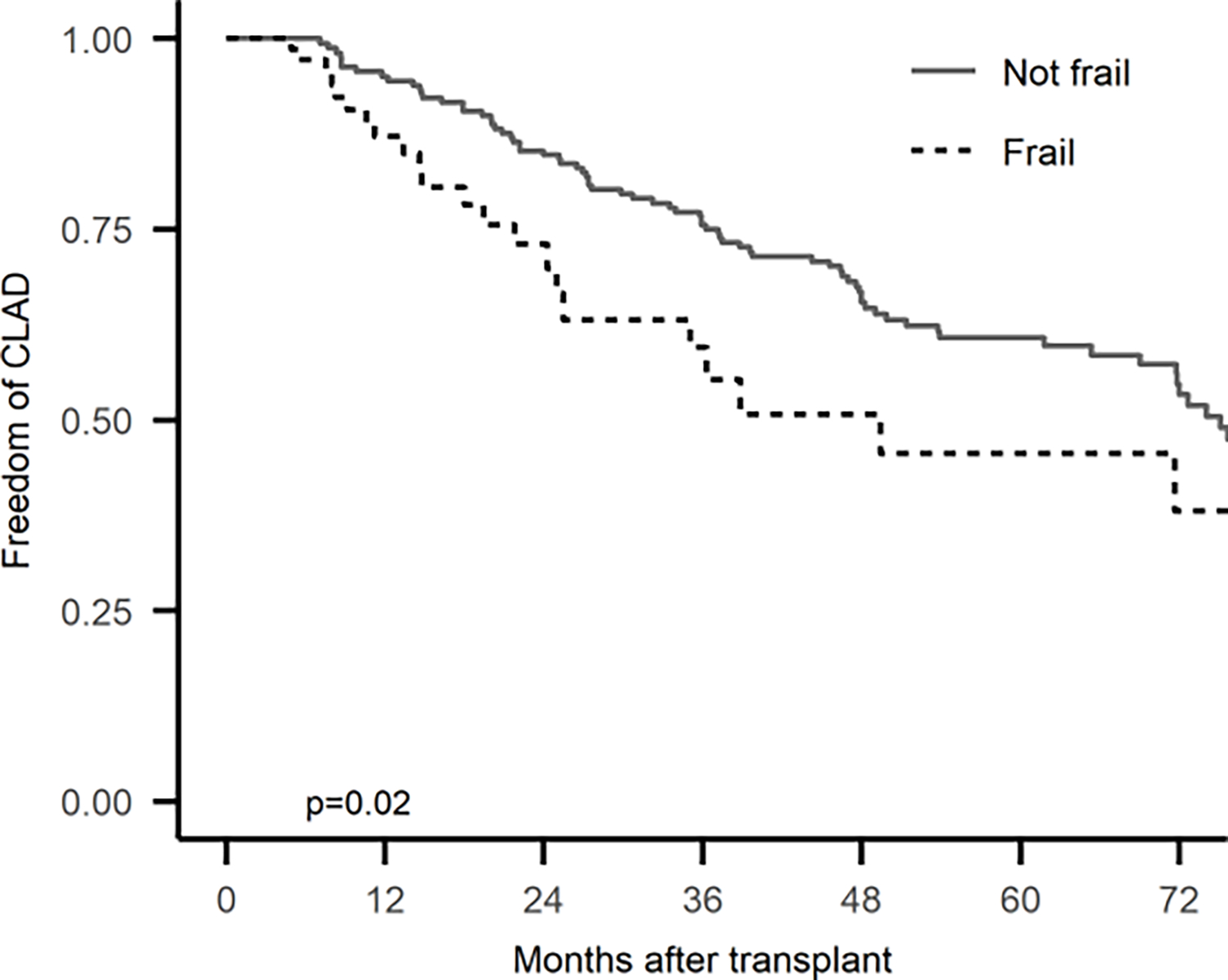
The 231 participants were a mean age of 55.7 y (SD 12.1). After adjusting for covariates, the development of frailty within 3 y after lung transplant was associated with cause-specific CLAD risk (adjusted cause-specific hazard ratio: 1.76; 95% confidence interval [CI], 1.05-2.92 when defining frailty as SPPB ≤9 and adjusted cause-specific hazard ratio: 1.10, 95% CI, 1.03-1.18 per 1-point worsening in SPPB). CLAD onset did not appear to be a risk factor for subsequent frailty (odds ratio, 4.0; 95% CI, 0.4-197.0).
Studying the mechanisms underlying frailty and CLAD could provide new insights into the pathobiology of both and potential targets for intervention.
肺移植后,衰弱和慢性移植物肺功能障碍(CLAD)通常都会发生,且发生后会导致预后较差。鉴于两者可能存在共同的发病机制,我们试图探讨衰弱和 CLAD 发病之间的时间关系。
我们在一个单中心前瞻性研究中,反复使用短体适能表现测试(SPPB)来测量移植后的衰弱情况。由于衰弱和 CLAD 之间的关系性质尚不清楚,我们分别测试了衰弱(作为时间依赖性预测因素)与 CLAD 发病以及 CLAD 发病(作为时间依赖性预测因素)与衰弱发病之间的相关性。为此,我们使用 Cox 比例风险因果模型和条件逻辑回归模型,将年龄、性别、种族、诊断、巨细胞病毒血清学状态、移植后体重指数和急性细胞性排斥反应作为时间依赖性协变量进行调整。我们将 SPPB 衰弱定义为衰弱作为二分类(≤9 分)和连续(12 分制)预测因素;将衰弱定义为 SPPB≤9 分。
231 名参与者的平均年龄为 55.7 岁(标准差 12.1)。在调整了协变量后,肺移植后 3 年内发生的衰弱与特定病因的 CLAD 风险相关(调整后的特定病因风险比:1.76;95%置信区间[CI],定义为 SPPB≤9 时为 1.05-2.92;调整后的特定病因风险比:1.10,95% CI,SPPB 每恶化 1 分的风险比为 1.03-1.18)。CLAD 发病似乎不是随后发生衰弱的危险因素(比值比,4.0;95% CI,0.4-197.0)。
研究衰弱和 CLAD 的发病机制可以为两者的发病机制提供新的见解,并为潜在的干预靶点提供新的见解。