Bennett Troy L R, Marsh Adam V, Turner James M, Plasser Felix, Heeney Martin, Glöcklhofer Florian
Department of Chemistry and Centre for Processable Electronics, Imperial College London, Molecular Sciences Research Hub London UK
KAUST Solar Center (KSC), Physical Science and Engineering Division (PSE), King Abdullah University of Science and Technology (KAUST) Thuwal Saudi Arabia.
Mol Syst Des Eng. 2023 May 10;8(6):713-720. doi: 10.1039/d3me00045a. eCollection 2023 Jun 6.
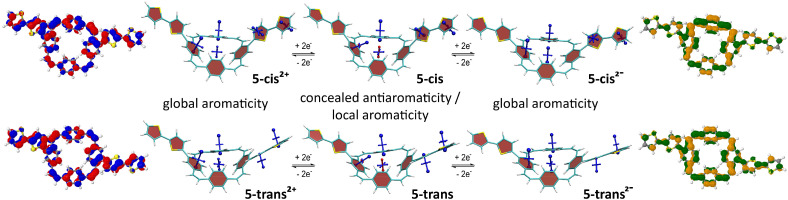
Conjugated macrocycles can exhibit concealed antiaromaticity; that is, despite not being antiaromatic, under specific circumstances, they can display properties typically observed in antiaromatic molecules due to their formal macrocyclic 4 π-electron system. Paracyclophanetetraene (PCT) and its derivatives are prime examples of macrocycles exhibiting this behaviour. In redox reactions and upon photoexcitation, they have been shown to behave like antiaromatic molecules (requiring type I and II concealed antiaromaticity, respectively), with such phenomena showing potential for use in battery electrode materials and other electronic applications. However, further exploration of PCTs has been hindered by the lack of halogenated molecular building blocks that would permit their integration into larger conjugated molecules by cross-coupling reactions. Here, we present two dibrominated PCTs, obtained as a mixture of regioisomers from a three-step synthesis, and demonstrate their functionalisation Suzuki cross-coupling reactions. Optical, electrochemical, and theoretical studies reveal that aryl substituents can subtly tune the properties and behaviour of PCT, showing that this is a viable strategy in further exploring this promising class of materials.
共轭大环化合物可表现出隐藏的反芳香性;也就是说,尽管它们本身并非反芳香性分子,但在特定条件下,由于其形式上的大环4π电子体系,它们能够展现出反芳香性分子通常具有的性质。对环芳烷四烯(PCT)及其衍生物就是表现出这种行为的大环化合物的典型例子。在氧化还原反应以及光激发过程中,它们已被证明表现得如同反芳香性分子(分别需要I型和II型隐藏反芳香性),这类现象在电池电极材料及其他电子应用中显示出潜在用途。然而,由于缺乏卤化分子构建单元,无法通过交叉偶联反应将其整合到更大的共轭分子中,这阻碍了对PCT的进一步探索。在此,我们展示了两种二溴化PCT,它们是通过三步合成法得到的区域异构体混合物,并展示了它们在铃木交叉偶联反应中的功能化。光学、电化学和理论研究表明,芳基取代基能够微调PCT的性质和行为,这表明这是进一步探索这类有前景材料的一种可行策略。