Department of Health Research, Chiba Foundation for Health Promotion and Disease Prevention, Chiba, Japan.
Department of Public Health, Chiba University Graduate School of Medicine, Chiba, Japan.
PLoS One. 2023 Jun 8;18(6):e0286909. doi: 10.1371/journal.pone.0286909. eCollection 2023.
In terms of medical policy for cervical cancer prevention, Japan lags far behind other industrialized countries. We initiated a randomized controlled trial to evaluate the self-sampling human papillomavirus (HPV) test as a tool to raise screening uptake and detection of pre-cancer. This study was conducted to explore the acceptability and preference of self-sampling using a subset of the data from this trial.
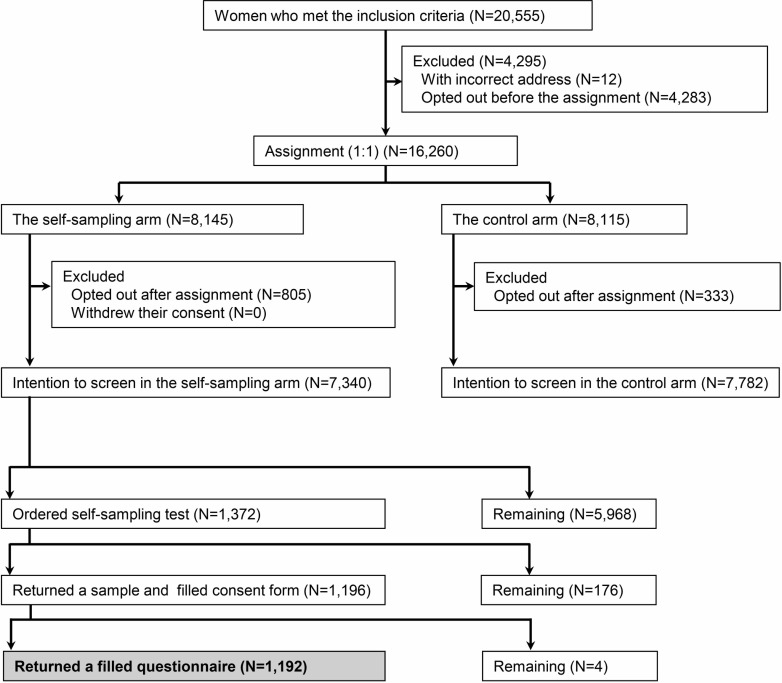
A pre-invitation letter was sent to eligible women, aged 30-59 years who had not undergone cervical cancer screening for three or more years. After excluding those who declined to participate in this trial, the remaining women were assigned to the self-sampling and control groups. A second invitation letter was sent to the former group, and those wanting to undergo the self-sampling test ordered the kit. A self-sampling HPV kit, consent form, and a self-administered questionnaire were sent to participants who ordered the test.
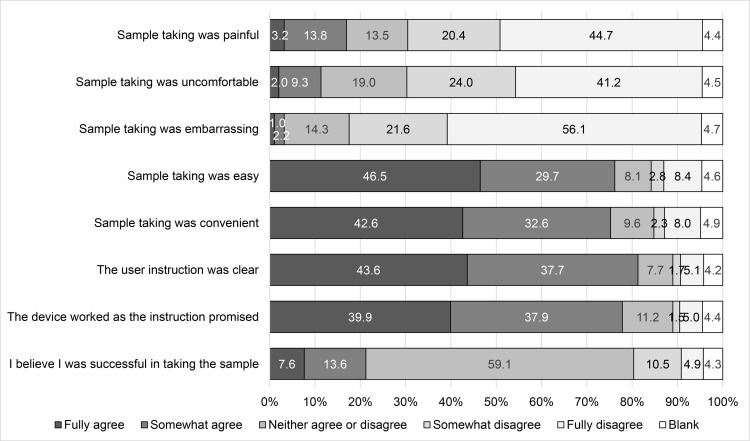
Of the 7,340 participants in the self-sampling group, 1,196 (16.3%) administered the test, and 1,192 (99.7%) answered the questionnaire. Acceptability of the test was favorable; 75.3-81.3% of participants agreed with positive impressions (easy, convenient, and clarity of instruction), and 65.1-77.8% disagreed with negative impressions (painful, uncomfortable, and embarrassing). However, only 21.2% were confident in their sampling procedure. Willingness to undergo screening with a self-collected sample was significantly higher than that with a doctor-collected sample (89.3% vs. 49.1%; p<0.001). Willingness to undergo screening with a doctor-collected sample was inversely associated with age and duration without screening (both p<0.001), but that with a self-collected sample was not associated.
Among women who used the self-sampling HPV test, high acceptability was confirmed, while concerns about self-sampling procedures remained. Screening with a self-collected sample was preferred over a doctor-collected sample and the former might alleviate disparities in screening rates.
在宫颈癌预防的医疗政策方面,日本远远落后于其他工业化国家。我们发起了一项随机对照试验,以评估自我采样人乳头瘤病毒(HPV)检测作为提高筛查率和检测癌前病变的工具。本研究旨在通过该试验的一个子数据集来探讨自我采样的可接受性和偏好。
向年龄在 30-59 岁之间、三年以上未接受宫颈癌筛查的合格女性发送预先邀请信。在排除那些拒绝参与本试验的女性后,其余女性被分配到自我采样组和对照组。向前者发送第二封邀请信,那些希望进行自我采样测试的人订购试剂盒。向订购测试的参与者发送自我采样 HPV 试剂盒、同意书和自我管理问卷。
在自我采样组的 7340 名参与者中,有 1196 人(16.3%)进行了测试,有 1192 人(99.7%)回答了问卷。测试的可接受性良好;75.3-81.3%的参与者对积极印象(简单、方便和说明清晰)表示赞同,而 65.1-77.8%的参与者对消极印象(疼痛、不适和尴尬)表示不赞同。然而,只有 21.2%的人对自己的采样过程有信心。愿意接受自我采集样本进行筛查的比例明显高于医生采集样本(89.3% vs. 49.1%;p<0.001)。愿意接受医生采集样本进行筛查与年龄和未筛查时间呈负相关(均 p<0.001),而愿意接受自我采集样本进行筛查则没有相关性。
在使用自我采样 HPV 测试的女性中,确认了高可接受性,同时对自我采样程序仍存在担忧。与医生采集样本相比,自我采集样本进行筛查更受欢迎,而前者可能会缓解筛查率的差异。