Desai Pankaja, Beck Todd, Krueger Kristin, Wilson Robert, Evans Denis, Rajan Kumar
Rush University Medical Center.
Res Sq. 2023 May 18:rs.3.rs-2874085. doi: 10.21203/rs.3.rs-2874085/v1.
Little is known about how physical activity influences the relationship between neuroticism and cognitive function and cognitive decline.
Data from the Chicago Health and Aging Project (CHAP) was utilized to conduct this study. CHAP is a population-based cohort study of chronic conditions in older adults. Participants completed in-home interviews cycles of three years from 1993-2012. Mixed effects regression models were conducted to test the associations between physical activity, neuroticism, and the interaction between neuroticism and global cognitive function and global cognitive decline. Stratified mixed effects regression models by physical activity level were conducted to test the associations between neuroticism and global cognitive function and global cognitive decline.
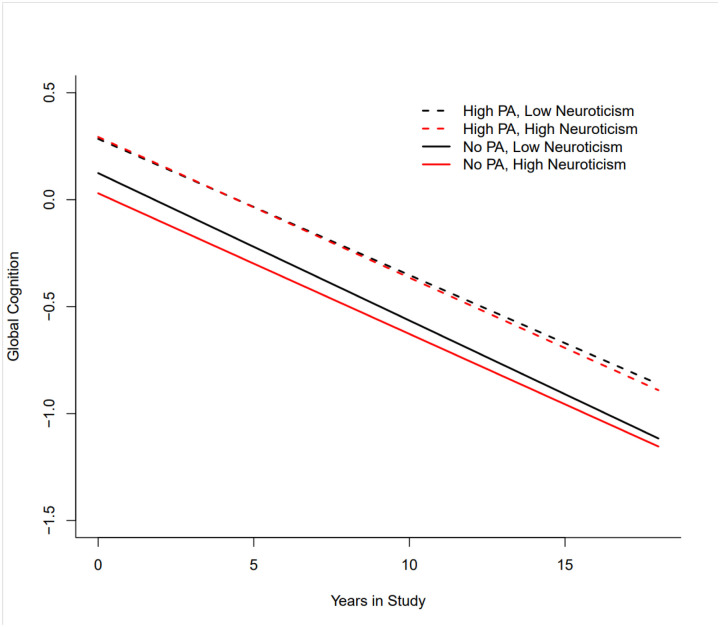
A total of 7,685 participants were eligible for this study. Participants were 62% female and 64% African American. We found statistically significant associations for the interaction of medium physical and neuroticism (β = 0.014 (SE = 0.007), p = .037) and the interaction of high physical activity and neuroticism (β = 0.021 (SE = 0.007), p = .003) on global cognitive function at baseline but not for decline over time. Stratified analysis showed that among participants with high physical activity levels, the association between neuroticism and global cognitive decline was statistically significant (β=-0.002 (SE = 0.001), p = .023).
Increasing physical activity level benefits the cognitive functioning of individuals with high neuroticism. Interventions should incorporate health behavior change approaches which aim to reduce characteristics of neuroticism.
关于身体活动如何影响神经质与认知功能及认知衰退之间的关系,我们知之甚少。
利用来自芝加哥健康与老龄项目(CHAP)的数据进行本研究。CHAP是一项针对老年人慢性病的基于人群的队列研究。参与者在1993年至2012年期间完成了为期三年的家庭访谈周期。采用混合效应回归模型来检验身体活动、神经质以及神经质与整体认知功能和整体认知衰退之间的相互作用之间的关联。通过身体活动水平进行分层混合效应回归模型,以检验神经质与整体认知功能和整体认知衰退之间的关联。
共有7685名参与者符合本研究的条件。参与者中62%为女性,64%为非裔美国人。我们发现,中等身体活动与神经质的相互作用(β = 0.014(标准误 = 0.007),p = 0.037)以及高身体活动与神经质的相互作用(β = 0.021(标准误 = 0.007),p = 0.003)在基线时对整体认知功能有统计学显著关联,但对随时间的衰退没有关联。分层分析表明,在身体活动水平高的参与者中,神经质与整体认知衰退之间的关联具有统计学显著性(β = -0.002(标准误 = 0.001),p = 0.023)。
提高身体活动水平有益于高神经质个体的认知功能。干预措施应纳入旨在减少神经质特征的健康行为改变方法。