Department of Surgery, Brandenburg Medical School, University Hospital Brandenburg/Havel, 14770, Brandenburg, Germany.
Clinic for General and Visceral Surgery, University Hospital Brandenburg an der Havel, Brandenburg Medical University, Hochstraße 29, 14770, Brandenburg an der Havel, Germany.
Sci Rep. 2023 Jun 9;13(1):9405. doi: 10.1038/s41598-023-36588-1.
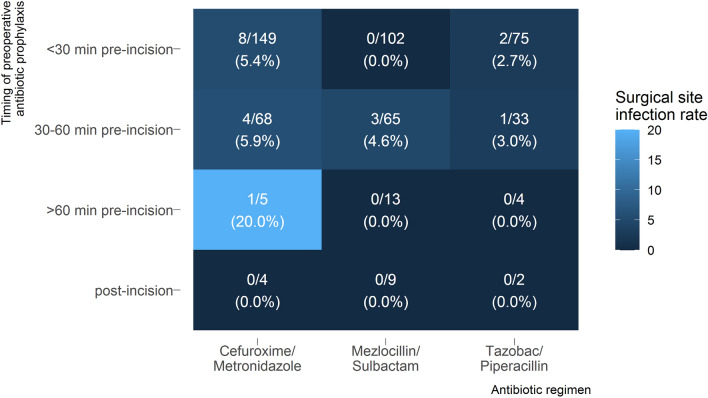
It has been revealed that the administration of an antimicrobial prophylaxis (AP) reduces the rate of surgical site (SSI) following colorectal cancer surgery. Nevertheless, the optimal timing of this medication remains unclear. The aim of this study was to determine more precisely the optimal time for administering antibiotics and to see if this could reduce the number of possible surgical site infections. The files of individuals who underwent colorectal cancer surgery at the University Hospital Brandenburg an der Havel (Germany) between 2009 and 2017 were analyzed. Piperacillin/tazobactam, cefuroxime/metronidazole and mezlocillin/sulbactam were administered as AP regimens. Timing of AP was obtained. The primary objective was the rate of SSIs based on CDC criteria. Multivariate analysis took place to identify risk factors for SSIs. A total of 326 patients (61.4%) received an AP within 30 min, 166 (31.3%) between 30 and 60 min, 22 (4.1%) more than 1 h before surgery, and 15 (2.8%) after surgery. In 19 cases (3.6%) a SSI occurred during hospital stay. A multivariate analysis did not identify AP timing as a risk factor for the occurrence of SSIs. With significance, more surgical site occurrences (SSO) were diagnosed when cefuroxime/metronidazole was given. Our results suggest that AP with cefuroxime/metronidazole is less effective in reducing SSO compared with mezlocillin/sulbactam and tazobactam/piperacillin. We assume that the timing of this AP regimen of < 30 min or 30-60 min prior to colorectal surgery does not impact the SSI rate.
研究表明,给予抗菌预防(AP)可降低结直肠癌手术后手术部位感染(SSI)的发生率。然而,这种药物的最佳给药时机仍不清楚。本研究的目的是更准确地确定抗生素的最佳给药时间,并观察这是否可以减少手术部位感染的发生。分析了 2009 年至 2017 年期间在勃兰登堡哈维尔大学医院(德国)接受结直肠癌手术的患者的档案。使用哌拉西林/他唑巴坦、头孢呋辛/甲硝唑和美洛西林/舒巴坦作为 AP 方案。获得 AP 的时间。主要目标是根据 CDC 标准的 SSI 发生率。进行多变量分析以确定 SSI 的危险因素。共有 326 例(61.4%)患者在手术前 30 分钟内接受 AP,166 例(31.3%)在 30-60 分钟内接受 AP,22 例(4.1%)在手术前 1 小时以上接受 AP,15 例(2.8%)在手术后接受 AP。在住院期间有 19 例(3.6%)发生 SSI。多变量分析未发现 AP 时机是 SSI 发生的危险因素。具有显著性意义的是,当使用头孢呋辛/甲硝唑时,更多的手术部位发生(SSO)被诊断出来。我们的结果表明,与美洛西林/舒巴坦和他唑巴坦/哌拉西林相比,头孢呋辛/甲硝唑的 AP 降低 SSO 的效果较差。我们假设,在结直肠手术前<30 分钟或 30-60 分钟内给予这种 AP 方案不会影响 SSI 发生率。