Department of Neurology, Neuroscience Center, The First Hospital of Jilin University, Changchun, China.
Clinical College, Jilin University, Changchun, China.
Sci Rep. 2023 Jun 9;13(1):9372. doi: 10.1038/s41598-023-36372-1.
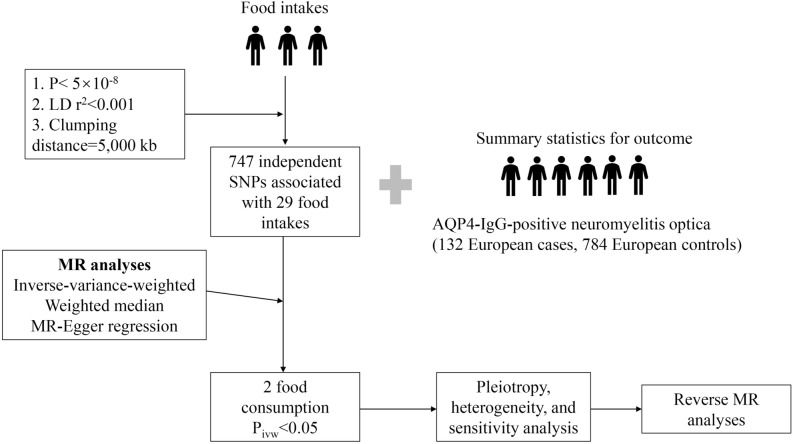
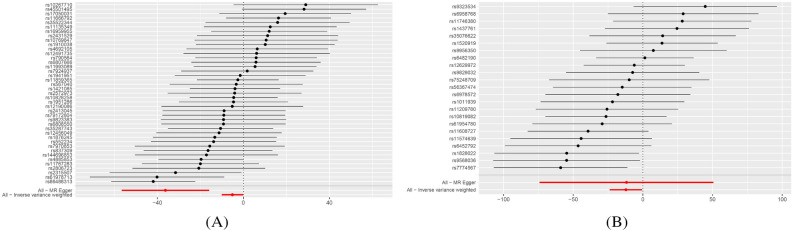
Neuromyelitis optica spectrum disorders (NMOSD) are severe inflammatory disorders of the central nervous system targeting aquaporin-4 (AQP4). The risk factors for NMOSD remain to be determined, though they may be related to diet and nutrition. This study aimed to explore the possibility of a causal relationship between specific food intake and AQP4-positive NMOSD risk. The study followed a two-sample Mendelian randomization (MR) design. Genetic instruments and self-reported information on the intake of 29 types of food were obtained from a genome-wide association study (GWAS) on 445,779 UK Biobank participants. A total of 132 individuals with AQP4-positive NMOSD and 784 controls from this GWAS were included in our study. The associations were evaluated using inverse-variance-weighted meta-analysis, weighted-median analysis, and MR-Egger regression. A high consumption of oily fish and raw vegetables was associated with a decreased risk of AQP4-positive NMOSD (odds ratio [OR] = 1.78 × 10, 95% confidence interval [CI] = 2.60 × 10-1.22 × 10, p = 0.001; OR = 5.28 × 10, 95% CI = 4.67 × 10-0.598, p = 0.041, respectively). The results were consistent in the sensitivity analyses, and no evidence of directional pleiotropy was observed. Our study provides useful implications for the development of AQP4-positive NMOSD prevention strategies. Further research is needed to determine the exact causal relationship and mechanisms underlying the association between specific food intake and AQP4-positive NMOSD.
视神经脊髓炎谱系疾病(NMOSD)是一种针对水通道蛋白 4(AQP4)的中枢神经系统严重炎症性疾病。NMOSD 的危险因素仍有待确定,但它们可能与饮食和营养有关。本研究旨在探讨特定食物摄入与 AQP4 阳性 NMOSD 风险之间是否存在因果关系。该研究采用两样本孟德尔随机化(MR)设计。遗传工具和 29 种食物摄入的自我报告信息来自对 445779 名英国生物库参与者进行的全基因组关联研究(GWAS)。本研究共纳入了来自该 GWAS 的 132 名 AQP4 阳性 NMOSD 患者和 784 名对照者。使用逆方差加权荟萃分析、加权中位数分析和 MR-Egger 回归评估关联。大量食用油性鱼类和生蔬菜与 AQP4 阳性 NMOSD 风险降低相关(比值比 [OR] = 1.78×10,95%置信区间 [CI] = 2.60×10-1.22×10,p = 0.001;OR = 5.28×10,95%CI = 4.67×10-0.598,p = 0.041)。敏感性分析结果一致,且未观察到方向性偏倚的证据。本研究为制定 AQP4 阳性 NMOSD 预防策略提供了有用的启示。需要进一步研究以确定特定食物摄入与 AQP4 阳性 NMOSD 之间关联的因果关系和机制。