Department of Epidemiology, University Medical Center Groningen, University of Groningen, Hanzeplein 1, 9713 GZ, Groningen, The Netherlands.
Rob Giel Research Center, University Medical Center Groningen, University Center for Psychiatry, University of Groningen, Groningen, The Netherlands.
Sci Rep. 2023 Jun 9;13(1):9391. doi: 10.1038/s41598-023-36235-9.
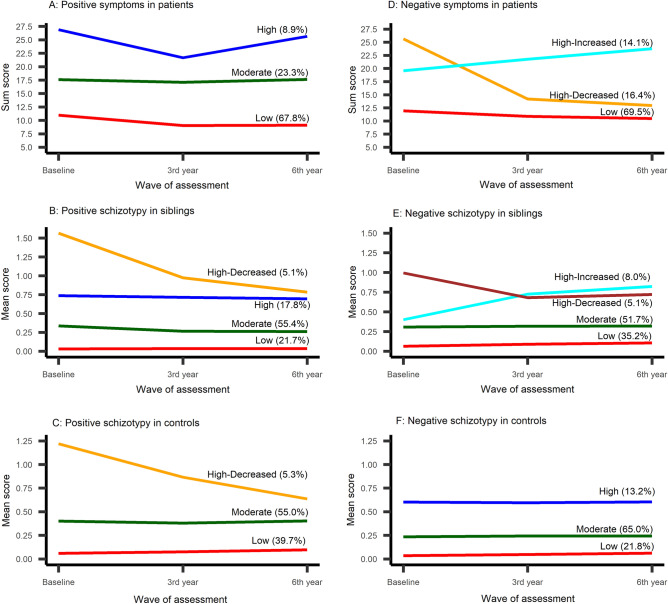
Positive and negative symptoms are prominent but heterogeneous characteristics of schizophrenia spectrum disorder (SSD). Within the framework of the Genetic Risk and Outcome of Psychosis (GROUP) longitudinal cohort study, we aimed to distinguish and identify the genetic and non-genetics predictors of homogenous subgroups of the long-term course of positive and negative symptoms in SSD patients (n = 1119) and their unaffected siblings (n = 1059) in comparison to controls (n = 586). Data were collected at baseline, and after 3- and 6-year follow-ups. Group-based trajectory modeling was applied to identify latent subgroups using positive and negative symptoms or schizotypy scores. A multinomial random-effects logistic regression model was used to identify predictors of latent subgroups. Patients had decreasing, increasing, and relapsing symptoms course. Unaffected siblings and healthy controls had three to four subgroups characterized by stable, decreasing, or increasing schizotypy. PRS did not predict the latent subgroups. Baseline symptoms severity in patients, premorbid adjustment, depressive symptoms, and quality of life in siblings predicted long-term trajectories while were nonsignificant in controls. In conclusion, up to four homogenous latent subgroups of symptom course can be distinguished within patients, siblings, and controls, while non-genetic factors are the main factors associated with the latent subgroups.
阳性和阴性症状是精神分裂症谱系障碍(SSD)的突出但异质的特征。在精神病遗传风险和结局(GROUP)纵向队列研究的框架内,我们旨在区分和确定 SSD 患者(n=1119)及其未受影响的兄弟姐妹(n=1059)与对照组(n=586)长期阳性和阴性症状的同质亚组的遗传和非遗传预测因素。数据在基线时收集,并在 3 年和 6 年随访时收集。使用阳性和阴性症状或精神分裂症特质评分,采用基于群组的轨迹建模来识别潜在亚组。使用多项随机效应逻辑回归模型来识别潜在亚组的预测因素。患者的症状呈下降、增加和复发的趋势。未受影响的兄弟姐妹和健康对照组有三个到四个特征为稳定、下降或增加精神分裂症特质的亚组。PRS 不能预测潜在亚组。患者的基线症状严重程度、病前适应、抑郁症状和兄弟姐妹的生活质量预测了长期轨迹,而在对照组中则不显著。总之,在患者、兄弟姐妹和对照组中可以区分出四个同质的症状病程潜在亚组,而非遗传因素是与潜在亚组相关的主要因素。