Department of Epidemiology and Health Statistics, Xiangya School of Public Health, Central South University, 110 Xiangya Road, Changsha, 410078, Hunan, China.
Hunan Provincial Key Laboratory of Clinical Epidemiology, Changsha, Hunan, China.
Sci Rep. 2023 Jun 9;13(1):9424. doi: 10.1038/s41598-023-36330-x.
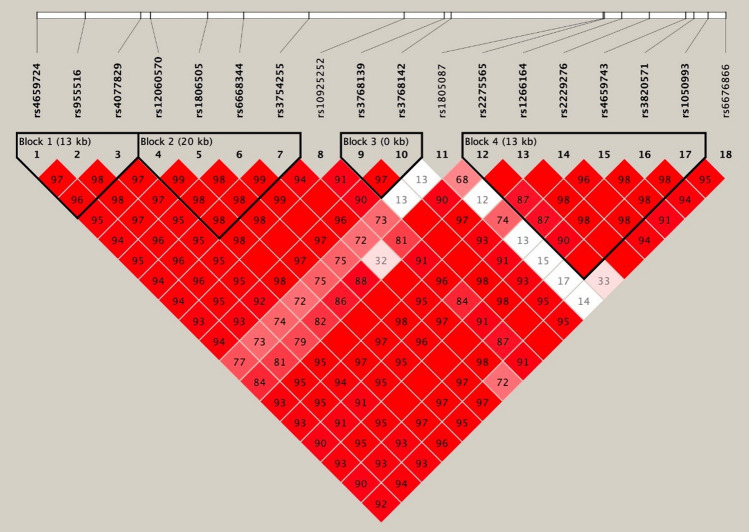
To exhaustively explore the association of infant genetic polymorphisms of methionine synthase (MTR) gene with the risk of non-syndromic congenital heart disease (CHD). A hospital-based case-control study involving 620 CHD cases and 620 health controls was conducted from November 2017 to March 2020. Eighteen SNPs were detected and analyzed. Our date suggested that the genetic polymorphisms of MTR gene at rs1805087 (GG vs. AA: aOR = 6.85, 95% CI 2.94-15.96; the dominant model: aOR = 1.77, 95% CI 1.35-2.32; the recessive model: aOR = 6.26, 95% CI 2.69-14.54; the addictive model: aOR = 1.81, 95% CI 1.44-2.29) and rs2275565 (GT vs. GG: aOR = 1.52, 95% CI 1.15-1.20; TT vs. GG: aOR = 4.93, 95% CI 1.93-12.58; the dominant model: aOR = 1.66, 95% CI 1.27-2.17; the recessive model: aOR = 4.41, 95% CI 1.73-11.22; the addictive model: aOR = 1.68, 95% CI 1.32-2.13) were significantly associated with the higher risk of CHD. And three haplotypes of G-A-T (involving rs4659724, rs95516 and rs4077829; OR = 5.48, 95% CI 2.58-11.66), G-C-A-T-T-G (involving rs2275565, rs1266164, rs2229276, rs4659743, rs3820571 and rs1050993; OR = 0.78, 95% CI 0.63-0.97) and T-C-A-T-T-G (involving rs2275565, rs1266164, rs2229276, rs4659743, rs3820571 and rs1050993; OR = 1.60, 95% CI 1.26-2.04) were observed to be significantly associated with risk of CHD. Our study found that genetic polymorphisms of MTR gene at rs1805087 and rs2275565 were significantly associated with higher risk of CHD. Additionally, our study revealed a significant association of three haplotypes with risk of CHD. However, the limitations in this study should be carefully taken into account. In the future, more specific studies in different ethnic populations are required to refine and confirm our findings.Trial registration: Registration number: ChiCTR1800016635; Date of first registration: 14/06/2018.
为了详尽地探究蛋氨酸合成酶(MTR)基因的婴儿遗传多态性与非综合征性先天性心脏病(CHD)风险之间的关联。我们进行了一项基于医院的病例对照研究,纳入了 620 例 CHD 病例和 620 名健康对照,时间为 2017 年 11 月至 2020 年 3 月。检测并分析了 18 个 SNPs。我们的数据表明,MTR 基因 rs1805087(GG 与 AA:aOR=6.85,95%CI 2.94-15.96;显性模型:aOR=1.77,95%CI 1.35-2.32;隐性模型:aOR=6.26,95%CI 2.69-14.54;加性模型:aOR=1.81,95%CI 1.44-2.29)和 rs2275565(GT 与 GG:aOR=1.52,95%CI 1.15-1.20;TT 与 GG:aOR=4.93,95%CI 1.93-12.58;显性模型:aOR=1.66,95%CI 1.27-2.17;隐性模型:aOR=4.41,95%CI 1.73-11.22;加性模型:aOR=1.68,95%CI 1.32-2.13)的遗传多态性与 CHD 风险的升高显著相关。并且三个 G-A-T 单倍型(涉及 rs4659724、rs95516 和 rs4077829;OR=5.48,95%CI 2.58-11.66)、G-C-A-T-T-G(涉及 rs2275565、rs1266164、rs2229276、rs4659743、rs3820571 和 rs1050993;OR=0.78,95%CI 0.63-0.97)和 T-C-A-T-T-G(涉及 rs2275565、rs1266164、rs2229276、rs4659743、rs3820571 和 rs1050993;OR=1.60,95%CI 1.26-2.04)与 CHD 风险显著相关。我们的研究发现,MTR 基因 rs1805087 和 rs2275565 的遗传多态性与 CHD 风险的升高显著相关。此外,我们的研究还揭示了三个单倍型与 CHD 风险之间的显著关联。然而,在未来的研究中,需要在不同的人群中进行更具体的研究,以进一步完善和验证我们的发现。试验注册:注册号:ChiCTR1800016635;首次注册日期:2018 年 6 月 14 日。