United Kingdom Health Security Agency, Harwell Science Campus, Didcot, Oxfordshire, United Kingdom.
Imperial College London School of Public Health, London, United Kingdom.
Arch Toxicol. 2023 Aug;97(8):2291-2302. doi: 10.1007/s00204-023-03522-3. Epub 2023 Jun 9.
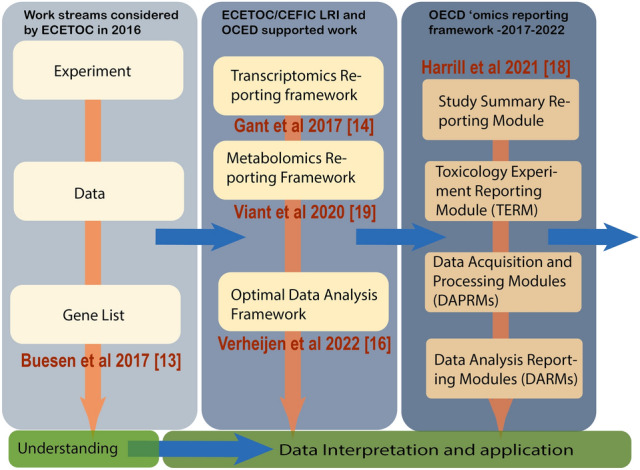
In a joint effort involving scientists from academia, industry and regulatory agencies, ECETOC's activities in Omics have led to conceptual proposals for: (1) A framework that assures data quality for reporting and inclusion of Omics data in regulatory assessments; and (2) an approach to robustly quantify these data, prior to interpretation for regulatory use. In continuation of these activities this workshop explored and identified areas of need to facilitate robust interpretation of such data in the context of deriving points of departure (POD) for risk assessment and determining an adverse change from normal variation. ECETOC was amongst the first to systematically explore the application of Omics methods, now incorporated into the group of methods known as New Approach Methodologies (NAMs), to regulatory toxicology. This support has been in the form of both projects (primarily with CEFIC/LRI) and workshops. Outputs have led to projects included in the workplan of the Extended Advisory Group on Molecular Screening and Toxicogenomics (EAGMST) group of the Organisation for Economic Co-operation and Development (OECD) and to the drafting of OECD Guidance Documents for Omics data reporting, with potentially more to follow on data transformation and interpretation. The current workshop was the last in a series of technical methods development workshops, with a sub-focus on the derivation of a POD from Omics data. Workshop presentations demonstrated that Omics data developed within robust frameworks for both scientific data generation and analysis can be used to derive a POD. The issue of noise in the data was discussed as an important consideration for identifying robust Omics changes and deriving a POD. Such variability or "noise" can comprise technical or biological variation within a dataset and should clearly be distinguished from homeostatic responses. Adverse outcome pathways (AOPs) were considered a useful framework on which to assemble Omics methods, and a number of case examples were presented in illustration of this point. What is apparent is that high dimension data will always be subject to varying processing pipelines and hence interpretation, depending on the context they are used in. Yet, they can provide valuable input for regulatory toxicology, with the pre-condition being robust methods for the collection and processing of data together with a comprehensive description how the data were interpreted, and conclusions reached.
在学术界、工业界和监管机构的科学家共同努力下,欧洲化学生物学与毒理学中心(ECETOC)在组学方面的活动提出了以下概念性建议:(1)建立一个框架,以确保报告数据质量,并将组学数据纳入监管评估;(2)采用一种方法,在对其进行监管用途解释之前,对这些数据进行稳健的定量分析。为了继续开展这些活动,本次研讨会探讨并确定了一些需要解决的领域,以促进在确定风险评估起点(POD)和确定正常变异的不利变化方面对这些数据进行稳健解释。ECETOC 是最早系统地探索组学方法应用的机构之一,现在这些方法已被纳入新方法学(NAMs)方法组,用于监管毒理学。这种支持的形式包括项目(主要与 CEFIC/LRI 合作)和研讨会。研究成果促成了一些项目被纳入经济合作与发展组织(OECD)分子筛选和毒理学基因组学扩展咨询小组(EAGMST)的工作计划,并为 OECD 组学数据报告指南的起草做出了贡献,可能还有更多关于数据转换和解释的指南。本次研讨会是一系列技术方法开发研讨会的最后一次会议,重点是从组学数据中推导出 POD。研讨会介绍表明,在科学数据生成和分析的稳健框架内开发的组学数据可用于推导出 POD。与会者讨论了数据中的噪声问题,认为这是识别稳健的组学变化并推导出 POD 的一个重要考虑因素。这种可变性或“噪声”可能包括数据集中的技术或生物学变异,并且应该与体内平衡反应明确区分开来。有害结局路径(AOP)被认为是一个有用的框架,可以用来组装组学方法,并且提出了一些案例来说明这一点。显而易见的是,高维数据将始终受到不同处理管道的影响,因此取决于它们在其中使用的上下文,它们的解释也会有所不同。然而,它们可以为监管毒理学提供有价值的信息,前提是要有用于数据收集和处理的稳健方法,以及对数据解释方式和得出的结论的全面描述。