Schwappach David, Pfeiffer Yvonne
Institute of Social and Preventive Medicine, University of Bern, Mittelstrasse 43, 3012, Bern, Switzerland.
Harmfree Healthcare, Wädenswil, Switzerland.
Patient Saf Surg. 2023 Jun 9;17(1):15. doi: 10.1186/s13037-023-00366-9.
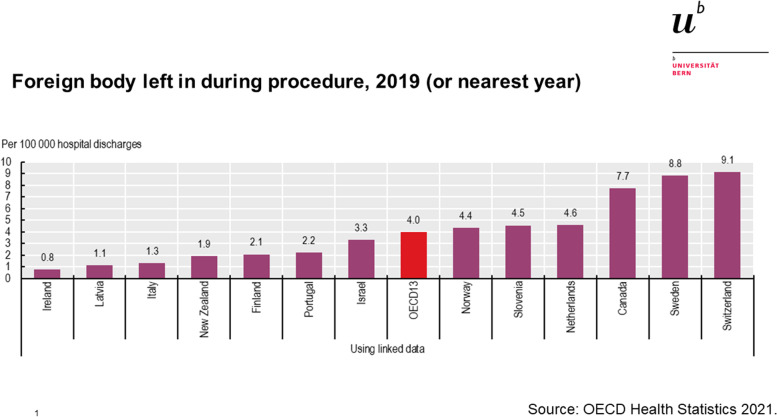
Retained foreign objects (RFO) after surgery are rare, serious patient safety events. In international comparisons based on routine data, Switzerland had remarkably high RFO rates. The objectives of this study were to 1) explore national key stakeholders' views on RFO as a safety problem, its preventability and need for action in Switzerland; and 2) to assess their interpretation of Switzerland's RFO incidence compared to other countries.
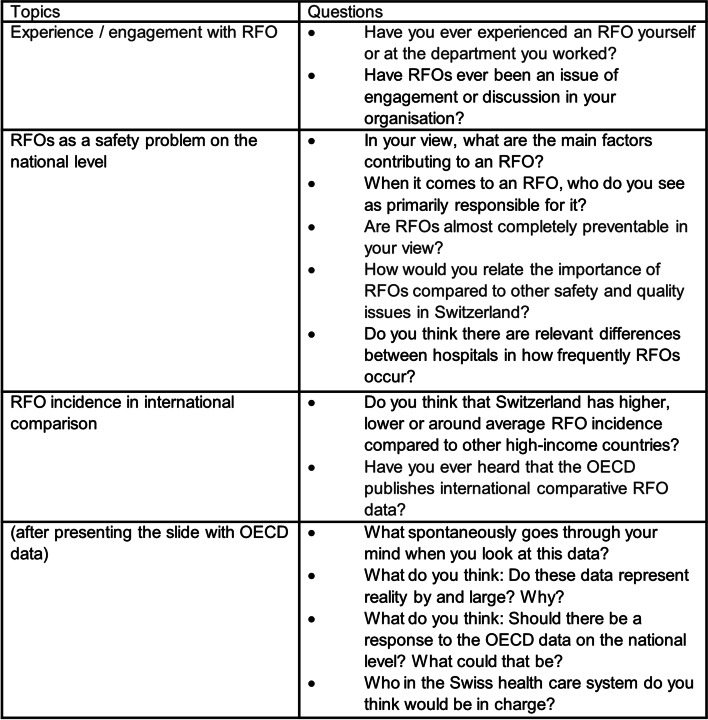
A semi-structured expert survey was conducted among national key representatives, including clinician experts, patient advocates, health administration representatives and other relevant stakeholders (n = 21). Data were coded and analyzed to generate themes related to the study questions following a deductive approach.
Experts in this study unequivocally emphasized the tragedy for individual patients affected by RFOs. Productivity pressure and the strong economization of operating rooms were perceived as detrimental to safety culture, which was seen as essential for RFO prevention, specifically by those working in the OR. RFOs were seen as "maximally minimizable" but not completely preventable. There was strong agreement that within country differences in RFO risk between Swiss hospitals existed. On the systems level and compared to other safety issues, RFO were having less urgency for most experts. The international comparison of RFO incidences raised serious skepticism across all groups of experts. The validity of the data was questioned and the dominant interpretation of Switzerland's high RFO incidence compared to other countries was a "reporting artifact" based on high coding quality in Swiss hospitals. While most experts thought that the published RFO incidence warrants in-depth analysis of the data, there was little agreement about who's role it was to initiate any further activities.
This investigation offers valuable insights into the perspectives of significant stakeholders concerning RFOs, their root causes, and preventability. The findings demonstrate how international comparative safety data are perceived, interpreted, and utilized by national experts to derive conclusive insights.
手术后异物残留(RFO)是罕见但严重的患者安全事件。在基于常规数据的国际比较中,瑞士的RFO发生率显著偏高。本研究的目的是:1)探讨瑞士国内主要利益相关者对RFO作为安全问题、其可预防性及采取行动的必要性的看法;2)评估他们对瑞士与其他国家RFO发生率的解读。
对包括临床专家、患者权益倡导者、卫生行政部门代表及其他相关利益者(n = 21)在内的国内主要代表进行了半结构化专家调查。采用演绎法对数据进行编码和分析,以生成与研究问题相关的主题。
本研究中的专家明确强调了RFO对个体患者造成的悲剧。生产力压力和手术室的高度经济化被认为对安全文化有害,而安全文化被视为预防RFO的关键,手术室工作人员尤其这么看。RFO被视为“可最大程度减少”但无法完全预防。大家强烈认同瑞士各医院之间RFO风险存在国内差异。在系统层面,与其他安全问题相比,大多数专家认为RFO的紧迫性较低。RFO发生率的国际比较引发了所有专家群体的严重怀疑。数据的有效性受到质疑,与其他国家相比,瑞士RFO发生率高的主要解释是基于瑞士医院高编码质量的“报告假象”。虽然大多数专家认为已公布的RFO发生率值得对数据进行深入分析,但对于由谁发起进一步活动几乎没有达成共识。
本调查为重要利益相关者对RFO、其根本原因及可预防性的观点提供了有价值的见解。研究结果展示了国家专家如何看待、解读和利用国际比较安全数据以得出结论性见解。