Kim Jihye, Hur Moon Haeng, Kim Seung Up, Kim Jin-Wook, Sinn Dong Hyun, Lee Hyun Woong, Kim Moon Young, Cheong Jae Youn, Jung Yong Jin, Lee Han Ah, Jin Young-Joo, Yoon Jun Sik, Park Sung-Jae, Lee Chang Hun, Kim In Hee, Lee June Sung, Cho Young Youn, Kim Hyung Joon, Park Soo Young, Seo Yeon Seok, Oh Hyunwoo, Jun Dae Won, Kim Mi Na, Chang Young, Jang Jae Young, Hwang Sang Youn, Kim Yoon Jun
Department of Internal Medicine, Seoul National University College of Medicine, Seoul National University Bundang Hospital, Seongnam 13620, Republic of Korea.
Department of Internal Medicine and Liver Research Institute, Seoul National University College of Medicine, Seoul 03080, Republic of Korea.
Cancers (Basel). 2023 May 26;15(11):2936. doi: 10.3390/cancers15112936.
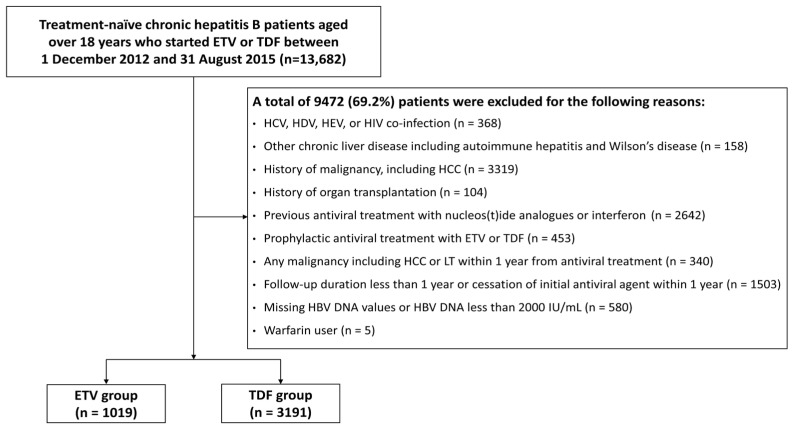
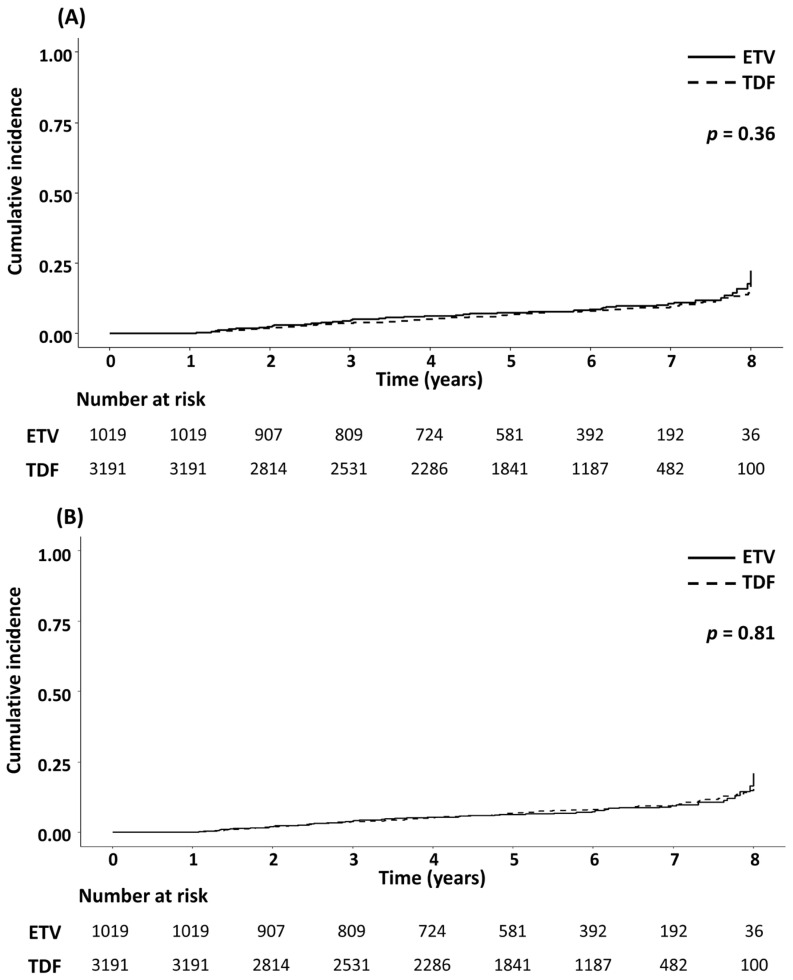
Tenofovir disoproxil fumarate (TDF) is reportedly superior or at least comparable to entecavir (ETV) in preventing hepatocellular carcinoma (HCC) among chronic hepatitis B (CHB) patients; however, it remains controversial. This study aimed to conduct comprehensive comparisons between the two antivirals. CHB patients initially treated with ETV or TDF between 2012 and 2015 at 20 referral centers in Korea were included. The primary outcome was the cumulative incidence of HCC. The secondary outcomes included death or liver transplantation, liver-related outcome, extrahepatic malignancy, development of cirrhosis, decompensation events, complete virologic response (CVR), seroconversion rate, and safety. Baseline characteristics were balanced using the inverse probability of treatment weighting (IPTW). Overall, 4210 patients were enrolled: 1019 received ETV and 3191 received TDF. During the median follow-ups of 5.6 and 5.5 years, 86 and 232 cases of HCC were confirmed in the ETV and TDF groups, respectively. There was no difference in HCC incidence between the groups both before ( = 0.36) and after IPTW was applied ( = 0.81). Although the incidence of extrahepatic malignancy was significantly higher in the ETV group than in the TDF group before weighting ( = 0.02), no difference was confirmed after IPTW ( = 0.29). The cumulative incidence rates of death or liver transplantation, liver-related outcome, new cirrhosis development, and decompensation events were also comparable in the crude population ( = 0.24-0.91) and in the IPTW-adjusted population ( = 0.39-0.80). Both groups exhibited similar rates of CVR (ETV vs. TDF: 95.1% vs. 95.8%, = 0.38), and negative conversion of hepatitis B e antigen (41.6% vs. 37.2%, = 0.09) or surface antigen (2.8% vs. 1.9%, = 0.10). Compared to the ETV group, more patients in the TDF group changed initial antivirals due to side effects, including decreased kidney function (n = 17), hypophosphatemia (n = 20), and osteoporosis (n = 18). In this large-scale multicenter study, ETV and TDF demonstrated comparable effectiveness across a broad range of outcomes in patients with treatment-naïve CHB during similar follow-up periods.
据报道,替诺福韦酯(TDF)在预防慢性乙型肝炎(CHB)患者肝细胞癌(HCC)方面优于或至少等同于恩替卡韦(ETV);然而,这仍存在争议。本研究旨在对这两种抗病毒药物进行全面比较。纳入了2012年至2015年期间在韩国20个转诊中心最初接受ETV或TDF治疗的CHB患者。主要结局是HCC的累积发病率。次要结局包括死亡或肝移植、肝脏相关结局、肝外恶性肿瘤、肝硬化的发生、失代偿事件、完全病毒学应答(CVR)、血清学转换率和安全性。使用治疗权重的逆概率(IPTW)平衡基线特征。总体而言,共纳入4210例患者:1019例接受ETV治疗,3191例接受TDF治疗。在ETV组和TDF组分别进行的中位随访5.6年和5.5年期间,分别确诊86例和232例HCC。在应用IPTW之前(P = 0.36)和之后(P = 0.81),两组之间的HCC发病率均无差异。尽管在加权前ETV组的肝外恶性肿瘤发生率显著高于TDF组(P = 0.02),但在应用IPTW后未确认差异(P = 0.29)。在未调整人群(P = 0.24 - 0.91)和IPTW调整人群(P = 0.39 - 0.80)中,死亡或肝移植、肝脏相关结局、新发生肝硬化和失代偿事件的累积发生率也相当。两组的CVR率相似(ETV组与TDF组:95.1%对95.8%,P =