Attipoe John Quarshie, Khan Waleed, Tayade Rupesh, Steven Senabulya, Islam Mohammad Shafiqul, Lay Liny, Ghimire Amit, Kim Hogyun, Sereyvichea Muong, Propey Then, Rana Yam Bahadur, Kim Yoonha
Department of Food Security and Agricultural Development, Kyungpook National University, Daegu 41566, Republic of Korea.
Laboratory of Crop Production, Department of Applied Biosciences, Kyungpook National University, Daegu 41566, Republic of Korea.
Plants (Basel). 2023 May 31;12(11):2190. doi: 10.3390/plants12112190.
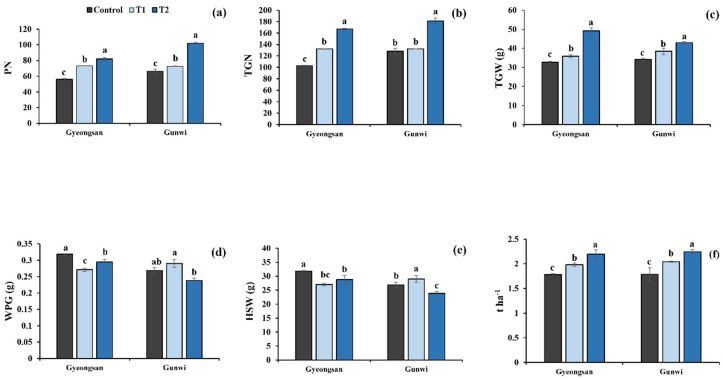
The application of silicon (Si) fertilizer positively impacts crop health, yield, and seed quality worldwide. Si is a "quasi-essential" element that is crucial for plant nutrition and stress response but is less associated with growth. This study aimed to investigate the effect of Si on the yield of cultivated soybean ( L). Two locations, Gyeongsan and Gunwi, in the Republic of Korea were selected, and a land suitability analysis was performed using QGIS version 3.28.1. The experiments at both locations consisted of three treatments: the control, Si fertilizer application at 2.3 kg per plot (9 m × 9 m) (T1), and Si fertilizer application at 4.6 kg per plot (9 m × 9 m) (T2). The agronomic, root, and yield traits, as well as vegetative indices, were analyzed to evaluate the overall impact of Si. The results demonstrated that Si had consistently significant effects on most root and shoot parameters in the two experimental fields, which led to significantly increased crop yield when compared with the control, with T2 (22.8% and 25.6%, representing an output of 2.19 and 2.24 t ha at Gyeongsan and Gunwi, respectively) showing a higher yield than T1 (11% and 14.2%, representing 1.98 and 2.04 t ha at Gyeongsan and Gunwi, respectively). These results demonstrate the positive impact of exogenous Si application on the overall growth, morphological and physiological traits, and yield output of soybeans. However, the application of the optimal concentration of Si according to the crop requirement, soil status, and environmental conditions requires further studies.
硅(Si)肥的应用对全球作物健康、产量和种子质量产生积极影响。硅是一种“准必需”元素,对植物营养和胁迫反应至关重要,但与生长的关联较小。本研究旨在调查硅对栽培大豆(L)产量的影响。在韩国庆尚和军威两个地点进行了选择,并使用QGIS 3.28.1版本进行了土地适宜性分析。两个地点的试验均包括三种处理:对照、每块地(9米×9米)施用2.3千克硅肥(T1)和每块地(9米×9米)施用4.6千克硅肥(T2)。分析了农艺、根系和产量性状以及植被指数,以评估硅的总体影响。结果表明,硅对两个试验田的大多数根系和地上部参数均具有持续显著影响,与对照相比,作物产量显著增加,其中T2(分别为22.8%和25.6%,庆尚和军威的产量分别为2.19吨/公顷和2.24吨/公顷)的产量高于T1(分别为11%和14.2%,庆尚和军威的产量分别为1.98吨/公顷和2.04吨/公顷)。这些结果证明了外源施用硅对大豆总体生长、形态和生理性状以及产量的积极影响。然而,根据作物需求、土壤状况和环境条件施用最佳浓度的硅仍需进一步研究。