Mir Rakeeb Ahmad, Bhat Basharat Ahmad, Yousuf Henan, Islam Sheikh Tajamul, Raza Ali, Rizvi Masood Ahmad, Charagh Sidra, Albaqami Mohammed, Sofi Parvaze A, Zargar Sajad Majeed
Department of Biotechnology, School of Life Sciences, Central University of Kashmir, Ganderbal, India.
Centre of Research for Development, University of Kashmir, Srinagar, India.
Front Plant Sci. 2022 Mar 23;13:819658. doi: 10.3389/fpls.2022.819658. eCollection 2022.
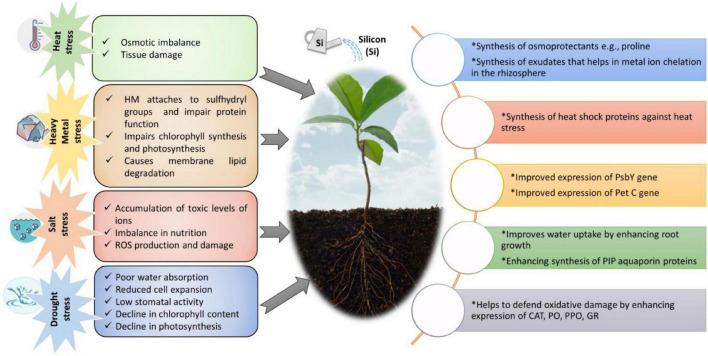
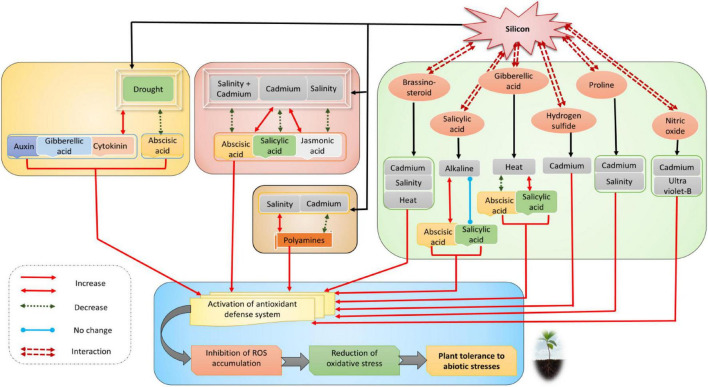
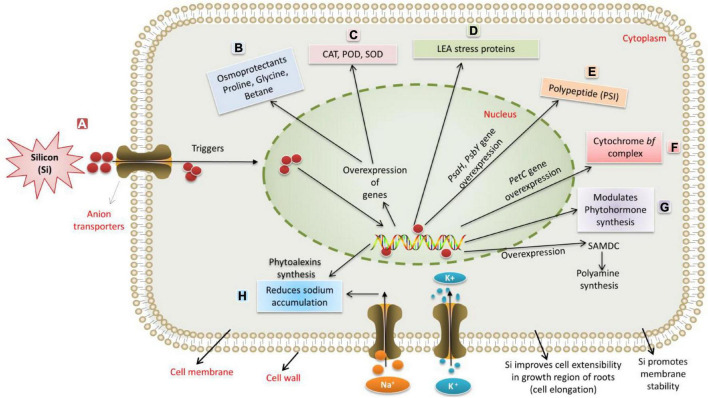
Sustainable agricultural production is critically antagonistic by fluctuating unfavorable environmental conditions. The introduction of mineral elements emerged as the most exciting and magical aspect, apart from the novel intervention of traditional and applied strategies to defend the abiotic stress conditions. The silicon (Si) has ameliorating impacts by regulating diverse functionalities on enhancing the growth and development of crop plants. Si is categorized as a non-essential element since crop plants accumulate less during normal environmental conditions. Studies on the application of Si in plants highlight the beneficial role of Si during extreme stressful conditions through modulation of several metabolites during abiotic stress conditions. Phytohormones are primary plant metabolites positively regulated by Si during abiotic stress conditions. Phytohormones play a pivotal role in crop plants' broad-spectrum biochemical and physiological aspects during normal and extreme environmental conditions. Frontline phytohormones include auxin, cytokinin, ethylene, gibberellin, salicylic acid, abscisic acid, brassinosteroids, and jasmonic acid. These phytohormones are internally correlated with Si in regulating abiotic stress tolerance mechanisms. This review explores insights into the role of Si in enhancing the phytohormone metabolism and its role in maintaining the physiological and biochemical well-being of crop plants during diverse abiotic stresses. Moreover, in-depth information about Si's pivotal role in inducing abiotic stress tolerance in crop plants through metabolic and molecular modulations is elaborated. Furthermore, the potential of various high throughput technologies has also been discussed in improving Si-induced multiple stress tolerance. In addition, a special emphasis is engrossed in the role of Si in achieving sustainable agricultural growth and global food security.
可持续农业生产受到不利环境条件波动的严重对抗。除了传统和应用策略的新型干预以抵御非生物胁迫条件外,矿物质元素的引入成为最令人兴奋和神奇的方面。硅(Si)通过调节多种功能对促进作物生长发育具有改善作用。由于作物在正常环境条件下积累较少,硅被归类为非必需元素。关于硅在植物中的应用研究突出了硅在极端胁迫条件下通过调节非生物胁迫条件下的几种代谢产物所发挥的有益作用。植物激素是在非生物胁迫条件下受硅正向调节的主要植物代谢产物。在正常和极端环境条件下,植物激素在作物的广谱生化和生理方面发挥着关键作用。前沿植物激素包括生长素、细胞分裂素、乙烯、赤霉素、水杨酸、脱落酸、油菜素内酯和茉莉酸。这些植物激素在调节非生物胁迫耐受机制方面与硅内在相关。本综述探讨了硅在增强植物激素代谢中的作用及其在不同非生物胁迫期间维持作物生理和生化健康方面的作用。此外,还阐述了硅通过代谢和分子调节在诱导作物非生物胁迫耐受性方面的关键作用的深入信息。此外,还讨论了各种高通量技术在提高硅诱导的多重胁迫耐受性方面的潜力。此外,特别强调了硅在实现可持续农业增长和全球粮食安全方面的作用。