Reza Kashyzadeh Kazem, Marusin Aleksandr Vyacheslavovich
Department of Transport, Academy of Engineering, RUDN University, 6 Miklukho-Maklaya St., Moscow 117198, Russia.
Polymers (Basel). 2023 May 27;15(11):2480. doi: 10.3390/polym15112480.
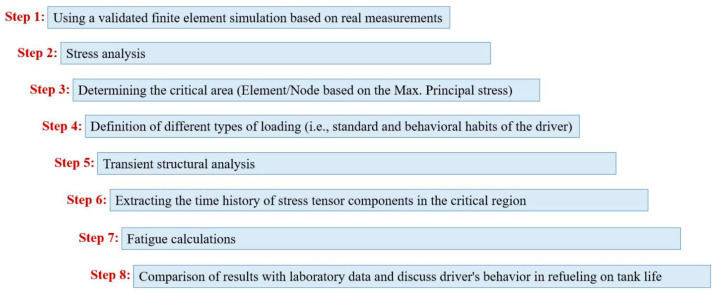
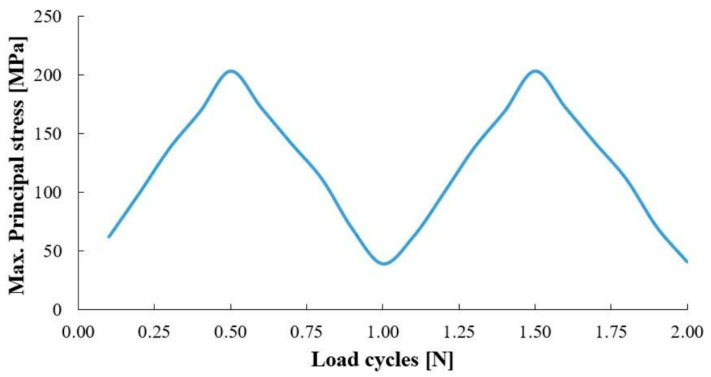
The new generation presented for CNG fuel tanks of vehicles (type-IV) is made entirely of composites. The reason for that is to prevent the sudden explosion of metal tanks and to use the advantage of gas leakage in composite materials. Previous research has shown that type-IV CNG fuel tanks also have challenges such as variable wall thickness in outer shell parts, which are prone to failure under cyclic refueling loading. The optimization of this structure is on the agenda of many scholars and automakers, and in this regard, there are many standards for strength assessment. Despite reporting injury events, it seems that another parameter should be included in these calculations. In this article, the authors have attempted to numerically investigate the effect of drivers' refueling habits on the service life of type-IV CNG fuel tanks. For this purpose, a 34-L CNG tank made of glass/epoxy composite, polyethylene, and Al-7075T6, respectively, for the outer shell parts, liner, and flanges was considered as a case study. Moreover, a real-size measurement-based finite element model validated in the corresponding author's previous research was used. The loading history was applied as internal pressure according to the standard statement. Furthermore, considering different behavior of drivers for refueling, several loading histories with asymmetric details were applied. Eventually, the results obtained for different cases were compared to experimental data in symmetrical loading. The results showed that, based on the car's mileage, the driver's behavior in the refueling process can significantly reduce the service life of the tank (up to 78% of the predicted life based on the standard methodology).
新一代车辆压缩天然气(CNG)燃料箱(IV型)完全由复合材料制成。这样做的原因是为了防止金属燃料箱突然爆炸,并利用复合材料中气体泄漏的优势。先前的研究表明,IV型CNG燃料箱也存在一些挑战,例如外壳部件壁厚不均匀,在循环加油载荷下容易失效。这种结构的优化是许多学者和汽车制造商的议程,在这方面,有许多强度评估标准。尽管报告了伤害事件,但似乎这些计算中应纳入另一个参数。在本文中,作者试图通过数值方法研究驾驶员加油习惯对IV型CNG燃料箱使用寿命的影响。为此,以一个34升的CNG燃料箱为例进行研究,该燃料箱的外壳部件、内衬和法兰分别由玻璃/环氧复合材料、聚乙烯和Al-7075T6制成。此外,还使用了在相应作者先前研究中经过验证的基于实际尺寸测量的有限元模型。根据标准规定,将加载历史作为内部压力施加。此外,考虑到驾驶员加油时的不同行为,应用了几种具有不对称细节的加载历史。最后,将不同情况下获得的结果与对称加载下的实验数据进行了比较。结果表明,根据汽车的行驶里程,驾驶员在加油过程中的行为会显著缩短燃料箱的使用寿命(最多可达基于标准方法预测寿命的78%)。