Wu Shuhui, Wang Yuxin, Song Yaqin, Hu Hongjie, Jing Liang, Zhu Wei
Department of Emergency Medicine, Tongji Hospital, Tongji Medical College, Huazhong University of Science and Technology, Wuhan, Hubei, China.
Department of Intensive Care Medicine, Tongji Hospital, Tongji Medical College, Huazhong University of Science and Technology, Wuhan, Hubei, China.
Front Neurosci. 2023 May 25;17:1152630. doi: 10.3389/fnins.2023.1152630. eCollection 2023.
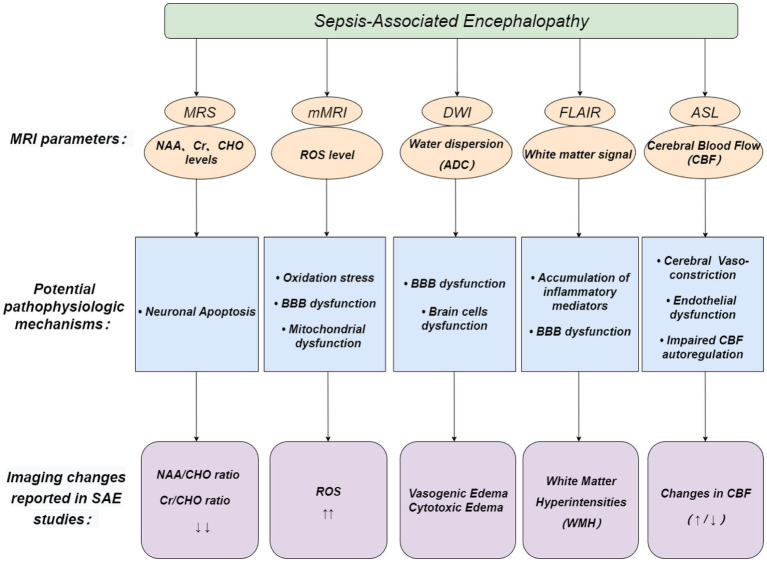
Sepsis-associated encephalopathy (SAE) refers to diffuse brain dysfunction secondary to systemic infection without central nervous system infection. The early diagnosis of SAE remains a major clinical problem, and its diagnosis is still exclusionary. Magnetic resonance imaging (MRI) related techniques, such as magnetic resonance spectroscopy (MRS), molecular MRI (mMRI), arterial spin-labeling (ASL), fluid-attenuated inversion recovery (FLAIR), and diffusion-weighted imaging (DWI), currently provide new options for the early identification of SAE. This review collected clinical and basic research and case reports related to SAE and MRI-related techniques in recent years, summarized and analyzed the basic principles and applications of MRI technology in diagnosing SAE, and provided a basis for diagnosing SAE by MRI-related techniques.
脓毒症相关性脑病(SAE)是指继发于全身感染而非中枢神经系统感染的弥漫性脑功能障碍。SAE的早期诊断仍然是一个主要的临床问题,其诊断仍为排除性诊断。磁共振成像(MRI)相关技术,如磁共振波谱(MRS)、分子MRI(mMRI)、动脉自旋标记(ASL)、液体衰减反转恢复序列(FLAIR)和扩散加权成像(DWI),目前为SAE的早期识别提供了新的选择。本综述收集了近年来与SAE及MRI相关技术有关的临床和基础研究以及病例报告,总结并分析了MRI技术在诊断SAE中的基本原理和应用,为通过MRI相关技术诊断SAE提供依据。