
新冠疫情期间神经抗体研究的频率和转诊模式:自身免疫性神经病学中心的经验。
Frequency and Referral Patterns of Neural Antibody Studies During the COVID-19 Pandemic: Experience From an Autoimmune Neurology Center.
机构信息
From the Consorci Institut D'Investigacions Biomediques August Pi i Sunyer (H.A., R.R.G., E.M.-H., A.S., F.G., J.D.); Neurology Service, Hospital Clínic de Barcelona (R.R.G., L.N., E.M.-H., A.S., J.D.); University of Barcelona (A.S., J.D.); Hospital Universitario Central de Asturias (B.R.), Oviedo; Centro de Investigación Biomédica en Red de Enfermedades Raras (CIBERER), Madrid; Catalan Institution for Research and Advanced Studies (J.D.) Barcelona, Spain; and Department of Neurology, University of Pennsylvania (J.D.), Philadelphia, PA.
出版信息
Neurol Neuroimmunol Neuroinflamm. 2023 Jun 13;10(4). doi: 10.1212/NXI.0000000000200129. Print 2023 Jul.
OBJECTIVE
To determine whether the frequency of paraneoplastic or autoimmune encephalitis antibodies examined in a referral center changed during the COVID-19 pandemic.
METHODS
The number of patients who tested positive for neuronal or glial (neural) antibodies during pre-COVID-19 (2017-2019) and COVID-19 (2020-2021) periods was compared. The techniques used for antibody testing did not change during these periods and included a comprehensive evaluation of cell-surface and intracellular neural antibodies. The chi-square test, Spearman correlation, and Python programming language v3 were used for statistical analysis.
RESULTS
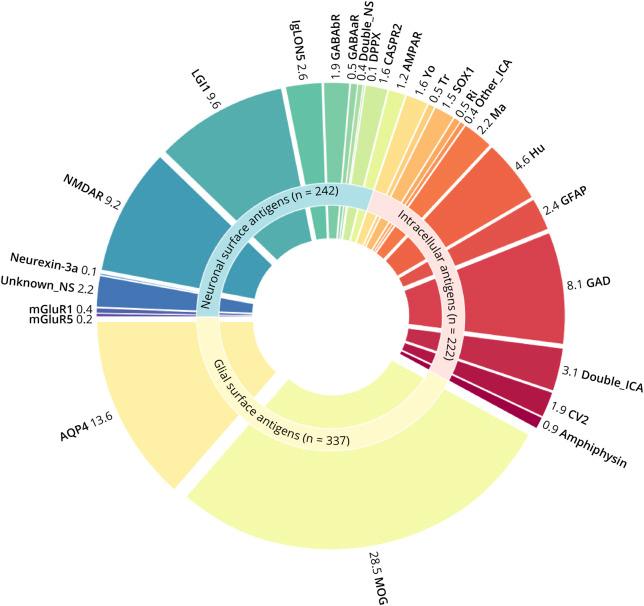
Serum or CSF from 15,390 patients with suspected autoimmune or paraneoplastic encephalitis was examined. The overall positivity rate for antibodies against neural-surface antigens was similar in the prepandemic and pandemic periods (neuronal 3.2% vs 3.5%; glial 6.1 vs 5.2) with a mild single-disease increase in the pandemic period (anti-NMDAR encephalitis). By contrast, the positivity rate for antibodies against intracellular antigens was significantly increased during the pandemic period (2.8% vs 3.9%, 0.01), particularly Hu and GFAP.
DISCUSSION
Our findings do not support that the COVID-19 pandemic led to a substantial increase of known or novel encephalitis mediated by antibodies against neural-surface antigens. The increase in Hu and GFAP antibodies likely reflects the progressive increased recognition of the corresponding disorders.
目的
确定在转诊中心检查的副肿瘤性或自身免疫性脑炎抗体的频率是否在 COVID-19 大流行期间发生变化。
方法
比较了 COVID-19 大流行前(2017-2019 年)和 COVID-19 大流行期间(2020-2021 年)检测出神经元或神经胶质(神经)抗体呈阳性的患者数量。在此期间,抗体检测所使用的技术并未改变,包括对细胞表面和细胞内神经抗体的综合评估。采用卡方检验、斯皮尔曼相关性和 Python 编程语言 v3 进行统计学分析。
结果
共检测了 15390 例疑似自身免疫性或副肿瘤性脑炎患者的血清或脑脊液。在大流行前和大流行期间,针对神经表面抗原的抗体总体阳性率相似(神经元 3.2% vs 3.5%;神经胶质 6.1% vs 5.2%),而在大流行期间(抗 NMDAR 脑炎)单一疾病的阳性率略有增加。相比之下,在大流行期间,针对细胞内抗原的抗体阳性率显著增加(2.8% vs 3.9%,0.01),尤其是 Hu 和 GFAP。
讨论
我们的研究结果不支持 COVID-19 大流行导致已知或新型脑炎抗体介导的抗体数量大量增加。Hu 和 GFAP 抗体的增加可能反映了相应疾病的逐渐增加。

 Zotero 插件