Department of Medicine, Division of Endocrinology, Diabetes, and Nutrition, University of Maryland School of Medicine, Baltimore, Maryland, USA.
Department of Medicine, Division of Cardiology, University of Maryland School of Medicine, Baltimore Street, Maryland, USA.
Hepatol Commun. 2023 Jun 14;7(7). doi: 10.1097/HC9.0000000000000174. eCollection 2023 Jul 1.
Alcohol-associated liver disease (ALD) and NAFLD often coexist in Western societies that consume energy-rich and cholesterol-containing Western diets. Increased rates of ALD mortality in young people in these societies are likely attributable to binge drinking. It is largely unknown how alcohol binge causes liver damage in the setting of Western diets.
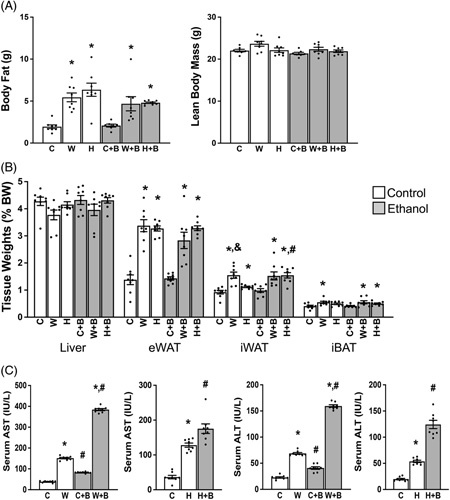
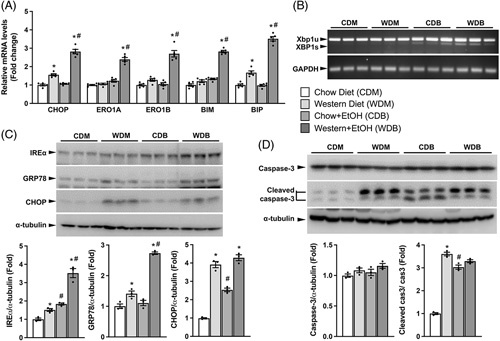
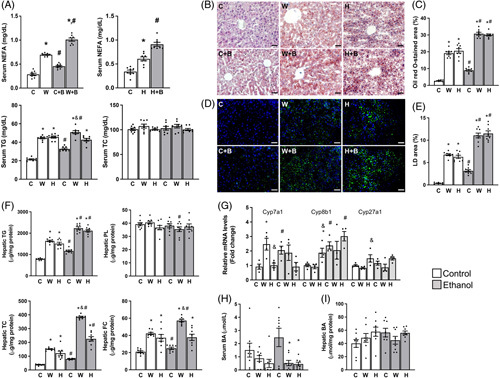
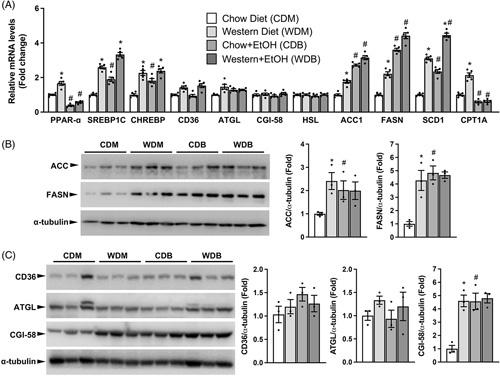
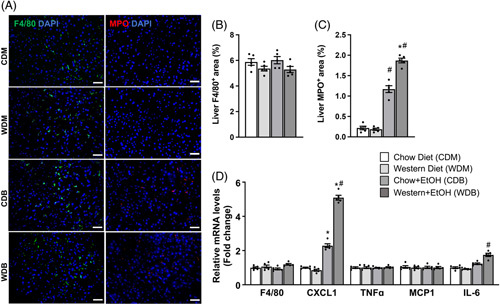
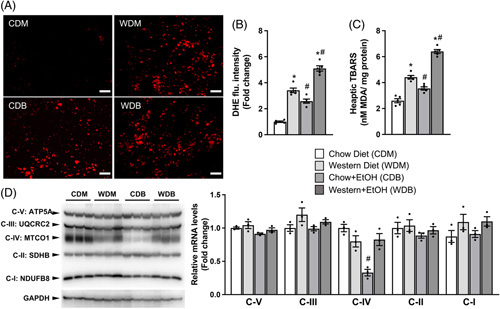
In this study, we showed that a single ethanol binge (5 g/kg body weight) induced severe liver injury as shown by marked increases in serum activities of the 2 aminotransferases AST and ALT in C57BL/6J mice that have been fed a Western diet for 3 weeks. The Western diet plus binge ethanol-fed mice also displayed severe lipid droplet deposition and high contents of triglycerides and cholesterol in the liver, which were associated with increased lipogenic and reduced fatty acid oxidative gene expression. These animals had the highest Cxcl1 mRNA expression and myeloperoxidase (MPO)-positive neutrophils in the liver. Their hepatic ROS and lipid peroxidation were the highest, but their hepatic levels of mitochondrial oxidative phosphorylation proteins remained largely unaltered. Hepatic levels of several ER stress markers, including mRNAs for CHOP, ERO1A, ERO1B, BIM, and BIP, as well as Xbp1 splicing and proteins for BIP/GRP78 and IRE-α were also the highest in these animals. Interestingly, Western diet feeding for 3 weeks or ethanol binge dramatically increased hepatic caspase 3 cleavage, and the combination of the 2 did not further increase it. Thus, we successfully established a murine model of acute liver injury by mimicking human diets and binge drinking.
This simple Western diet plus single ethanol binge model recapitulates major hepatic phenotypes of ALD, including steatosis and steatohepatitis characterized by neutrophil infiltration, oxidative stress, and ER stress.
在摄入高热量、高胆固醇的西方饮食的西方国家,酒精相关的肝病(ALD)和非酒精性脂肪性肝病(NAFLD)经常同时存在。在这些社会中,年轻人的 ALD 死亡率增加可能归因于狂饮。在西方饮食的背景下,酒精狂饮如何导致肝损伤在很大程度上是未知的。
在这项研究中,我们表明,单次乙醇狂饮(5 g/kg 体重)在喂养了 3 周西方饮食的 C57BL/6J 小鼠中引起严重的肝损伤,血清中 2 种氨基转移酶 AST 和 ALT 的活性显著增加。西方饮食加乙醇狂饮的小鼠还表现出严重的脂滴沉积和肝内甘油三酯和胆固醇含量升高,这与脂肪生成增加和脂肪酸氧化基因表达减少有关。这些动物的 Cxcl1mRNA 表达和肝内髓过氧化物酶(MPO)阳性中性粒细胞最高。它们的肝内 ROS 和脂质过氧化最高,但肝内线粒体氧化磷酸化蛋白水平基本不变。几种内质网应激标志物的肝水平,包括 CHOP、ERO1A、ERO1B、BIM 和 BIP 的 mRNA,以及 Xbp1 剪接和 BIP/GRP78 和 IRE-α 的蛋白,在这些动物中也是最高的。有趣的是,西方饮食喂养 3 周或乙醇狂饮显著增加了肝内 caspase 3 裂解,而两者的组合并没有进一步增加它。因此,我们通过模拟人类饮食和狂饮成功建立了急性肝损伤的小鼠模型。
这种简单的西方饮食加单次乙醇狂饮模型重现了 ALD 的主要肝表型,包括以中性粒细胞浸润、氧化应激和内质网应激为特征的脂肪变性和脂肪性肝炎。