Sorbonne Université, AP-HP, Hôpital Saint Antoine, Service de médecine interne et Inflammation-Immunopathology-Biotherapy Department (DMU i3), F-75012, Paris, France, French Armenian research center, Erevan, Armenia
Université de Paris, AP-HP, Hôpital Saint Louis, Service de Biostatistique et Information Médicale (DMU PRISME), INSERM U1153 Team ECSTRRA, Paris, France.
RMD Open. 2023 Jun;9(2). doi: 10.1136/rmdopen-2022-002830.
In this large multicentre study, we compared the effectiveness and safety of tocilizumab intravenous versus subcutaneous (SC) in 109 Takayasu arteritis (TAK) patients.
We conducted a retrospective multicentre study in referral centres from France, Italy, Spain, Armenia, Israel, Japan, Tunisia and Russia regarding biological-targeted therapies in TAK, since January 2017 to September 2019.
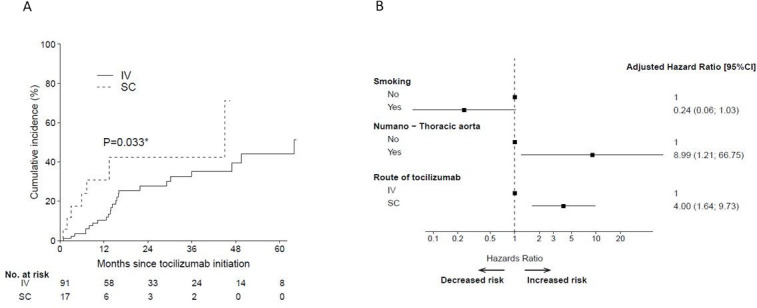
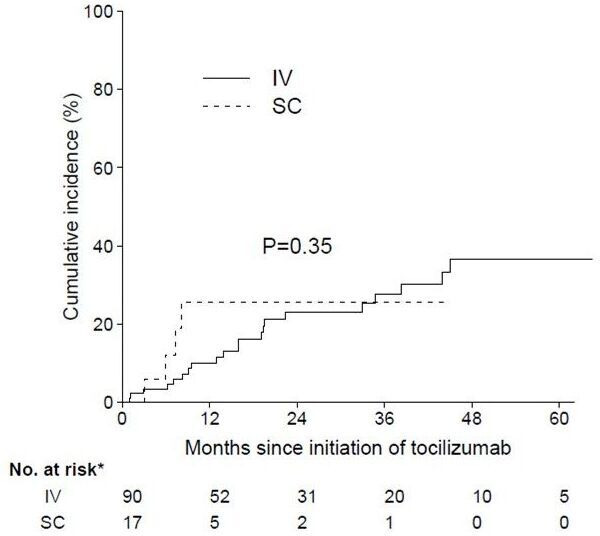
A total of 109 TAK patients received at least 3 months tocilizumab therapy and were included in this study. Among them, 91 and 18 patients received intravenous and SC tocilizumab, respectively. A complete response (NIH <2 with less than 7.5 mg/day of prednisone) at 6 months was evidenced in 69% of TAK patients, of whom 57 (70%) and 11 (69%) patients were on intravenous and SC tocilizumab, respectively (p=0.95). The factors associated with complete response to tocilizumab at 6 months in multivariate analysis, only age <30 years (OR 2.85, 95% CI 1.14 to 7.12; p=0.027) and time between TAK diagnosis and tocilizumab initiation (OR 1.18, 95% CI 1.02 to 1.36; p=0.034). During the median follow-up of 30.1 months (0.4; 105.8) and 10.8 (0.1; 46.4) (p<0.0001) in patients who received tocilizumab in intravenous and SC forms, respectively, the risk of relapse was significantly higher in TAK patients on SC tocilizumab (HR=2.55, 95% CI 1.08 to 6.02; p=0.033). The overall cumulative incidence of relapse at 12 months in TAK patients was at 13.7% (95% CI 7.6% to 21.5%), with 10.3% (95% CI 4.8% to 18.4%) for those on intravenous tocilizumab vs 30.9% (95% CI 10.5% to 54.2%) for patients receiving SC tocilizumab. Adverse events occurred in 14 (15%) patients on intravenous route and in 2 (11%) on SC tocilizumab.
In this study, we confirm that tocilizumab is effective in TAK, with complete remission being achieving by 70% of disease-modifying antirheumatic drugs-refractory TAK patients at 6 months.
在这项大型多中心研究中,我们比较了托珠单抗静脉与皮下(SC)给药治疗 109 例 Takayasu 动脉炎(TAK)患者的疗效和安全性。
我们对自 2017 年 1 月至 2019 年 9 月,来自法国、意大利、西班牙、亚美尼亚、以色列、日本、突尼斯和俄罗斯的 TAK 生物靶向治疗转诊中心,进行了一项关于生物靶向治疗的回顾性多中心研究。
共有 109 例 TAK 患者接受了至少 3 个月的托珠单抗治疗,并纳入本研究。其中,91 例和 18 例患者分别接受了静脉和 SC 托珠单抗治疗。6 个月时,69%的 TAK 患者达到完全缓解(NIH <2 且泼尼松用量<7.5mg/d),其中 57 例(70%)和 11 例(69%)患者分别接受静脉和 SC 托珠单抗治疗(p=0.95)。多变量分析显示,仅年龄<30 岁(OR 2.85,95%CI 1.14 至 7.12;p=0.027)和 TAK 诊断与托珠单抗起始时间(OR 1.18,95%CI 1.02 至 1.36;p=0.034)与 6 个月时托珠单抗完全缓解相关。在分别接受静脉和 SC 托珠单抗治疗的患者中,中位随访 30.1 个月(0.4;105.8)和 10.8 个月(0.1;46.4)(p<0.0001)期间,SC 托珠单抗组 TAK 患者的复发风险显著更高(HR=2.55,95%CI 1.08 至 6.02;p=0.033)。TAK 患者在 12 个月时的总复发累积发生率为 13.7%(95%CI 7.6%至 21.5%),静脉托珠单抗组为 10.3%(95%CI 4.8%至 18.4%),SC 托珠单抗组为 30.9%(95%CI 10.5%至 54.2%)。静脉途径组有 14 例(15%)患者和 SC 托珠单抗组有 2 例(11%)患者发生不良事件。
在这项研究中,我们证实托珠单抗治疗 TAK 有效,70%的疾病修饰抗风湿药物难治性 TAK 患者在 6 个月时达到完全缓解。