Song Yingjie, Ji Kaiyue, Duan Haohong, Shao Mingfei
State Key Laboratory of Chemical Resource Engineering Beijing University of Chemical Technology Beijing P. R. China.
Department of Chemistry Tsinghua University Beijing P. R. China.
Exploration (Beijing). 2021 Dec 16;1(3):20210050. doi: 10.1002/EXP.20210050. eCollection 2021 Dec.
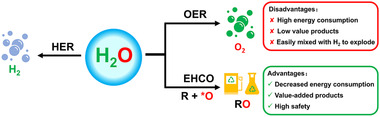
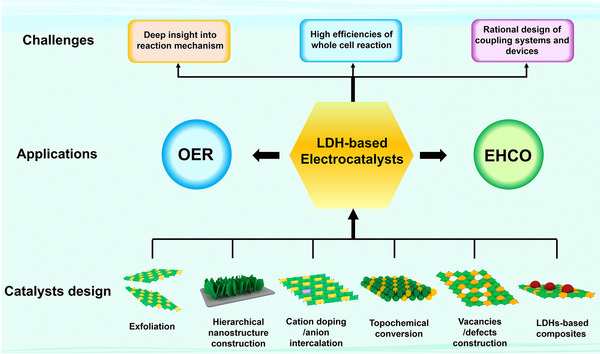
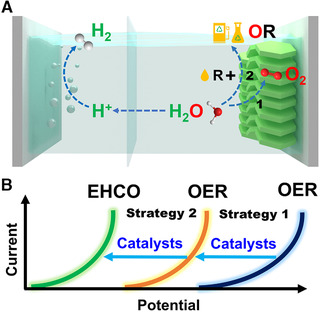
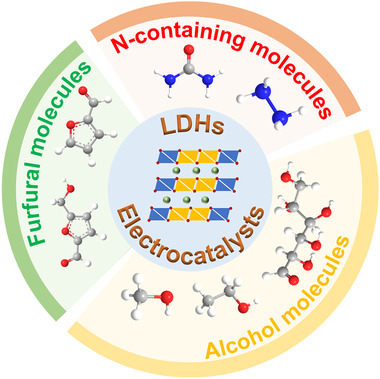
Hydrogen production via electrochemical water splitting is one of the most green and promising ways to produce clean energy and address resource crisis, but still suffers from low efficiency and high cost mainly due to the sluggish oxygen evolution reaction (OER) process. Alternatively, electrochemical hydrogen-evolution coupled with alternative oxidation (EHCO) has been proposed as a considerable strategy to improve hydrogen production efficiency combined with the production of high value-added chemicals. Although with these merits, high-efficient electrocatalysts are always needed in practical operation. Typically, layered double hydroxides (LDHs) have been developed as a large class of advanced electrocatalysts toward both OER and EHCO with high efficiency and stability. In this review, we have summarized the latest progress of hydrogen production from the perspectives of designing efficient LDHs-based electrocatalysts for OER and EHCO. Particularly, the influence of structure design and component regulation on the efficiency of their electrocatalytic process have been discussed in detail. Finally, we look forward to the challenges in the field of hydrogen production via electrochemical water splitting coupled with organic oxidation, such as the mechanism, selected oxidation as well as system design, hoping to provide certain inspiration for the development of low-cost hydrogen production technology.
通过电化学水分解制氢是生产清洁能源和应对资源危机最绿色且最具前景的方法之一,但由于析氧反应(OER)过程缓慢,其仍然存在效率低和成本高的问题。另外,电化学析氢与替代氧化耦合(EHCO)已被提出作为一种可观的策略,可在生产高附加值化学品的同时提高制氢效率。尽管有这些优点,但在实际操作中始终需要高效的电催化剂。通常,层状双氢氧化物(LDHs)已被开发成为一大类用于OER和EHCO的高效且稳定的先进电催化剂。在这篇综述中,我们从设计用于OER和EHCO的高效基于LDHs的电催化剂的角度总结了制氢的最新进展。特别地,详细讨论了结构设计和组分调控对其电催化过程效率的影响。最后,我们展望了通过电化学水分解与有机氧化耦合制氢领域的挑战,如机理、选择性氧化以及系统设计等,希望能为低成本制氢技术的发展提供一定的启发。