Pan Tiezheng, Wang Yaling, Xue Xue, Zhang Chunqiu
State Key Laboratory of Medicinal Chemical Biology Nankai University Tianjin China.
School of Life Sciences Northwestern Polytechnical University Xi'an China.
Exploration (Beijing). 2022 Feb 23;2(2):20210095. doi: 10.1002/EXP.20210095. eCollection 2022 Apr.
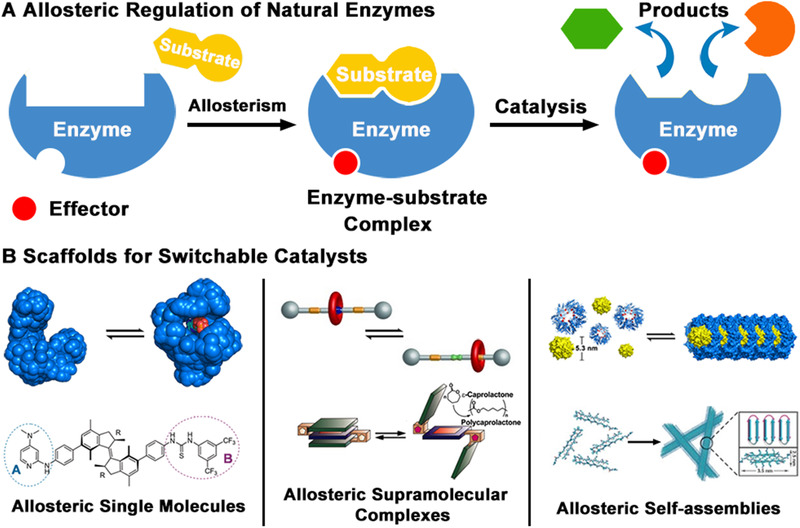
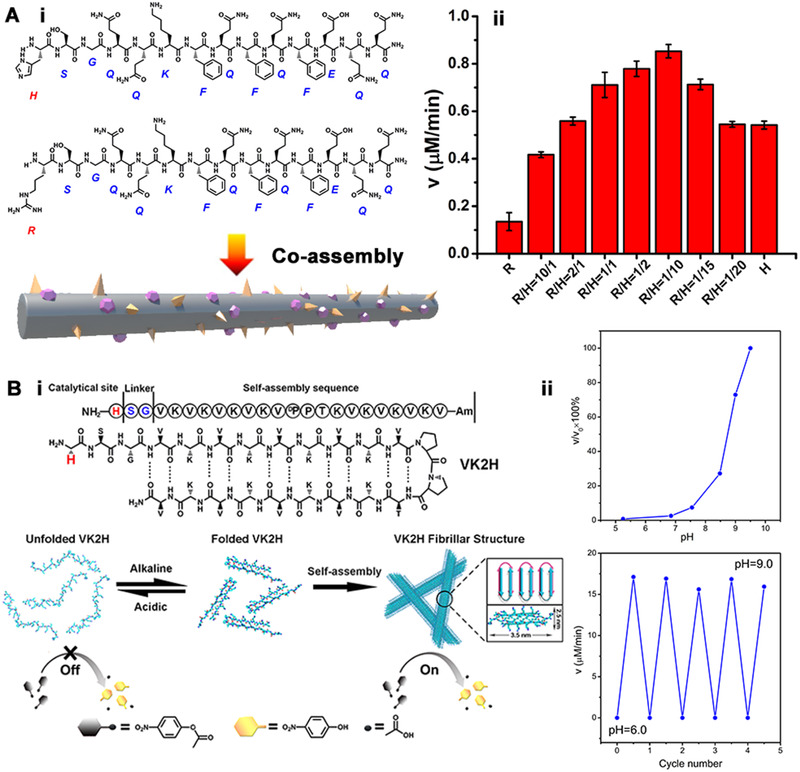
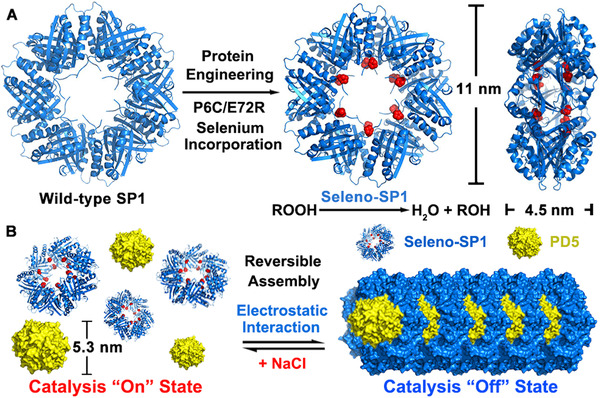
Allosteric regulation, in many cases, involves switching the activities of natural enzymes, which further affects the enzymatic network and cell signaling in the living systems. The research on the construction of allosteric switchable catalysts has attracted broad interests, aiming to control the progress and asymmetry of catalytic reactions, expand the chemical biology toolbox, substitute unstable natural enzymes in the biological detection and biosensors, and fabricate the biomimetic cascade reactions. Thus, in this review, we summarize the recent outstanding works in switchable catalysts based on the allosterism of single molecules, supramolecular complexes, and self-assemblies. The concept of allosterism was extended from natural proteins to polymers, organic molecules, and supramolecular systems. In terms of the difference between these building scaffolds, a variety of design methods that tailor biological and synthetic molecules into controllable catalysts were introduced with emphasis.
在许多情况下,别构调节涉及改变天然酶的活性,这进而影响生命系统中的酶网络和细胞信号传导。关于构建别构可切换催化剂的研究已引起广泛关注,旨在控制催化反应的进程和不对称性、扩展化学生物学工具箱、在生物检测和生物传感器中替代不稳定的天然酶以及构建仿生级联反应。因此,在本综述中,我们总结了基于单分子、超分子复合物和自组装的别构作用的可切换催化剂方面的近期杰出工作。别构概念已从天然蛋白质扩展到聚合物、有机分子和超分子体系。根据这些构建支架之间的差异,重点介绍了将生物和合成分子定制为可控催化剂的多种设计方法。