Altalal Alanoud, Almomen Aliyah, Alkholief Musaed, Binkhathlan Ziyad, Alzoman Nourah Z, Alshamsan Aws
Department of Pharmaceutics, College of Pharmacy, King Saud University, Riyadh 11495, Saudi Arabia.
Department of Pharmaceutical Chemistry, College of Pharmacy, King Saud University, Riyadh 11495, Saudi Arabia.
Saudi Pharm J. 2023 Jul;31(7):1317-1326. doi: 10.1016/j.jsps.2023.05.025. Epub 2023 Jun 1.
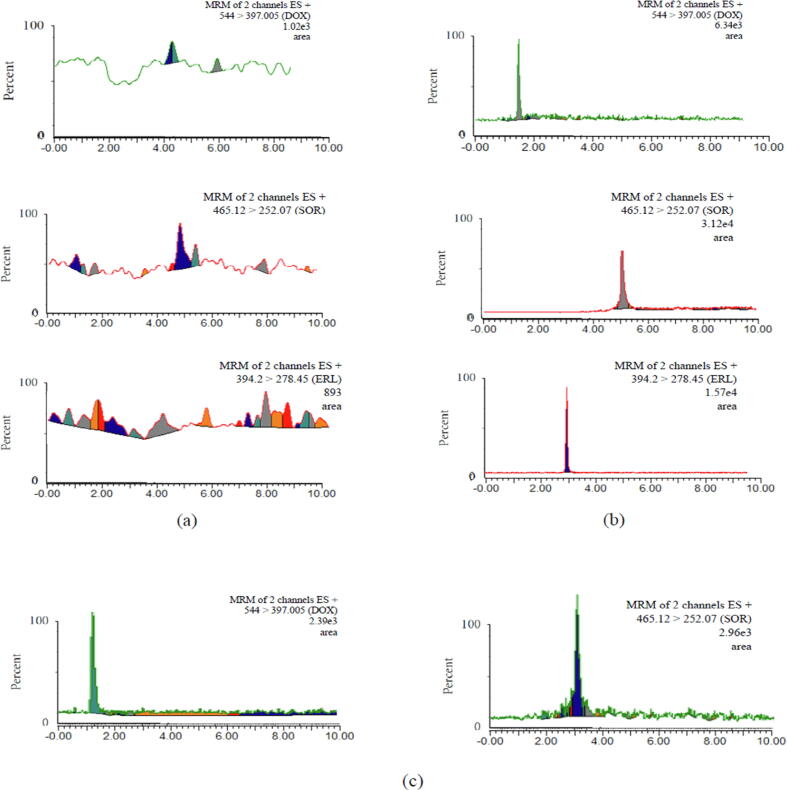
An ultra-performance liquid chromatography-tandem mass spectrometry (UPLC-MS/MS) was developed for the simultaneous quantitation of doxorubicin (DOX) and sorafenib (SOR) in rat plasma. Chromatographic separation was performed using a reversed-phase column C (1.7 μm, 1.0 × 100 mm Acquity UPLC BEH™). The gradient mobile phase system consisted of water containing 0.1% acetic acid (mobile phase A) and methanol (mobile phase B) with a flow rate of 0.40 mL/min over 8 min. Erlotinib (ERL) was used as an internal standard (IS). The quantitation of conversion of [M + H]+, which was the protonated precursor ion, to the corresponding product ions was performed using multiple reaction monitoring (MRM) with a mass-to-charge ratio (/) of 544 > 397.005 for DOX, 465.05 > 252.03 for SOR, and 394 > 278 for the IS. Different parameters were used to validate the method including accuracy, precision, linearity, and stability. The developed UPLC-MS/MS method was linear over the concentration ranges of 9-2000 ng/mL and 7-2000 ng/mL with LLOQ of 9 and 7 ng/mL for DOX and SOR, respectively. The intra-day and inter-day accuracy, expressed as % relative standard deviation (RSD%), was below 10% for both DOX and SOR in all QC samples that have drug concentrations above the LLOQ. The intra-day and inter-day precision, expressed as percent relative error (Er %), was within the limit of 15.0% for all concentrations above LLOQ. Four groups of Wistar rats (250-280 g) were used to conduct the pharmacokinetic study. Group I received a single intraperitoneal (IP) injection of DOX (5 mg/kg); Group II received a single oral dose of SOR (40 mg/kg), Group III received a combination of both drugs; and Group IV received sterile water for injection IP and 0.9% w/v sodium chloride solution orally to serve as a control. Non-compartmental analysis was used to calculate the different pharmacokinetic parameters. Data revealed that coadministration of DOX and SOR altered some of the pharmacokinetic parameters of both agents and resulted in an increase in the Cmax and AUC and reduction in the apparent clearance (CL/F). In conclusion, our newly developed method is sensitive, specific, and can reliably be used to simultaneously determine DOX and SOR concentrations in rat plasma. Moreover, the results of the pharmacokinetic study suggest that coadministration of DOX and SOR might cause an increase in exposure of both drugs.
建立了一种超高效液相色谱 - 串联质谱法(UPLC-MS/MS),用于同时定量大鼠血浆中的多柔比星(DOX)和索拉非尼(SOR)。采用反相C18柱(1.7μm,1.0×100mm Acquity UPLC BEH™)进行色谱分离。梯度流动相系统由含0.1%乙酸的水(流动相A)和甲醇(流动相B)组成,在8分钟内流速为0.40mL/min。厄洛替尼(ERL)用作内标(IS)。使用多反应监测(MRM)对质子化前体离子[M + H]+转化为相应产物离子进行定量,多柔比星的质荷比(m/z)为544>397.005,索拉非尼为465.05>252.03,内标为394>278。采用不同参数验证该方法,包括准确度、精密度、线性和稳定性。所建立的UPLC-MS/MS方法在9 - 2000ng/mL和7 - 2000ng/mL浓度范围内呈线性,多柔比星和索拉非尼的定量下限(LLOQ)分别为9和7ng/mL。在所有药物浓度高于LLOQ的质量控制(QC)样品中,多柔比星和索拉非尼的日内和日间准确度以相对标准偏差(RSD%)表示均低于10%。日内和日间精密度以相对误差(Er%)表示,对于所有高于LLOQ的浓度均在15.0%的限度内。使用四组Wistar大鼠(250 - 280g)进行药代动力学研究。第一组接受单次腹腔注射多柔比星(5mg/kg);第二组接受单次口服索拉非尼(40mg/kg),第三组接受两种药物联合给药;第四组接受腹腔注射无菌水和口服0.9% w/v氯化钠溶液作为对照。采用非房室分析计算不同的药代动力学参数。数据显示,多柔比星和索拉非尼联合给药改变了两种药物的一些药代动力学参数,导致Cmax和AUC增加,表观清除率(CL/F)降低。总之,我们新开发的方法灵敏、特异,可可靠地用于同时测定大鼠血浆中多柔比星和索拉非尼的浓度。此外,药代动力学研究结果表明,多柔比星和索拉非尼联合给药可能导致两种药物的暴露增加。