Li Lin, Li Shuwang
Department of Physical Education, Renmin University of China, Beijing, China.
Front Hum Neurosci. 2023 May 31;17:1193937. doi: 10.3389/fnhum.2023.1193937. eCollection 2023.
The purpose of this study was to investigate how grip force affects wrist joint position sense.
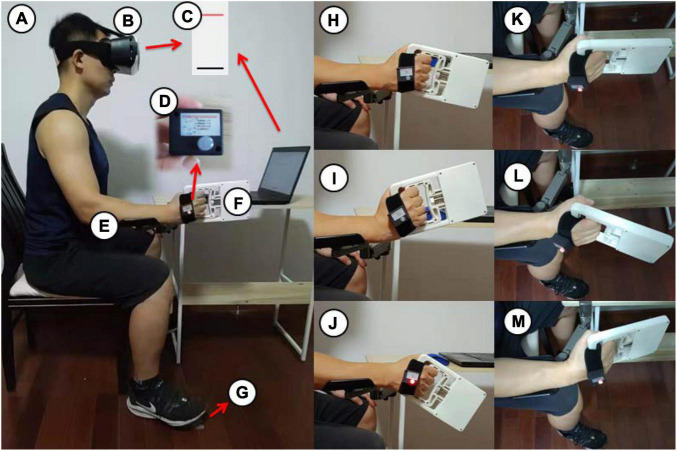
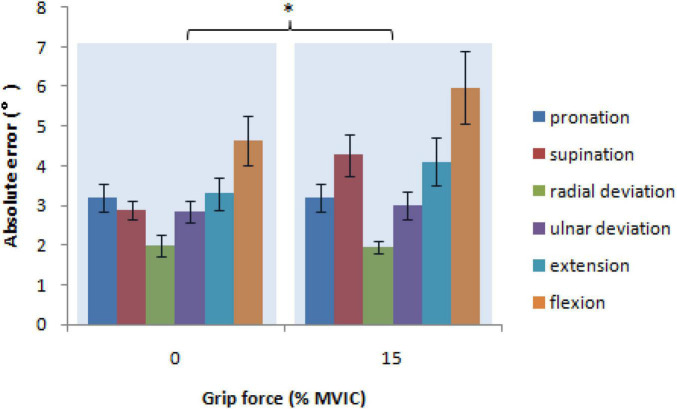
Twenty-two healthy participants (11 men and 11 women) underwent an ipsilateral wrist joint reposition test at 2 distinct grip forces [0 and 15% of maximal voluntary isometric contraction (MVIC)] and 6 different wrist positions (pronation 24°, supination 24°, radial deviation 16°, ulnar deviation 16°, extension 32°, and flexion 32°).
The findings demonstrated significantly elevated absolute error values at 15% MVIC (3.8 ± 0.3°) than at 0% MVIC grip force [3.1 ± 0.2°, (20) = 2.303, = 0.032].
These findings demonstrated that there was significantly worse proprioceptive accuracy at 15% MVIC than at 0% MVIC grip force. These results may contribute to a better comprehension of the mechanisms underlying wrist joint injuries, the development of preventative measures to lower the risk of injuries, and the best possible design of engineering or rehabilitation devices.
本研究的目的是调查握力如何影响腕关节位置觉。
22名健康参与者(11名男性和11名女性)在两种不同的握力[最大自主等长收缩(MVIC)的0%和15%]以及6种不同的腕关节位置(旋前24°、旋后24°、桡偏16°、尺偏16°、伸展32°和屈曲32°)下进行同侧腕关节复位测试。
研究结果表明,与握力为0% MVIC时相比,握力为15% MVIC时的绝对误差值显著升高[握力为0% MVIC时为3.1±0.2°,握力为15% MVIC时为3.8±0.3°,t(20)=2.303,P = 0.032]。
这些研究结果表明,与握力为0% MVIC时相比,握力为15% MVIC时的本体感觉准确性显著更差。这些结果可能有助于更好地理解腕关节损伤的潜在机制、制定降低损伤风险的预防措施以及工程或康复设备的最佳设计。