Soares Giovana Alice Sampaio, Moraes Felipe Augusto de Sousa, Ramos Amanda Ferreira Paes Landim, Santiago Silvana Barbosa, Germano Janaina Naiara, Fernandes Gisele Aparecida, Curado Maria Paula, Barbosa Mônica Santiago
Núcleo de Estudo da Helicobacter pylori, Department of Biosciences and Biotechnology, Institute of Tropical Pathology and Public Health, Federal University of Goiás, Goiânia, GO, Brazil.
A.C. Camargo Cancer Center, São Paulo, SP, Brazil.
Therap Adv Gastroenterol. 2023 Jun 6;16:17562848231160620. doi: 10.1177/17562848231160620. eCollection 2023.
() is a group 1 carcinogen and the etiological agent of gastric diseases such as gastritis, ulcers, and gastric cancer. It infects approximately half of the world's population. Risk factors associated with infection include socioeconomic status, lifestyle, and diet.
This study aimed to evaluate the association between eating habits and infection in patients from a reference hospital in Central Brazil.
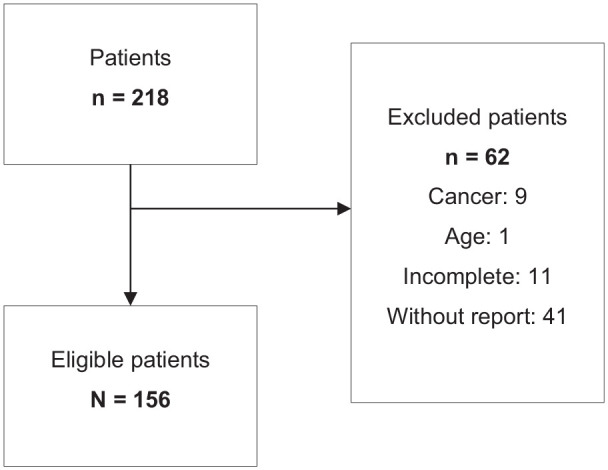
This cross-sectional study included 156 patients from 2019 to 2022.
Data were collected using a structured questionnaire on sociodemographic and lifestyle characteristics and a validated food frequency questionnaire. infection status (positive negative) was determined using the histopathological method. After grams/day, foods were stratified into tertiles of consumption (low, medium, and high). Simple and multiple binary logistic regression models were used in the analysis of odds ratios (ORs) and their respective 95% confidence intervals (CIs), with a 5% significance level.
The prevalence of infection was 44.2% (69/156 patients). Infected individuals had a mean age of 49.6 ± 14.6 years; 40.6% were men, 34.8% were aged 60 years or older, 42.0% were unmarried, 7.2% had higher education, 72.5% were non-white, and 30.4% were obese. In the -positive group, 55.1% were alcohol drinkers and 42.0% were smokers. The results of multiple analyses showed that the chance of infection was higher among male participants (OR = 2.25; CI = 1.09-4.68) and individuals with obesity (OR = 2.68; CI = 1.10-6.51). Participants with moderate consumption of refined grains (bread, cookies, cakes, breakfast cereal) (OR = 2.41; CI = 1.04-5.62) and fruits (OR = 2.53; CI = 1.08-5.94) were more likely to be infected.
In this study, male sex, obesity, and the consumption of refined grains and fruits were positively associated with infection. Further research is needed to investigate this association and elucidate the underlying mechanisms.
()是第1组致癌物,是胃炎、溃疡和胃癌等胃部疾病的病原体。它感染了世界上约一半的人口。与感染相关的风险因素包括社会经济地位、生活方式和饮食。
本研究旨在评估巴西中部一家参考医院患者的饮食习惯与感染之间的关联。
这项横断面研究纳入了2019年至2022年的156名患者。
使用关于社会人口学和生活方式特征的结构化问卷以及经过验证的食物频率问卷收集数据。使用组织病理学方法确定感染状态(阳性/阴性)。按克/天计算,将食物分为消费三分位数(低、中、高)。在分析比值比(OR)及其各自的95%置信区间(CI)时,使用简单和多元二元逻辑回归模型,显著性水平为5%。
感染的患病率为44.2%(69/156名患者)。感染个体的平均年龄为49.6±14.6岁;40.6%为男性,3,4.8%年龄在60岁及以上,42.0%未婚,7.2%受过高等教育,72.5%为非白人,30.4%肥胖。在阳性组中,55.1%饮酒,42.0%吸烟。多元分析结果显示,男性参与者(OR = 2.25;CI = 1.09 - 4.6)和肥胖个体(OR = 2.68;CI = 1.10 - 6.51)感染的几率更高。中等量食用精制谷物(面包、饼干、蛋糕、早餐谷物)(OR = 2.41;CI = 1.04 - 5.62)和水果(OR = 2.53;CI = 1.08 - 5.94)的参与者感染的可能性更大。但原文中“49.6±14.6岁”的“±”符号在翻译中未准确体现,应改为“49.6岁±14.6岁”;“4,2.0%”的逗号为多余,应改为“42.0%”;“49.6”后面的“岁”遗漏,应改为“49.6岁”;“1.09 - 4.6”应改为“1.09 - 4.68”;“5.6”应改为“5.62”;“1.08 - 5.9”应改为“1.08 - 5.94”。修改后的译文如下:
()是第1组致癌物,是胃炎、溃疡和胃癌等胃部疾病的病原体。它感染了世界上约一半的人口。与感染相关的风险因素包括社会经济地位、生活方式和饮食。
本研究旨在评估巴西中部一家参考医院患者的饮食习惯与感染之间的关联。
这项横断面研究纳入了2019年至2022年的156名患者。
使用关于社会人口学和生活方式特征的结构化问卷以及经过验证的食物频率问卷收集数据。使用组织病理学方法确定感染状态(阳性/阴性)。按克/天计算,将食物分为消费三分位数(低、中、高)。在分析比值比(OR)及其各自的95%置信区间(CI)时,使用简单和多元二元逻辑回归模型,显著性水平为5%。
感染的患病率为44.2%(69/156名患者)。感染个体的平均年龄为49.6岁±14.6岁;40.6%为男性,34.8%年龄在60岁及以上,42.0%未婚,7.2%受过高等教育,72.5%为非白人,30.4%肥胖。在阳性组中,55.1%饮酒,42.0%吸烟。多元分析结果显示,男性参与者(OR = 2.25;CI = 1.09 - 4.68)和肥胖个体(OR = 2.68;CI = 1.10 - 6.51)感染的几率更高。中等量食用精制谷物(面包、饼干、蛋糕、早餐谷物)(OR = 2.41;CI = 1.04 - 5.62)和水果(OR = 2.53;CI = 1.08 - 5.94)的参与者感染的可能性更大。
在本研究中,男性、肥胖以及精制谷物和水果的消费与感染呈正相关。需要进一步研究来调查这种关联并阐明潜在机制。
在本研究中,男性、肥胖以及精制谷物和水果的消费与感染呈正相关。需要进一步研究来调查这种关联并阐明潜在机制。