Zhou Ju-Kun, Zheng Ya, Wang Yu-Ping, Ji Rui
The First Clinical Medical College, Lanzhou University, Lanzhou 730000, Gansu Province, China.
Department of Gastroenterology, The First Hospital of Lanzhou University, Lanzhou 730000, Gansu Province, China.
World J Gastroenterol. 2024 Dec 21;30(47):5018-5031. doi: 10.3748/wjg.v30.i47.5018.
() infection exhibits a familial clustering phenomenon.
To investigate the prevalence of infection, identify associated factors, and analyze patterns of transmission within families residing in the community.
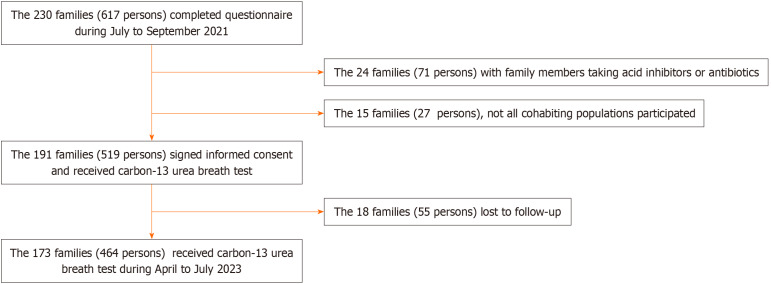
From July 2021 to September 2021, a total of 191 families (519 people) in two randomly chosen community health service centers in the Chengguan District of Lanzhou in Gansu Province, were recruited to fill out questionnaires and tested for infection. Individuals were followed up again from April 2023 and June 2023 to test for infection. The relationship between variables and infection was analyzed using logistic regression and generalized linear mixed models.
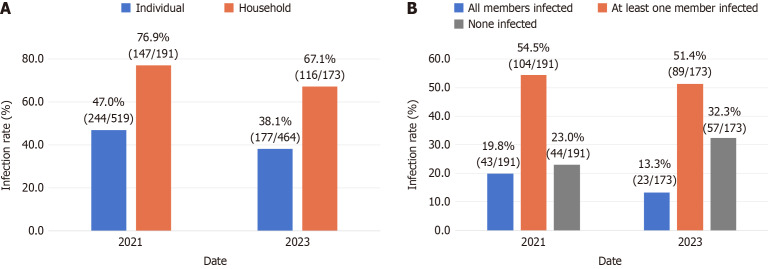
In 2021, the individual-based infection rate was found to be 47.0% (244/519), which decreased to 38.1% (177/464) in 2023. Additionally, the rate of individual-based new infection was 22.8% (55/241). The family-based infection rate in 2021 was 76.9% (147/191), which decreased to 67.1% (116/173) in 2023, and the rate of family-based new infection was 38.6% (17/44). Individual infection was positively correlated with age, body mass index (BMI), eating food that was excessively hot, frequent acid reflux, bloating, and halitosis symptoms, and negatively correlated with family size and nut consumption. New individual infection was positively correlated with BMI, other types of family structures, drinking purified water, and frequent heartburn symptoms, while negatively correlated with the use of refrigerators and following a regular eating schedule. A larger living area was an independent protective factor for infection in households. Frequently consuming excessively hot food and symptoms of halitosis were independent risk factors for infection in individuals; frequent consumption of nuts was an independent protective factor for infection. Other types of family structure, drinking purified water, and frequent heartburn symptoms were independent risk factors for new individual infection; the use of a refrigerator was an independent protective factor for new infections.
The household infection rate in Lanzhou is relatively high and linked to socio-demographic factors and lifestyles. Eradication efforts and control of related risk factors are recommended in the general population.
()感染呈现家族聚集现象。
调查感染的患病率,确定相关因素,并分析社区家庭内部的传播模式。
2021年7月至2021年9月,在甘肃省兰州市城关区两个随机选取的社区卫生服务中心,共招募了191个家庭(519人)填写问卷并进行感染检测。从2023年4月至2023年6月对个体进行再次随访以检测感染情况。使用逻辑回归和广义线性混合模型分析变量与感染之间的关系。
2021年,基于个体的感染率为47.0%(244/519),2023年降至38.1%(177/464)。此外,基于个体的新感染率为22.8%(55/241)。2021年基于家庭的感染率为76.9%(147/191),2023年降至67.1%(116/173),基于家庭的新感染率为38.6%(17/44)。个体感染与年龄、体重指数(BMI)、食用过热食物、频繁反酸、腹胀和口臭症状呈正相关,与家庭规模和食用坚果呈负相关。个体新感染与BMI、其他类型的家庭结构、饮用纯净水和频繁烧心症状呈正相关,而与使用冰箱和规律饮食呈负相关。较大的居住面积是家庭中感染的独立保护因素。经常食用过热食物和口臭症状是个体感染的独立危险因素;经常食用坚果是感染的独立保护因素。其他类型的家庭结构、饮用纯净水和频繁烧心症状是个体新感染的独立危险因素;使用冰箱是新感染的独立保护因素。
兰州家庭感染率相对较高,与社会人口学因素和生活方式有关。建议在普通人群中开展根除工作并控制相关危险因素。