Demetriou Lysia, Krassowski Michal, Abreu Mendes Pedro, Garbutt Kurtis, Vitonis Allison F, Wilkins Elizabeth, Coxon Lydia, Arendt-Nielsen Lars, Aziz Qasim, Birch Judy, Horne Andrew W, Hoffman Anja, Hummelshoj Lone, Lunde Claire E, Meijlink Jane, Perro Danielle, Rahmioglu Nilufer, Terry Kathryn L, Pogatzki-Zahn Esther, Sieberg Christine B, Treede Rolf-Detlef, Becker Christian M, Cruz Francisco, Missmer Stacey A, Zondervan Krina T, Nagel Jens, Vincent Katy
Oxford Endometriosis Centre, Nuffield Department of Women's and Reproductive Health, University of Oxford, Oxford, United Kingdom.
IBMC/I3S and Faculty of Medicine of Porto, Hospital S João, Porto, Portugal.
Front Reprod Health. 2023 May 30;5:1140857. doi: 10.3389/frph.2023.1140857. eCollection 2023.
Chronic pelvic pain (CPP) is a common condition affecting up to 26.6% of women, with many suffering for several years before diagnosis and/or treatment. Its clinical presentation is varied and there are frequently comorbid conditions both within and outside the pelvis. We aim to explore whether specific subgroups of women with CPP report different clinical symptoms and differing impact of pain on their quality of life (QoL).
The study is part of the Translational Research in Pelvic Pain (TRiPP) project which is a cross-sectional observational cohort study. The study includes 769 female participants of reproductive age who completed an extensive set of questions derived from standardised WERF EPHect questionnaires. Within this population we defined a control group (reporting no pelvic pain, no bladder pain syndrome, and no endometriosis diagnosis, = 230) and four pain groups: endometriosis-associated pain (EAP, = 237), interstitial cystitis/bladder pain syndrome (BPS, = 72), comorbid endometriosis-associated pain and BPS (EABP, = 120), and pelvic pain only (PP, = 127).
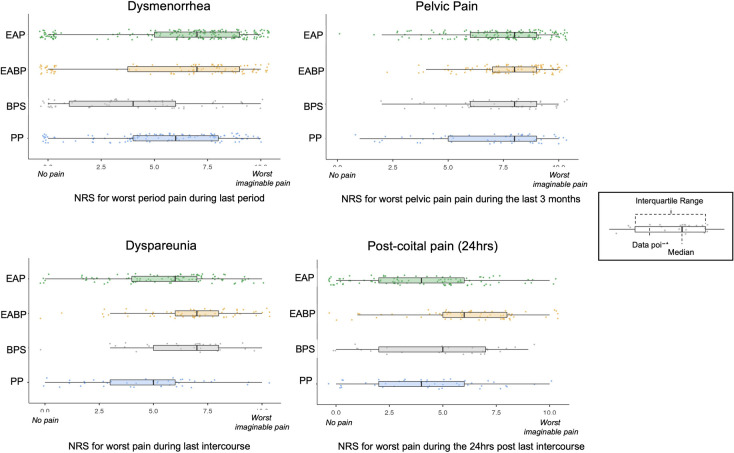
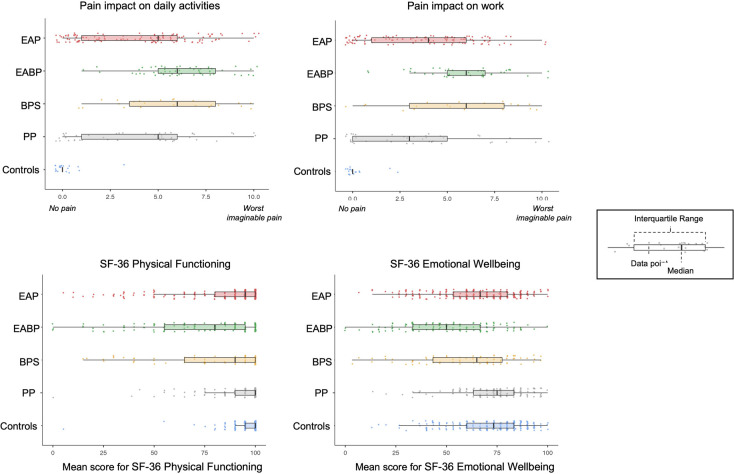
Clinical profiles of women with CPP (13-50 years old) show variability of clinical symptoms. The EAP and EABP groups scored higher than the PP group ( < 0.001) on the pain intensity scales for non-cyclical pelvic pain and higher than both the BPS and PP groups ( < 0.001) on the dysmenorrhoea scale. The EABP group also had significantly higher scores for dyspareunia ( < 0.001), even though more than 50% of sexually active participants in each pain group reported interrupting and/or avoiding sexual intercourse due to pain in the last 12 months. Scores for the QoL questionnaire (SF-36) reveal that CPP patients had significantly lower QoL across all SF-36 subscales ( < 0.001). Significant effects were also observed between the pain groups for pain interference with their work ( < 0.001) and daily lives ( < 0.001), with the EABP suffering more compared to the EAP and PP groups ( < 0.001).
Our results demonstrate the negative impact that chronic pain has on CPP patients' QoL and reveal an increased negative impact of pain on the comorbid EABP group. Furthermore, it demonstrates the importance of dyspareunia in women with CPP. Overall, our results demonstrate the need for further exploration of interventions targeting QoL more broadly and suggest that novel approaches to classifying women with CPP are needed.
慢性盆腔疼痛(CPP)是一种常见病症,影响着高达26.6%的女性,许多患者在诊断和/或治疗前会遭受数年的痛苦。其临床表现多样,盆腔内外常常存在合并症。我们旨在探讨患有CPP的特定女性亚组是否报告不同的临床症状以及疼痛对其生活质量(QoL)的不同影响。
该研究是盆腔疼痛转化研究(TRiPP)项目的一部分,这是一项横断面观察性队列研究。该研究纳入了769名育龄期女性参与者,她们完成了一系列源自标准化WERF EPHect问卷的广泛问题。在这个群体中,我们定义了一个对照组(报告无盆腔疼痛、无膀胱疼痛综合征且无子宫内膜异位症诊断,n = 230)和四个疼痛组:子宫内膜异位症相关疼痛(EAP,n = 237)、间质性膀胱炎/膀胱疼痛综合征(BPS,n = 72)、合并子宫内膜异位症相关疼痛和BPS(EABP,n = 120)以及仅盆腔疼痛(PP,n = 127)。
患有CPP(13 - 50岁)的女性的临床特征显示出临床症状的变异性。EAP组和EABP组在非周期性盆腔疼痛的疼痛强度量表上得分高于PP组(P < 0.001),在痛经量表上得分高于BPS组和PP组(P < 0.001)。EABP组的性交困难得分也显著更高(P < 0.001),尽管每个疼痛组中超过50%的性活跃参与者报告在过去12个月中因疼痛而中断和/或避免性交。生活质量问卷(SF - 36)的得分显示,CPP患者在所有SF - 36子量表上的生活质量显著较低(P < 0.001)。在疼痛组之间还观察到疼痛对其工作(P < 0.001)和日常生活(P < 0.001)的干扰有显著影响,与EAP组和PP组相比,EABP组受影响更大(P < 0.001)。
我们的结果证明了慢性疼痛对CPP患者生活质量的负面影响,并揭示了疼痛对合并的EABP组有更大的负面影响。此外,它证明了性交困难在患有CPP的女性中的重要性。总体而言,我们的结果表明需要进一步更广泛地探索针对生活质量的干预措施,并表明需要新的方法来对患有CPP的女性进行分类。