
吞咽困难在 1 年内与脑干下节的平均剂量相关。
Dysphagia at 1 Year is Associated With Mean Dose to the Inferior Section of the Brain Stem.
机构信息
Division of Cancer Sciences, University of Manchester, Manchester, United Kingdom.
Division of Cancer Sciences, University of Manchester, Manchester, United Kingdom.
出版信息
Int J Radiat Oncol Biol Phys. 2023 Nov 15;117(4):903-913. doi: 10.1016/j.ijrobp.2023.06.004. Epub 2023 Jun 17.
PURPOSE
Dysphagia is a common toxicity after head and neck (HN) radiation therapy that negatively affects quality of life. We explored the relationship between radiation therapy dose to normal HN structures and dysphagia 1 year after treatment using image-based datamining (IBDM), a voxel-based analysis technique.
METHODS AND MATERIALS
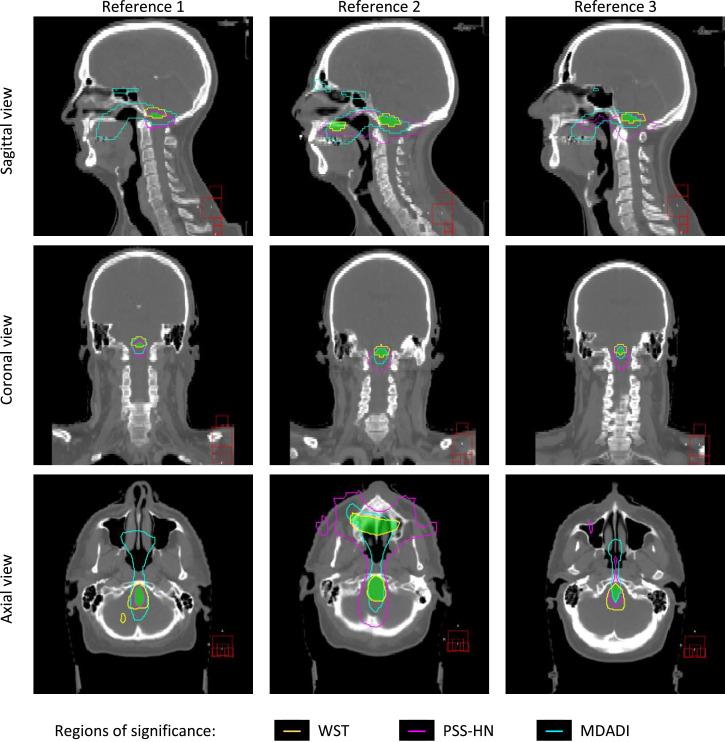
We used data from 104 patients with oropharyngeal cancer treated with definitive (chemo)radiation therapy. Swallow function was assessed pretreatment and 1 year posttreatment using 3 validated measures: MD Anderson Dysphagia Inventory (MDADI), performance status scale for normalcy of diet (PSS-HN), and water swallowing test (WST). For IBDM, we spatially normalized all patients' planning dose matrices to 3 reference anatomies. Regions where the dose was associated with dysphagia measures at 1 year were found by performing voxel-wise statistics and permutation testing. Clinical factors, treatment variables, and pretreatment measures were used in multivariable analysis to predict each dysphagia measure at 1 year. Clinical baseline models were found using backward stepwise selection. Improvement in model discrimination after adding the mean dose to the identified region was quantified using the Akaike information criterion. We also compared the prediction performance of the identified region with a well-established association: mean doses to the pharyngeal constrictor muscles.
RESULTS
IBDM revealed highly significant associations between dose to distinct regions and the 3 outcomes. These regions overlapped around the inferior section of the brain stem. All clinical models were significantly improved by including mean dose to the overlap region (P ≤ .006). Including pharyngeal dosimetry significantly improved WST (P = .04) but not PSS-HN or MDADI (P ≥ .06).
CONCLUSIONS
In this hypothesis-generating study, we found that mean dose to the inferior section of the brain stem is strongly associated with dysphagia 1 year posttreatment. The identified region includes the swallowing centers in the medulla oblongata, providing a possible mechanistic explanation. Further work including validation in an independent cohort is required.
目的
吞咽困难是头颈部(HN)放射治疗后的常见毒性反应,会降低生活质量。我们通过基于图像的数据分析(IBDM),一种基于体素的分析技术,探索了治疗后 1 年 HN 正常结构的放射治疗剂量与吞咽困难之间的关系。
方法和材料
我们使用了 104 例接受根治性(化疗)放射治疗的口咽癌患者的数据。使用 3 种经过验证的测量方法:MD 安德森吞咽障碍指数(MDADI)、正常饮食的体力状态量表(PSS-HN)和水吞咽试验(WST),在治疗前和治疗后 1 年评估吞咽功能。对于 IBDM,我们将所有患者的计划剂量矩阵空间归一化为 3 个参考解剖结构。通过执行体素统计和置换检验,找到了与 1 年时吞咽困难测量值相关的剂量区域。使用多变量分析将临床因素、治疗变量和治疗前测量值用于预测 1 年时的每种吞咽困难测量值。使用向后逐步选择找到临床基线模型。通过添加到识别区域的平均剂量来量化对模型区分度的改善,使用赤池信息量准则。我们还比较了所识别区域与一个成熟关联:咽缩肌平均剂量的预测性能。
结果
IBDM 显示剂量与 3 种结果之间存在高度显著的相关性。这些区域在延髓下部周围重叠。所有临床模型都通过包括重叠区域的平均剂量得到显著改善(P≤0.006)。包括咽剂量学显著改善了 WST(P=0.04),但不改善 PSS-HN 或 MDADI(P≥0.06)。
结论
在这项假设生成研究中,我们发现延髓下部的平均剂量与治疗后 1 年的吞咽困难密切相关。所识别的区域包括延髓中的吞咽中心,为可能的机制解释提供了依据。需要进一步的工作,包括在独立队列中的验证。


 Zotero 插件