
哮喘或慢性阻塞性肺疾病中β2肾上腺素能受体激动剂与帕金森病风险:巢式病例对照研究
β2-Adrenoceptor Agonists in Asthma or Chronic Obstructive Pulmonary Disease and Risk of Parkinson's Disease: Nested Case-Control Study.
作者信息
Paakinaho Anne, Tiihonen Miia, Koskela Heikki, Koponen Marjaana, Tiihonen Jari, Hartikainen Sirpa, Tolppanen Anna-Maija
机构信息
School of Pharmacy, Faculty of Health Sciences, University of Eastern Finland, Kuopio, Finland.
Unit for Medicine and Clinical Research, Pulmonary Division, Kuopio University Hospital, Kuopio, Finland.
出版信息
Clin Epidemiol. 2023 Jun 12;15:695-705. doi: 10.2147/CLEP.S405325. eCollection 2023.
INTRODUCTION
Although β2-adrenoceptor (β2AR) agonists have been associated with a lower risk of Parkinson's disease (PD), the findings are inconclusive and may reflect confounding by indication. We studied the association between inhaled β2AR agonists and risk of PD in persons with asthma or chronic obstructive pulmonary disease (COPD).
METHODS
The nested case-control study was conducted within a register-based Finnish Parkinson's disease study (FINPARK) and included 1406 clinically verified PD cases diagnosed during 1999-2015, who also had asthma/COPD >3 years before PD. PD cases were matched with up to seven controls by age, sex, duration of asthma/COPD, pulmonary diagnosis, and region (N = 8630). Cumulative and average annual exposure to short- and long-acting β2AR agonists before a 3-year lag period was assessed with quartiles of defined daily doses (DDDs). Adjusted odds ratios (aORs) were calculated with 95% confidence intervals (CIs) using conditional logistic regression.
RESULTS
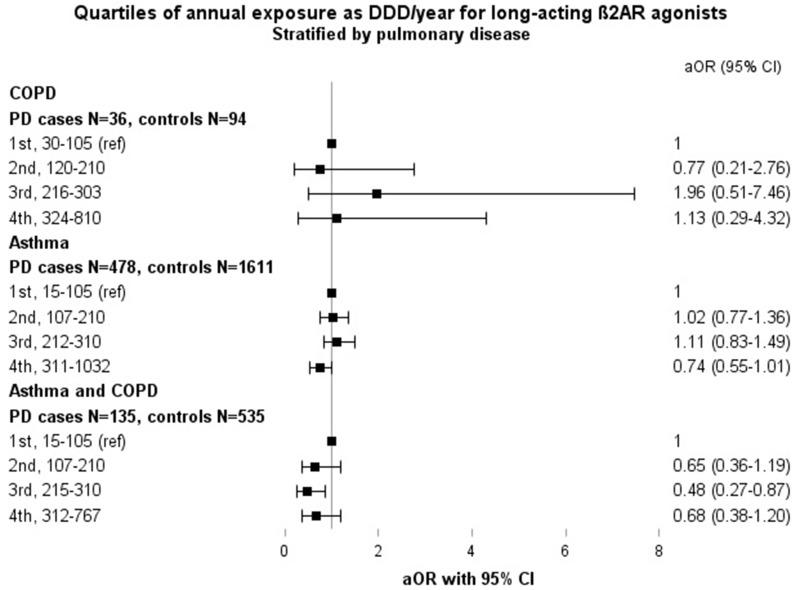
Cumulative exposure to either short- or long-acting β2AR agonists was not associated with a risk of PD. With average annual exposure, a decreased risk was observed only for the highest quartile of long-acting β2AR agonists (aOR 0.75; 95% CI 0.58-0.97). In the stratified analysis the lowest risk estimates were observed among those with both asthma and COPD diagnoses. The suggestion of an inverse association was seen for the highest quartile of long-acting β2AR agonists in asthma.
DISCUSSION
Higher levels of exposure to β2AR agonists were not consistently associated with a reduced risk of PD. The inverse association in the highest category of average annual exposure to long-acting β2AR agonists may be explained by unmeasured confounding, such as disease severity or smoking.
引言
尽管β2肾上腺素能受体(β2AR)激动剂与帕金森病(PD)风险较低有关,但研究结果尚无定论,可能反映了适应证的混杂因素。我们研究了吸入性β2AR激动剂与哮喘或慢性阻塞性肺疾病(COPD)患者患PD风险之间的关联。
方法
这项巢式病例对照研究在基于登记的芬兰帕金森病研究(FINPARK)中进行,纳入了1999年至2015年期间临床确诊的1406例PD病例,这些病例在患PD前3年以上患有哮喘/COPD。PD病例按年龄、性别、哮喘/COPD病程、肺部诊断和地区与最多7名对照进行匹配(N = 8630)。使用限定日剂量(DDD)四分位数评估在3年滞后期之前短期和长效β2AR激动剂的累积暴露量和年均暴露量。采用条件逻辑回归计算调整后的比值比(aOR)及其95%置信区间(CI)。
结果
短期或长效β2AR激动剂的累积暴露与PD风险无关。对于年均暴露,仅在长效β2AR激动剂最高四分位数组中观察到风险降低(aOR 0.75;95% CI 0.58 - 0.97)。在分层分析中,哮喘和COPD诊断均有的患者风险估计最低。在哮喘患者中,长效β2AR激动剂最高四分位数组可见反向关联的迹象。
讨论
较高水平的β2AR激动剂暴露与降低的PD风险并非始终相关。年均暴露于长效β2AR激动剂最高类别中的反向关联可能由未测量的混杂因素解释,如疾病严重程度或吸烟。

 Zotero 插件