Gooch Eloïse A, Horne Kyla-Louise, Melzer Tracy R, McAuliffe Megan J, MacAskill Michael, Dalrymple-Alford John C, Anderson Tim J, Theys Catherine
Te Kura Mahi ā-Hirikapo, School of Psychology, Speech, and Hearing University of Canterbury Christchurch New Zealand.
New Zealand Brain Research Institute Christchurch New Zealand.
Mov Disord Clin Pract. 2023 May 8;10(6):956-966. doi: 10.1002/mdc3.13758. eCollection 2023 Jun.
Parkinson's disease frequently causes communication impairments, but knowledge about the occurrence of new-onset stuttering is limited.
To determine the presence of acquired neurogenic stuttering and its relationship with cognitive and motor functioning in individuals with Parkinson's disease.
Conversation, picture description, and reading samples were collected from 100 people with Parkinson's disease and 25 controls to identify the presence of stuttered disfluencies (SD) and their association with neuropsychological test performance and motor function.
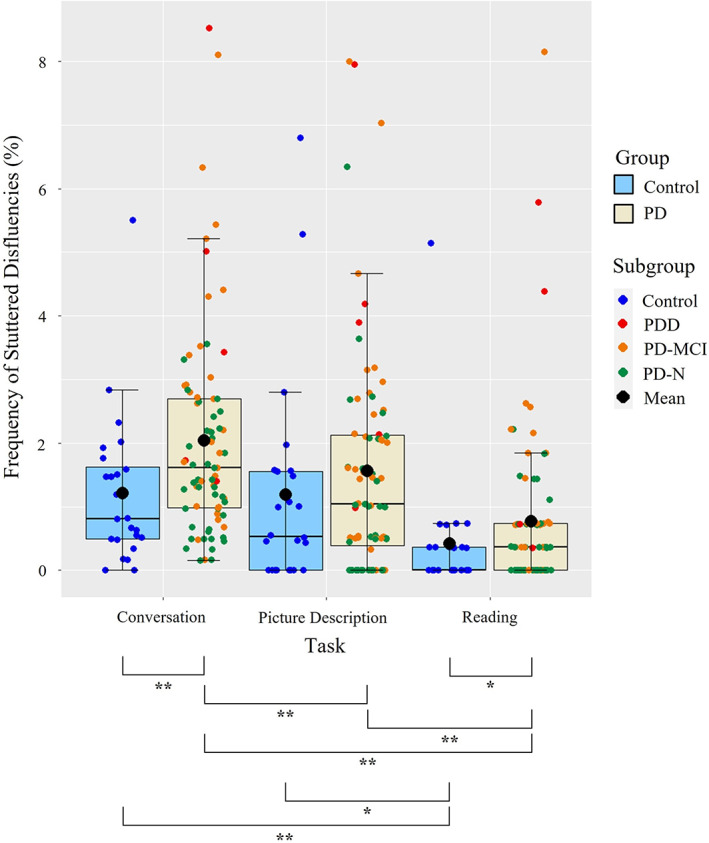
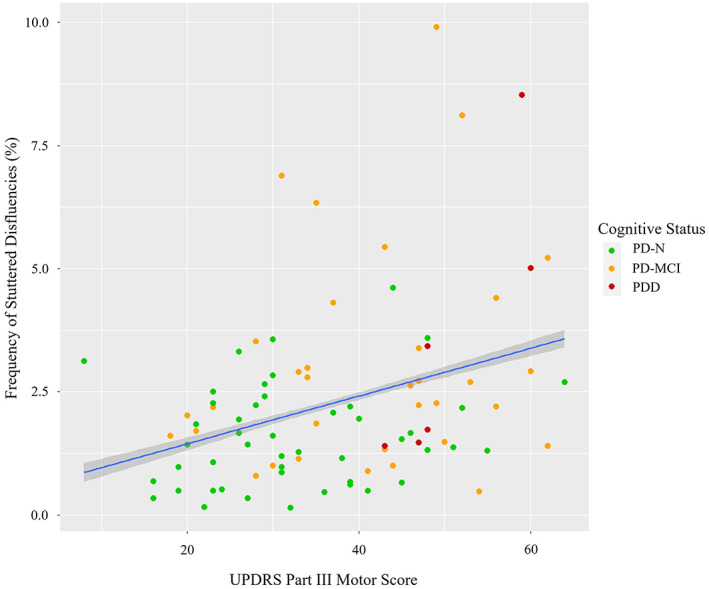
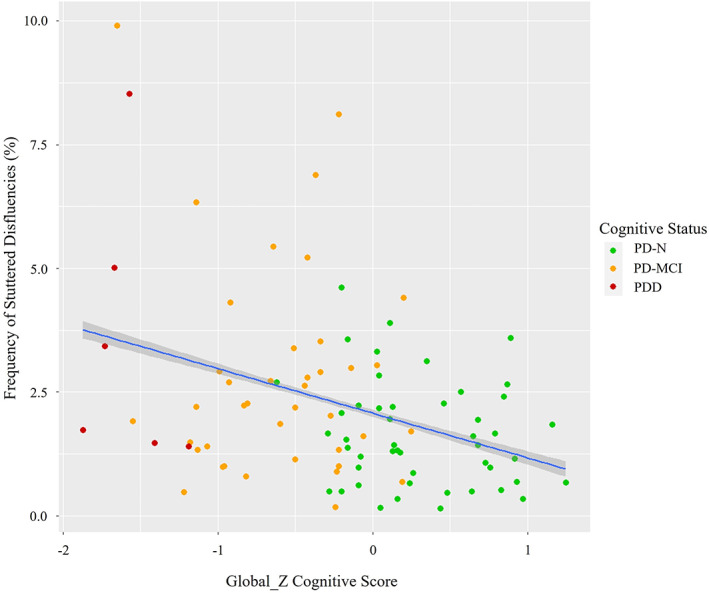
Participants with Parkinson's disease presented with twice as many stuttered disfluencies during conversation (2.2% ± 1.8%SD) compared to control participants (1.2% ± 1.2%SD; < 0.01). 21% of people with Parkinson's disease ( = 20/94) met the diagnostic criterion for stuttering, compared with 1/25 controls. Stuttered disfluencies also differed significantly across speech tasks, with more disfluencies during conversation compared to reading ( < 0.01). Stuttered disfluencies in those with Parkinson's disease were associated with longer time since disease onset ( < 0.01), higher levodopa equivalent dosage ( < 0.01), and lower cognitive ( < 0.01) and motor scores ( < 0.01).
One in five participants with Parkinson's disease presented with acquired neurogenic stuttering, suggesting that speech disfluency assessment, monitoring and intervention should be part of standard care. Conversation was the most informative task for identifying stuttered disfluencies. The frequency of stuttered disfluencies was higher in participants with worse motor functioning, and lower cognitive functioning. This challenges previous suggestions that the development of stuttered disfluencies in Parkinson's disease has purely a motoric basis.
帕金森病常导致沟通障碍,但关于新发口吃发生情况的了解有限。
确定帕金森病患者中后天性神经源性口吃的存在情况及其与认知和运动功能的关系。
从100名帕金森病患者和25名对照者中收集对话、图片描述和阅读样本,以确定口吃性言语不流畅(SD)的存在情况及其与神经心理测试表现和运动功能的关联。
与对照参与者(1.2%±1.2%SD)相比,帕金森病患者在对话过程中出现的口吃性言语不流畅次数是其两倍(2.2%±1.8%SD;P<0.01)。21%的帕金森病患者(n=20/94)符合口吃诊断标准,而对照者中这一比例为1/25。口吃性言语不流畅在不同言语任务中也存在显著差异,对话时的不流畅次数多于阅读时(P<0.01)。帕金森病患者的口吃性言语不流畅与疾病发病时间较长(P<0.01)、左旋多巴等效剂量较高(P<0.01)以及较低的认知(P<0.01)和运动评分(P<0.01)相关。
五分之一的帕金森病患者存在后天性神经源性口吃,这表明言语不流畅评估、监测和干预应成为标准护理的一部分。对话是识别口吃性言语不流畅最具信息量的任务。运动功能较差和认知功能较低的参与者中,口吃性言语不流畅的频率更高。这对之前认为帕金森病中口吃性言语不流畅的发展纯粹基于运动的观点提出了挑战。