Grodner Benjamin, Shi Hao, Farchione Owen, Vill Albert C, Ntekas Ioannis, Diebold Peter J, Zipfel Warren R, Brito Ilana L, Vlaminck Iwijn De
Meinig School of Biomedical Engineering, Cornell University, Ithaca, NY, USA.
bioRxiv. 2023 Jun 9:2023.06.09.544291. doi: 10.1101/2023.06.09.544291.
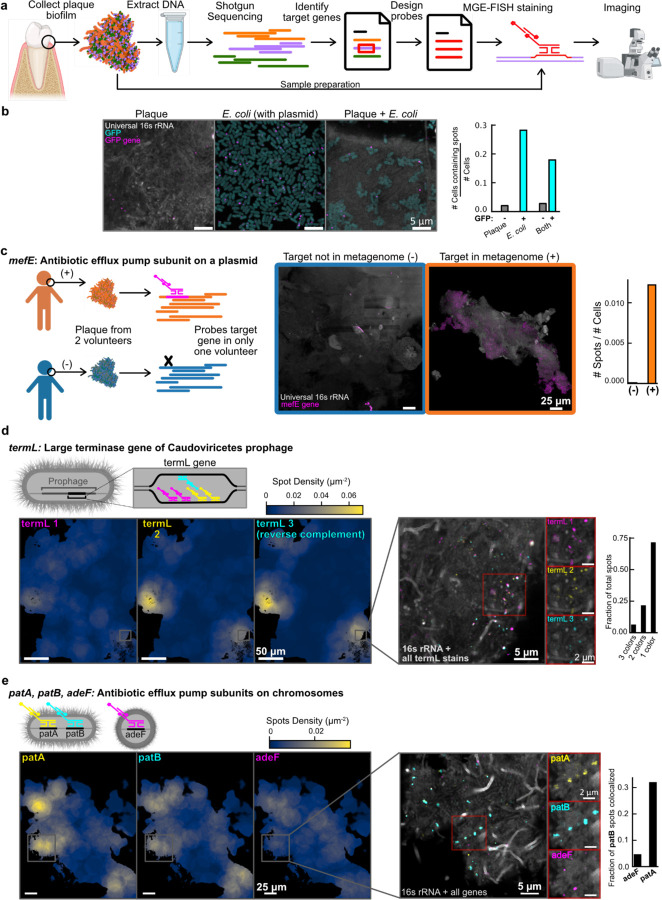
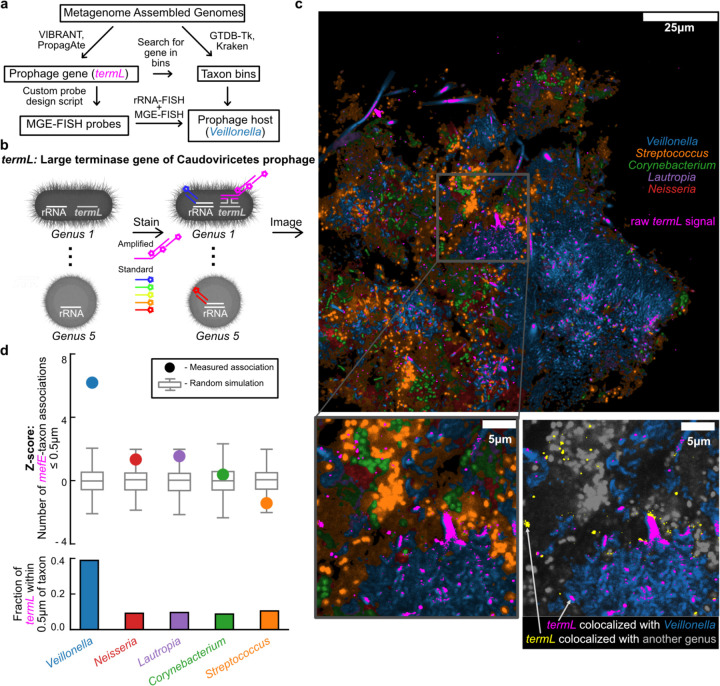
The frequent exchange of mobile genetic elements (MGEs) between bacteria accelerates the spread of functional traits, including antimicrobial resistance, within the human microbiome. Yet, progress in understanding these intricate processes has been hindered by the lack of tools to map the spatial spread of MGEs in complex microbial communities, and to associate MGEs to their bacterial hosts. To overcome this challenge, we present an imaging approach that pairs single molecule DNA Fluorescence In Situ Hybridization (FISH) with multiplexed ribosomal RNA FISH, thereby enabling the simultaneous visualization of both MGEs and host bacterial taxa. We used this methodology to spatially map bacteriophage and antimicrobial resistance (AMR) plasmids in human oral biofilms, and we studied the heterogeneity in their spatial distributions and demonstrated the ability to identify their host taxa. Our data revealed distinct clusters of both AMR plasmids and prophage, coinciding with densely packed regions of host bacteria in the biofilm. These results suggest the existence of specialized niches that maintain MGEs within the community, possibly acting as local hotspots for horizontal gene transfer. The methods introduced here can help advance the study of MGE ecology and address pressing questions regarding antimicrobial resistance and phage therapy.
细菌之间移动遗传元件(MGEs)的频繁交换加速了功能性状在人类微生物组中的传播,包括抗生素耐药性。然而,由于缺乏在复杂微生物群落中绘制MGEs空间传播图谱以及将MGEs与其细菌宿主关联起来的工具,对这些复杂过程的理解进展受到阻碍。为了克服这一挑战,我们提出了一种成像方法,将单分子DNA荧光原位杂交(FISH)与多重核糖体RNA FISH相结合,从而能够同时可视化MGEs和宿主细菌分类群。我们使用这种方法在人类口腔生物膜中对噬菌体和抗生素耐药性(AMR)质粒进行空间定位,并研究了它们空间分布的异质性,证明了识别其宿主分类群的能力。我们的数据揭示了AMR质粒和原噬菌体的不同簇,与生物膜中宿主细菌的密集区域一致。这些结果表明,群落中存在维持MGEs的特殊生态位,可能作为水平基因转移的局部热点。这里介绍的方法有助于推动MGE生态学的研究,并解决有关抗生素耐药性和噬菌体治疗的紧迫问题。