Antibiotic Resistance Evolution Group, Max Planck Institute for Evolutionary Biology, Plön, Germany.
Department of Evolutionary Ecology and Genetics, Zoological Institute, Christian Albrechts University, Kiel, Germany.
Nucleic Acids Res. 2023 Jan 11;51(1):236-252. doi: 10.1093/nar/gkac1220.
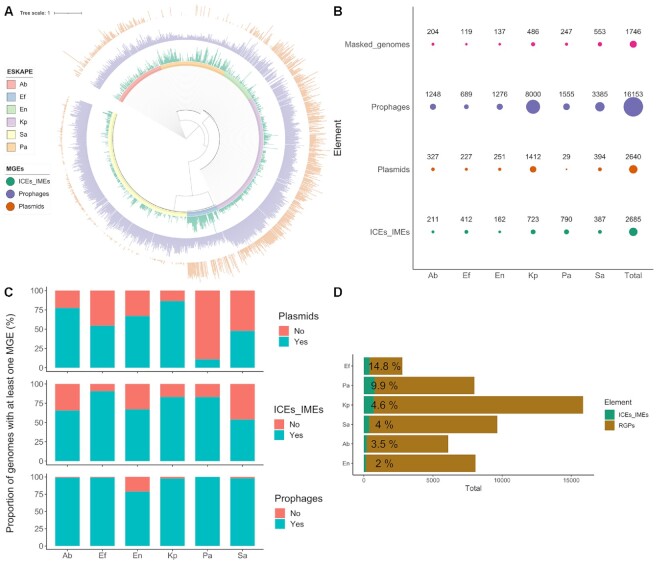
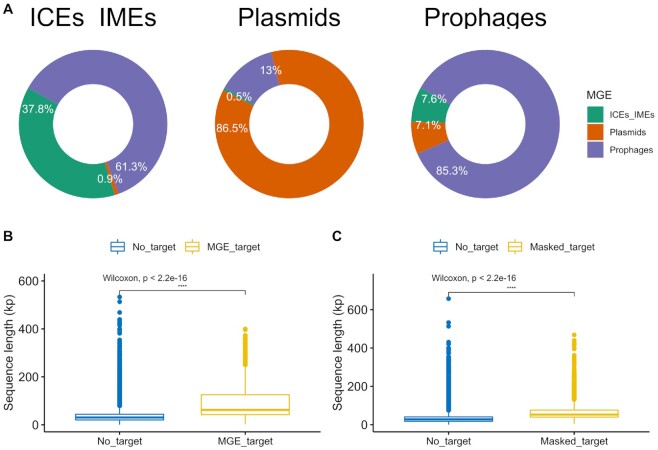
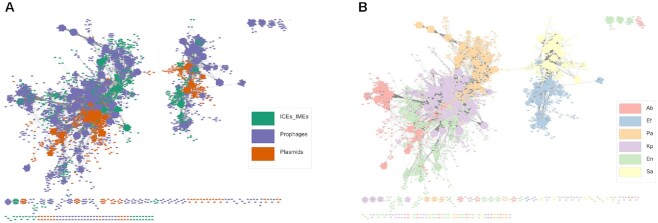
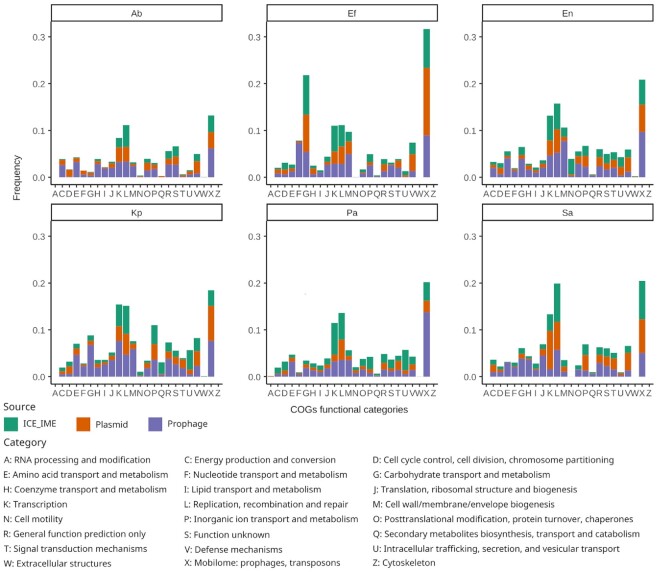
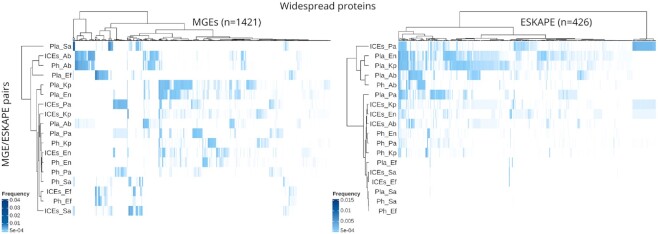
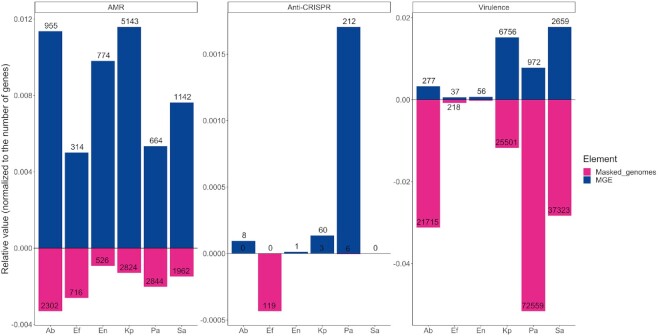
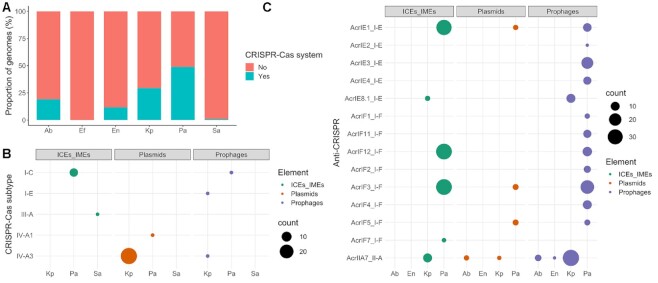
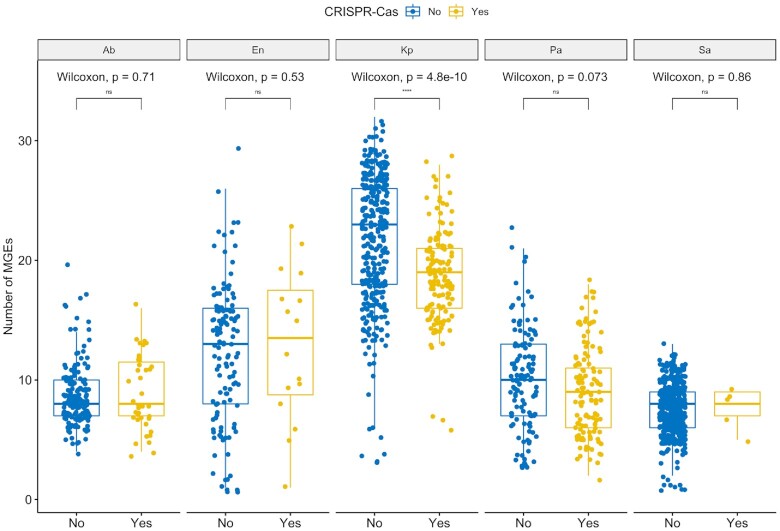
Mobile genetic elements (MGEs) mediate the shuffling of genes among organisms. They contribute to the spread of virulence and antibiotic resistance (AMR) genes in human pathogens, such as the particularly problematic group of ESKAPE pathogens. Here, we performed the first systematic analysis of MGEs, including plasmids, prophages, and integrative and conjugative/mobilizable elements (ICEs/IMEs), across all ESKAPE pathogens. We found that different MGE types are asymmetrically distributed across these pathogens, and that most horizontal gene transfer (HGT) events are restricted by phylum or genus. We show that the MGEs proteome is involved in diverse functional processes and distinguish widespread proteins within the ESKAPE context. Moreover, anti-CRISPRs and AMR genes are overrepresented in the ESKAPE mobilome. Our results also underscore species-specific trends shaping the number of MGEs, AMR, and virulence genes across pairs of conspecific ESKAPE genomes with and without CRISPR-Cas systems. Finally, we observed that CRISPR spacers found on prophages, ICEs/IMEs, and plasmids have different targeting biases: while plasmid and prophage CRISPRs almost exclusively target other plasmids and prophages, respectively, ICEs/IMEs CRISPRs preferentially target prophages. Overall, our study highlights the general importance of the ESKAPE mobilome in contributing to the spread of AMR and mediating conflict among MGEs.
移动遗传元件 (MGEs) 在生物体之间介导基因的混合。它们有助于人类病原体中毒力和抗生素耐药 (AMR) 基因的传播,例如 ESKAPE 病原体这一特别成问题的群体。在这里,我们对所有 ESKAPE 病原体中的 MGE 进行了首次系统分析,包括质粒、噬菌体和整合性和可转移性元件 (ICEs/IMEs)。我们发现,不同的 MGE 类型在这些病原体中不对称分布,并且大多数水平基因转移 (HGT) 事件受到门或属的限制。我们表明,MGE 蛋白质组参与了多样化的功能过程,并区分了 ESKAPE 背景下广泛存在的蛋白质。此外,抗 CRISPRs 和 AMR 基因在 ESKAPE 移动组中过度表达。我们的研究结果还强调了特定物种的趋势,这些趋势塑造了具有和不具有 CRISPR-Cas 系统的同种 ESKAPE 基因组对之间 MGE、AMR 和毒力基因的数量。最后,我们观察到噬菌体、ICEs/IMEs 和质粒上的 CRISPR 间隔区具有不同的靶向偏好:尽管质粒和噬菌体 CRISPR 几乎专门靶向其他质粒和噬菌体,但 ICEs/IMEs CRISPR 优先靶向噬菌体。总体而言,我们的研究强调了 ESKAPE 移动组在 AMR 传播和介导 MGE 之间冲突中的普遍重要性。