Hunter Stephanie R, Beatty Candelaria, Dalton Pamela H
Monell Chemical Senses Center, Philadelphia, PA.
medRxiv. 2023 Jun 5:2023.06.05.23290966. doi: 10.1101/2023.06.05.23290966.
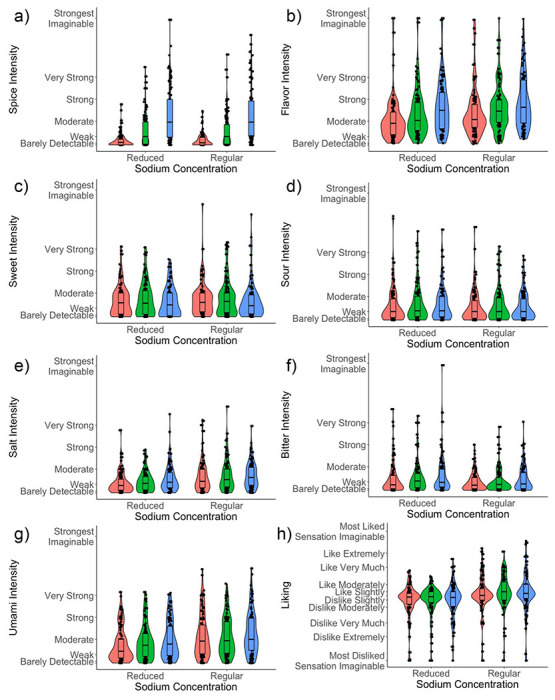
People who lose their sense of smell self-report consuming more salt to compensate for a lack of flavor and enhance eating enjoyment. However, this can contribute to excess sodium intake and a poor diet. Capsaicin may help increase salt taste intensity and eating enjoyment in this population, but this has not been studied. The purpose of this study was to determine 1) whether salt intake in those with smell loss differs from population averages, 2) whether capsaicin increases flavor and salt taste intensity, and 3) if adding spice to foods increases food liking in individuals with smell loss. Participants 18-65 years old with confirmed partial or total smell loss for at least 12 weeks completed two sets of replicate test sessions (four total). In two sessions participants rated overall flavor intensity, taste qualities' intensities, spicy intensity, and liking for model tomato soups with low or regular sodium content and three levels of capsaicin (none, low, or moderate). In the other two sessions, participants rated the same sensory attributes for model food samples with three levels of added spice (none, low, or moderate). 24-hour urine samples were also collected to determine sodium intake. Results indicate that although sodium intake is higher than recommended in those with smell loss (2893 ± 258 mg/day), they do not consume more sodium than population averages. Adding low and moderate amounts of capsaicin to a model tomato soup increased the intensity of overall flavor and saltiness compared to a model tomato soup without capsaicin. However, the effect of capsaicin on liking differed by food type. In conclusion, the addition of capsaicin can improve flavor, salt taste intensity, and eating enjoyment in people with smell loss.
嗅觉丧失的人自述会摄入更多盐分,以弥补味道的缺失并提升进食的愉悦感。然而,这可能会导致钠摄入过量以及饮食不良。辣椒素或许有助于增强这一人群的咸味感知强度并提升进食愉悦感,但这一点尚未得到研究。本研究的目的在于确定:1)嗅觉丧失者的盐摄入量是否与总体人群平均水平不同;2)辣椒素是否会增强风味和咸味感知强度;3)在食物中添加香料是否会提升嗅觉丧失者对食物的喜爱程度。18至65岁、经确认至少有12周部分或完全嗅觉丧失的参与者完成了两组重复测试环节(共四个)。在两个环节中,参与者对低钠或常规钠含量以及三种辣椒素水平(无、低或中)的模拟番茄汤的总体风味强度、味觉品质强度、辣味强度和喜爱程度进行评分。在另外两个环节中,参与者对添加了三种香料水平(无、低或中)的模拟食物样本的相同感官属性进行评分。还收集了24小时尿液样本以确定钠摄入量。结果表明,尽管嗅觉丧失者的钠摄入量高于推荐水平(2893±258毫克/天),但他们的钠摄入量并不高于总体人群平均水平。与未添加辣椒素的模拟番茄汤相比,在模拟番茄汤中添加低量和中等量的辣椒素会增加总体风味和咸味的强度。然而,辣椒素对喜爱程度的影响因食物类型而异。总之,添加辣椒素可以改善嗅觉丧失者的风味、咸味感知强度和进食愉悦感。