Division of Human Nutrition and Health, Wageningen University, Stippeneng 4, 6708, Wageningen, The Netherlands.
Department of Psychology, Temple University, 1701 North 13th Street, PA, 19122, Philadelphia, USA.
Cell Tissue Res. 2021 Jan;383(1):559-567. doi: 10.1007/s00441-020-03367-7. Epub 2021 Jan 12.
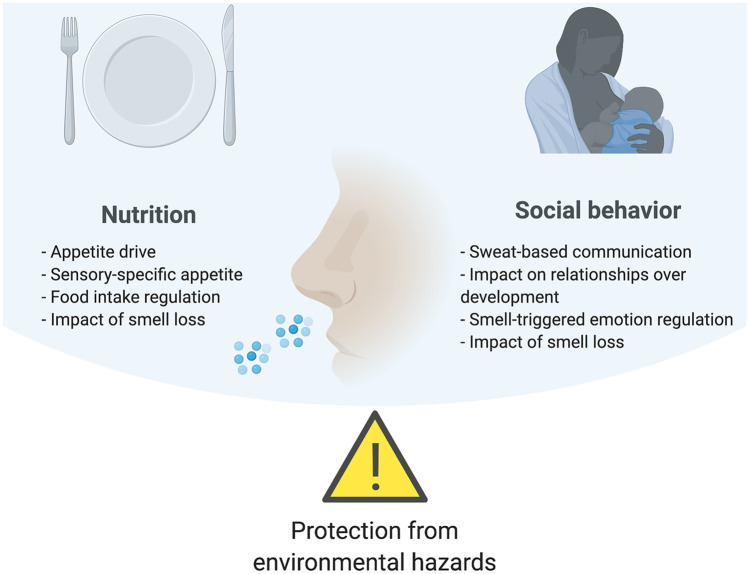
The human sense of smell is still much underappreciated, despite its importance for vital functions such as warning and protection from environmental hazards, eating behavior and nutrition, and social communication. We here approach olfaction as a sense of well-being and review the available literature on how the sense of smell contributes to building and maintaining well-being through supporting nutrition and social relationships. Humans seem to be able to extract nutritional information from olfactory food cues, which can trigger specific appetite and direct food choice, but may not always impact actual intake behavior. Beyond food enjoyment, as part of quality of life, smell has the ability to transfer and regulate emotional conditions, and thus impacts social relationships, at various stages across life (e.g., prenatal and postnatal, during puberty, for partner selection and in sickness). A better understanding of how olfactory information is processed and employed for these functions so vital for well-being may be used to reduce potential negative consequences.
人类的嗅觉仍然被严重低估了,尽管它对重要的生命功能至关重要,如警告和保护免受环境危害、饮食行为和营养以及社会交流。我们将嗅觉视为一种幸福感,并回顾了现有文献,探讨了嗅觉如何通过支持营养和社会关系来帮助建立和维持幸福感。人类似乎能够从嗅觉食物线索中提取营养信息,这些信息可以引发特定的食欲并直接选择食物,但并不总是影响实际的摄入行为。除了食物享受作为生活质量的一部分,气味还有能力传递和调节情绪状态,从而影响社会关系,在生命的各个阶段(例如,产前和产后、青春期、伴侣选择和疾病期间)都有影响。更好地了解嗅觉信息如何被处理和用于这些对幸福感至关重要的功能,可能有助于减少潜在的负面影响。