Xie Hua, Moraczewski Dustin, McNaughton Kathryn A, Warnell Katherine R, Alkire Diana, Merchant Junaid S, Kirby Laura A, Yarger Heather A, Redcay Elizabeth
Neuroscience and Cognitive Science Program, University of Maryland, College Park, Maryland, USA.
Department of Psychology, University of Maryland, College Park, Maryland, USA.
bioRxiv. 2023 Jun 7:2023.06.05.543807. doi: 10.1101/2023.06.05.543807.
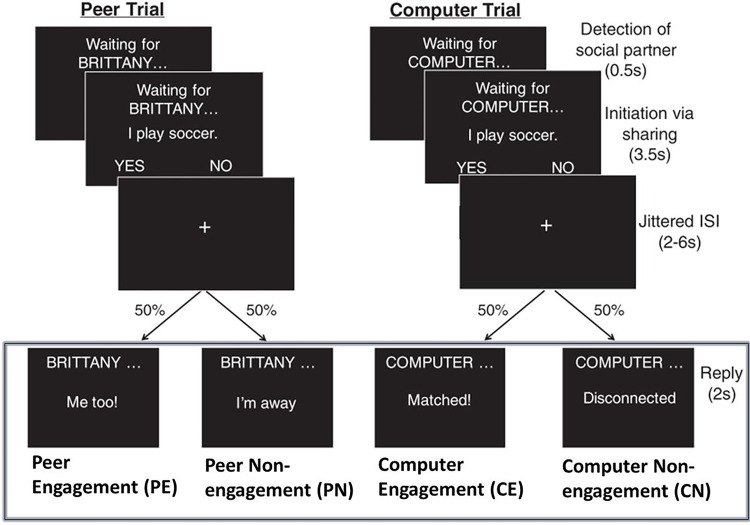
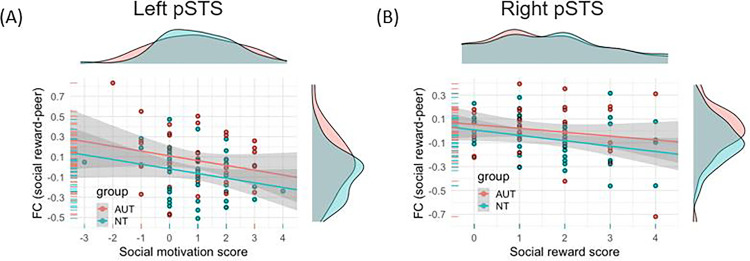
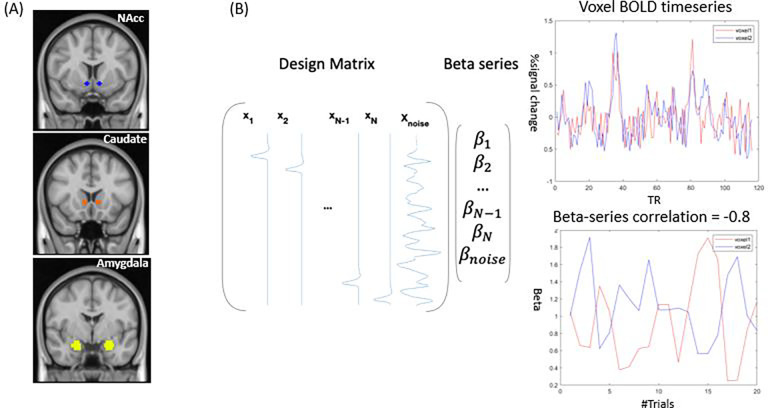
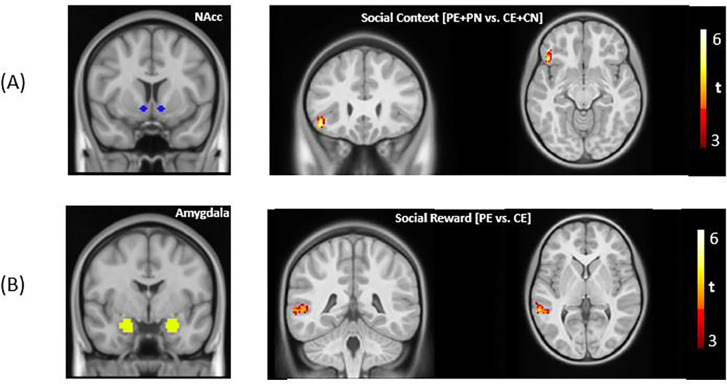
A core feature of autism is difficulties with social interaction. Atypical social motivation is proposed to underlie these difficulties. However, prior work testing this hypothesis has shown mixed support and has been limited in its ability to understand real-world social-interactive processes in autism. We attempted to address these limitations by scanning neurotypical and autistic youth (n = 86) during a text-based reciprocal social interaction that mimics a "live" chat and elicits social reward processes. We focused on task-evoked functional connectivity (FC) of regions responsible for motivational-reward and mentalizing processes within the broader social reward circuitry. We found that task-evoked FC between these regions was significantly modulated by social interaction and receipt of social-interactive reward. Compared to neurotypical peers, autistic youth showed significantly greater task-evoked connectivity of core regions in the mentalizing network (e.g., posterior superior temporal sulcus) and the amygdala, a key node in the reward network. Furthermore, across groups, the connectivity strength between these mentalizing and reward regions was negatively correlated with self-reported social motivation and social reward during the scanner task. Our results highlight an important role of FC within the broader social reward circuitry for social-interactive reward. Specifically, greater context-dependent FC (i.e., differences between social engagement and non-social engagement) may indicate an increased "neural effort" during social reward and relate to differences in social motivation within autistic and neurotypical populations.
自闭症的一个核心特征是社交互动存在困难。非典型的社会动机被认为是这些困难的潜在原因。然而,之前检验这一假设的研究结果喜忧参半,并且在理解自闭症患者现实世界中的社会互动过程方面能力有限。我们试图通过在一种基于文本的互惠式社会互动过程中对神经典型和自闭症青少年(n = 86)进行扫描来解决这些局限性,这种互动模拟“实时”聊天并引发社会奖励过程。我们关注了在更广泛的社会奖励回路中负责动机奖励和心理化过程的区域的任务诱发功能连接(FC)。我们发现,这些区域之间的任务诱发FC受到社会互动和社会互动奖励的显著调节。与神经典型的同龄人相比,自闭症青少年在心理化网络(例如颞上沟后部)和杏仁核(奖励网络中的一个关键节点)的核心区域表现出显著更强的任务诱发连接。此外,在所有组中,这些心理化和奖励区域之间的连接强度与扫描仪任务期间自我报告的社会动机和社会奖励呈负相关。我们的研究结果突出了在更广泛的社会奖励回路中FC对社会互动奖励的重要作用。具体而言,更大的情境依赖FC(即社会参与和非社会参与之间的差异)可能表明在社会奖励期间“神经努力”增加,并且与自闭症和神经典型人群在社会动机方面的差异有关。