Montrose Kristopher, Lac Dung T, Burnetti Anthony J, Tong Kai, Ozan Bozdag G, Hukkanen Mikaela, Ratcliff William C, Saarikangas Juha
Helsinki Institute of Life Science, HiLIFE, University of Helsinki.
Faculty of Biological and Environmental Sciences, University of Helsinki.
bioRxiv. 2024 Jan 22:2023.05.31.543183. doi: 10.1101/2023.05.31.543183.
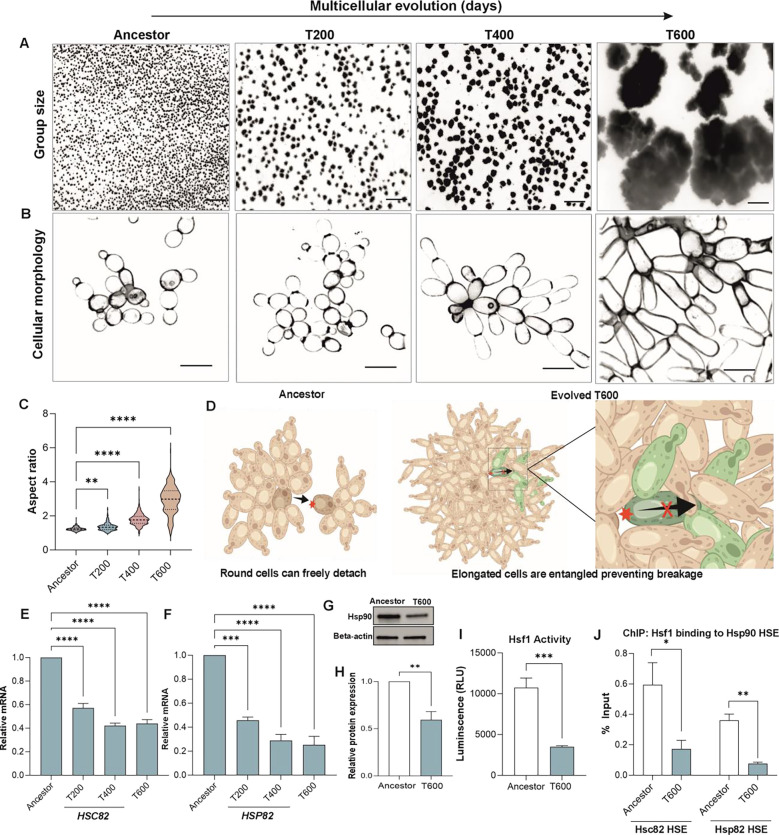
The evolution of multicellularity paved the way for the origin of complex life on Earth, but little is known about the mechanistic basis of early multicellular evolution. Here, we examine the molecular basis of multicellular adaptation in the Multicellularity Long Term Evolution Experiment (MuLTEE). We demonstrate that cellular elongation, a key adaptation underpinning increased biophysical toughness and organismal size, is convergently driven by downregulation of the chaperone Hsp90. Mechanistically, Hsp90-mediated morphogenesis operates by destabilizing the cyclin-dependent kinase Cdc28, resulting in delayed mitosis and prolonged polarized growth. Reinstatement of Hsp90 or Cdc28 expression resulted in shortened cells that formed smaller groups with reduced multicellular fitness. Together, our results show how ancient protein folding systems can be tuned to drive rapid evolution at a new level of biological individuality by revealing novel developmental phenotypes.
多细胞性的进化为地球上复杂生命的起源铺平了道路,但对于早期多细胞进化的机制基础却知之甚少。在此,我们在多细胞长期进化实验(MuLTEE)中研究了多细胞适应性的分子基础。我们证明,细胞伸长是增强生物物理韧性和生物体大小的关键适应性特征,它是由伴侣蛋白Hsp90的下调趋同驱动的。从机制上讲,Hsp90介导的形态发生是通过使细胞周期蛋白依赖性激酶Cdc28不稳定来实现的,从而导致有丝分裂延迟和极化生长延长。恢复Hsp90或Cdc28的表达会导致细胞缩短,形成较小的群体,多细胞适应性降低。总之,我们的结果表明,古老的蛋白质折叠系统如何通过揭示新的发育表型,在新的生物个体水平上进行调整以驱动快速进化。