Conner Stephanie M, Choi Nancy, Fuller Jessica, Daya Sneha, Barish Peter, Rennke Stephanie, Harrison James D, Narayana Sirisha
Washington University School of Medicine.
University of California-San Francisco.
Res Sq. 2023 Jun 6:rs.3.rs-2982838. doi: 10.21203/rs.3.rs-2982838/v1.
Balancing autonomy and supervision during medical residency is important for trainee development while ensuring patient safety. In the modern clinical learning environment, tension exists when this balance is skewed. This study aimed to understand the current and ideal states of autonomy and supervision, then describe the factors that contribute to imbalance from both trainee and attending perspectives.
A mixed-methods design included surveys and focus groups of trainees and attendings at three institutionally affiliated hospitals between May 2019-June 2020. Survey responses were compared using chi-square tests or Fisher's exact tests. Open-ended survey and focus group questions were analyzed using thematic analysis.
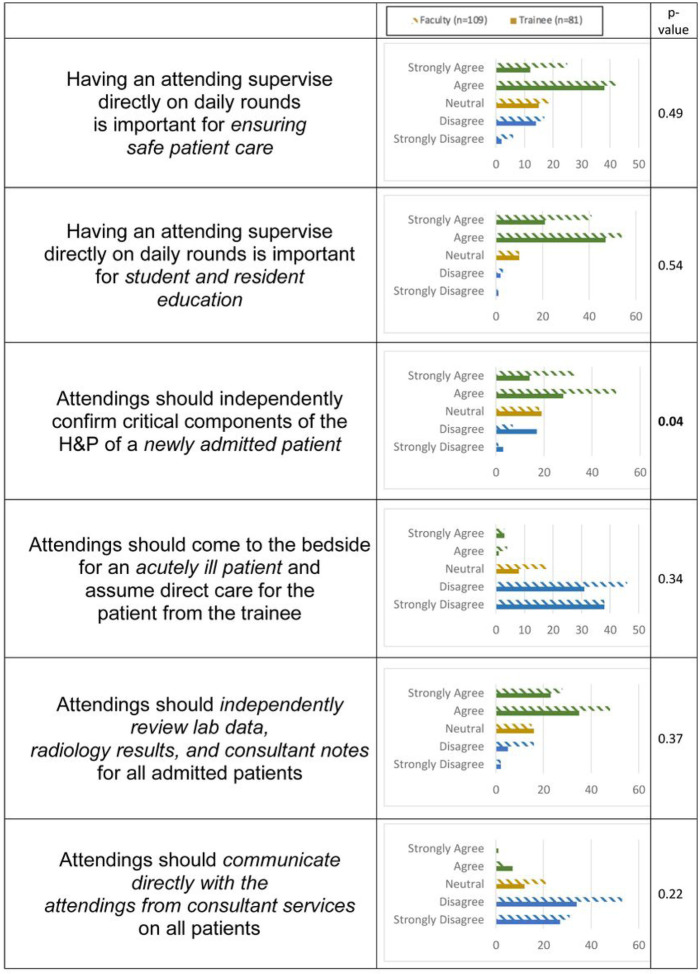
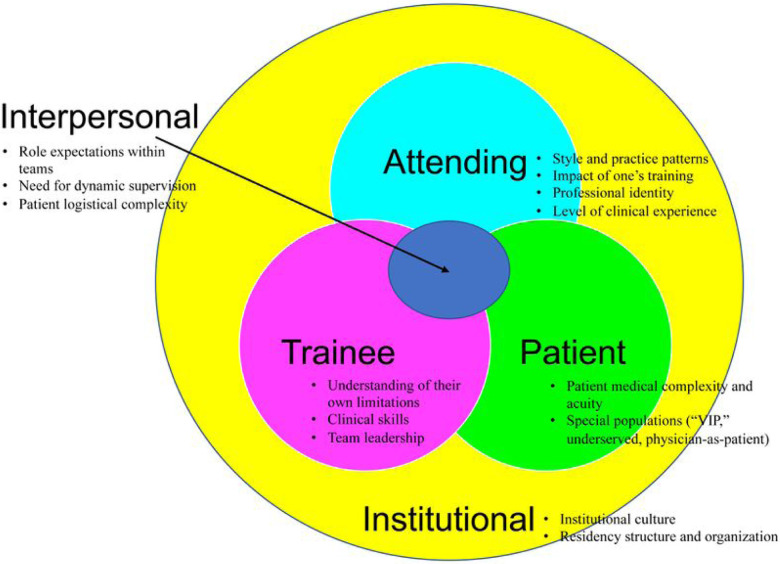
Surveys were sent to 182 trainees and 208 attendings; 76 trainees (42%) and 101 attendings (49%) completed the survey. Fourteen trainees (8%) and 32 attendings (32%) participated in focus groups. Trainees perceived the current culture to be significantly more autonomous than attendings; both groups described an "ideal" culture as more autonomous than the current state. Focus group analysis revealed five core contributors to the balance of autonomy and supervision: attending-, trainee-, patient-, interpersonal-, and institutional-related factors. These factors were found to be dynamic and interactive with each other. Additionally, we identified a cultural shift in how the modern inpatient environment is impacted by increased hospitalist attending supervision and emphasis on patient safety and health system improvement initiatives.
Trainees and attendings agree that the clinical learning environment should favor resident autonomy and that the current environment does not achieve the ideal balance. There are several factors contributing to autonomy and supervision, including attending-, resident-, patient-, interpersonal-, and institutional-related. These factors are complex, multifaceted, and dynamic. Cultural shifts towards supervision by primarily hospitalist attendings and increased attending accountability for patient safety and systems improvement outcomes further impacts trainee autonomy.
在医学住院医师培训期间平衡自主权和监督对于学员发展很重要,同时要确保患者安全。在现代临床学习环境中,当这种平衡出现偏差时就会产生紧张关系。本研究旨在了解自主权和监督的现状及理想状态,然后从学员和带教教师的角度描述导致失衡的因素。
采用混合方法设计,于2019年5月至2020年6月对三家附属医院的学员和带教教师进行了调查和焦点小组访谈。使用卡方检验或费舍尔精确检验比较调查回复。对开放式调查和焦点小组问题进行主题分析。
向182名学员和208名带教教师发送了调查问卷;76名学员(42%)和101名带教教师(49%)完成了调查。14名学员(8%)和32名带教教师(32%)参加了焦点小组访谈。学员认为当前的文化比带教教师所认为的更具自主性;两组都将“理想”文化描述为比当前状态更具自主性。焦点小组分析揭示了影响自主权和监督平衡的五个核心因素:与带教教师、学员、患者、人际关系和机构相关的因素。发现这些因素是动态的且相互作用。此外,我们确定了一种文化转变,即现代住院环境如何受到住院医师带教教师监督增加以及对患者安全和卫生系统改进举措的重视的影响。
学员和带教教师一致认为临床学习环境应有利于住院医师的自主权,而当前环境未实现理想的平衡。有几个因素影响自主权和监督,包括与带教教师、住院医师、患者、人际关系和机构相关的因素。这些因素复杂、多方面且具有动态性。向主要由住院医师带教教师进行监督的文化转变以及带教教师对患者安全和系统改进结果的问责增加,进一步影响了学员的自主权。