Cruchaga Carlos, Western Dan, Timsina Jigyasha, Wang Lihua, Wang Ciyang, Yang Chengran, Ali Muhammad, Beric Aleksandra, Gorijala Priyanka, Kohlfeld Patsy, Budde John, Levey Allan, Morris John, Perrin Richard, Ruiz Agustín, Marquié Marta, Boada Mercè, de Rojas Itziar, Rutledge Jarod, Oh Hamilton, Wilson Edward, Guen Yann Le, Alvarez Ignacio, Aguilar Miquel, Greicius Michael, Pastor Pau, Pulford David, Ibanez Laura, Wyss-Coray Tony, Sung Yun Ju, Phillips Bridget
Washington University School of Medicine.
Department of Psychiatry, Washington University School of Medicine, St. Louis, MO, USA.
Res Sq. 2023 Jun 9. doi: 10.21203/rs.3.rs-2814616/v1.
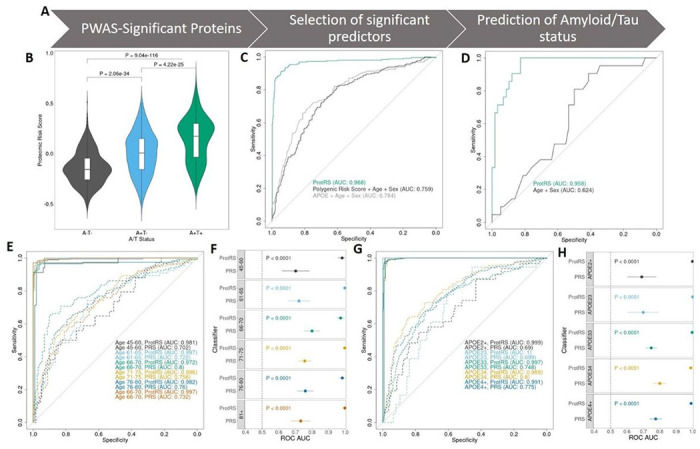
The integration of quantitative trait loci (QTL) with disease genome-wide association studies (GWAS) has proven successful at prioritizing candidate genes at disease-associated loci. QTL mapping has mainly been focused on multi-tissue expression QTL or plasma protein QTL (pQTL). Here we generated the largest-to-date cerebrospinal fluid (CSF) pQTL atlas by analyzing 7,028 proteins in 3,107 samples. We identified 3,373 independent study-wide associations for 1,961 proteins, including 2,448 novel pQTLs of which 1,585 are unique to CSF, demonstrating unique genetic regulation of the CSF proteome. In addition to the established chr6p22.2-21.32 HLA region, we identified pleiotropic regions on chr3q28 near and chr19q13.32 near that were enriched for neuron-specificity and neurological development. We also integrated this pQTL atlas with the latest Alzheimer's disease (AD) GWAS through PWAS, colocalization and Mendelian Randomization and identified 42 putative causal proteins for AD, 15 of which have drugs available. Finally, we developed a proteomics-based risk score for AD that outperforms genetics-based polygenic risk scores. These findings will be instrumental to further understand the biology and identify causal and druggable proteins for brain and neurological traits.
数量性状基因座(QTL)与疾病全基因组关联研究(GWAS)的整合已被证明在确定疾病相关基因座的候选基因方面是成功的。QTL定位主要集中在多组织表达QTL或血浆蛋白QTL(pQTL)上。在这里,我们通过分析3107个样本中的7028种蛋白质,生成了迄今为止最大的脑脊液(CSF)pQTL图谱。我们鉴定出1961种蛋白质的3373个独立的全研究关联,包括2448个新的pQTL,其中1585个是脑脊液特有的,这证明了脑脊液蛋白质组独特的遗传调控。除了已确定的6号染色体p22.2 - 21.32 HLA区域外,我们还在靠近的3号染色体q28和靠近的19号染色体q13.32上鉴定出多效性区域,这些区域富含神经元特异性和神经发育相关基因。我们还通过蛋白质组全关联研究(PWAS)、共定位和孟德尔随机化将这个pQTL图谱与最新的阿尔茨海默病(AD)GWAS进行整合,鉴定出42种AD的假定因果蛋白,其中15种有可用药物。最后,我们开发了一种基于蛋白质组学的AD风险评分,其表现优于基于遗传学的多基因风险评分。这些发现将有助于进一步了解生物学机制,并识别与大脑和神经性状相关的因果蛋白和可成药蛋白。