Rowe Callum, Wiesendanger Kathryn, Polet Conner, Kuppermann Nathan, Aronoff Stephen
Department of Emergency Medicine, University of California, Davis School of Medicine, Sacramento, CA.
Department of Psychiatry, SUNY Downstate, New York, NY.
J Pediatr X. 2020 Apr 22;3:100026. doi: 10.1016/j.ympdx.2020.100026. eCollection 2020 Summer.
To develop a simplified clinical prediction tool for identifying children with clinically important traumatic brain injuries (ciTBIs) after minor blunt head trauma by applying machine learning to the previously reported Pediatric Emergency Care Applied Research Network dataset.
The deidentified dataset consisted of 43 399 patients <18 years old who presented with blunt head trauma to 1 of 25 pediatric emergency departments between June 2004 and September 2006. We divided the dataset into derivation (training) and validation (testing) subsets; 4 machine learning algorithms were optimized using the training set. Fitted models used the test set to predict ciTBI and these predictions were compared statistically with the a priori (no information) rate.
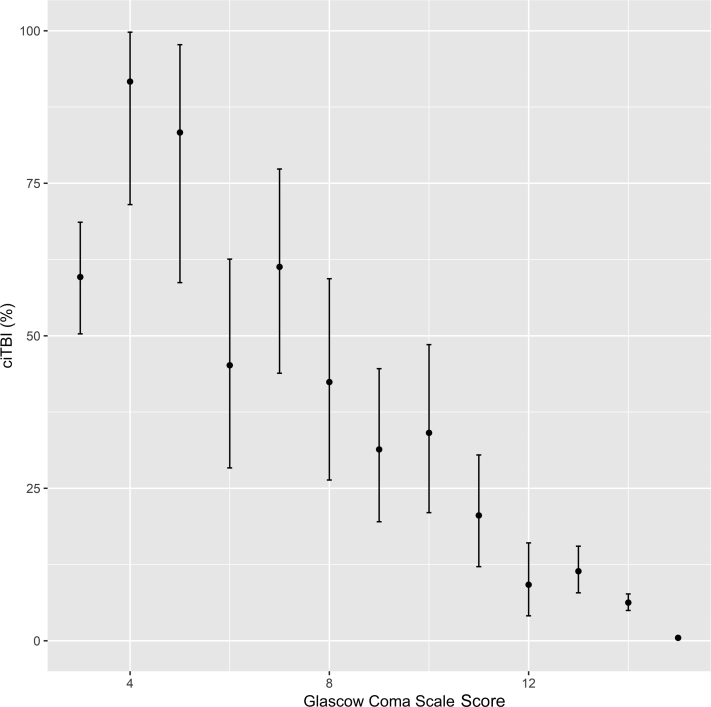
None of the 4 machine learning models was superior to the no information rate. Children without clinical evidence of a skull fracture and with Glasgow Coma Scale scores of 15 were at the lowest risk for ciTBIs (0.48%; 95% CI 0.42%-0.55%).
Machine learning algorithms were unable to produce a more accurate prediction tool for ciTBI among children with minor blunt head trauma beyond the absence of clinical evidence of skull fractures and having Glasgow Coma Scale scores of 15.
通过对先前报道的儿科急诊应用研究网络数据集应用机器学习,开发一种简化的临床预测工具,以识别轻度钝性头部外伤后具有临床重要性的创伤性脑损伤(ciTBI)患儿。
去识别化数据集包括2004年6月至2006年9月期间在25个儿科急诊科之一因钝性头部外伤就诊的43399例18岁以下患者。我们将数据集分为推导(训练)和验证(测试)子集;使用训练集对4种机器学习算法进行优化。拟合模型使用测试集预测ciTBI,并将这些预测与先验(无信息)率进行统计学比较。
4种机器学习模型均不优于无信息率。无颅骨骨折临床证据且格拉斯哥昏迷量表评分为15分的儿童发生ciTBI的风险最低(0.48%;95%CI 0.42%-0.55%)。
除了没有颅骨骨折的临床证据和格拉斯哥昏迷量表评分为15分之外,机器学习算法无法为轻度钝性头部外伤患儿的ciTBI生成更准确的预测工具。