Lorton F, Poullaouec C, Legallais E, Simon-Pimmel J, Chêne M A, Leroy H, Roy M, Launay E, Gras-Le Guen C
Department of Pediatric Emergency, University Hospital, Quai Moncousu, 44093, Nantes Cédex 01, France.
INSERM CIC 1413, University Hospital, 38 bd Jean Monnet, 44093, Nantes Cédex 01, France.
Scand J Trauma Resusc Emerg Med. 2016 Aug 4;24:98. doi: 10.1186/s13049-016-0287-3.
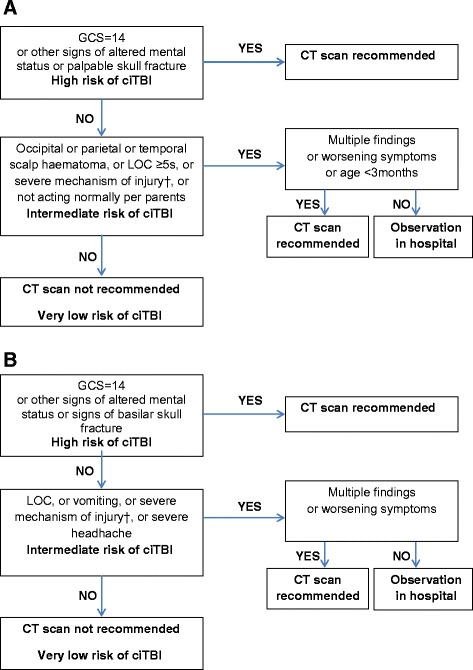
To date, the Pediatric Emergency Care Applied Research Network (PECARN) rule for identifying children who are at very low risk of clinically-important traumatic brain injuries after minor head trauma has not been validated prospectively in an independent population. Our goal was to evaluate the diagnostic performance of the PECARN clinical decision rule in a French pediatric population in multiple clinical settings.
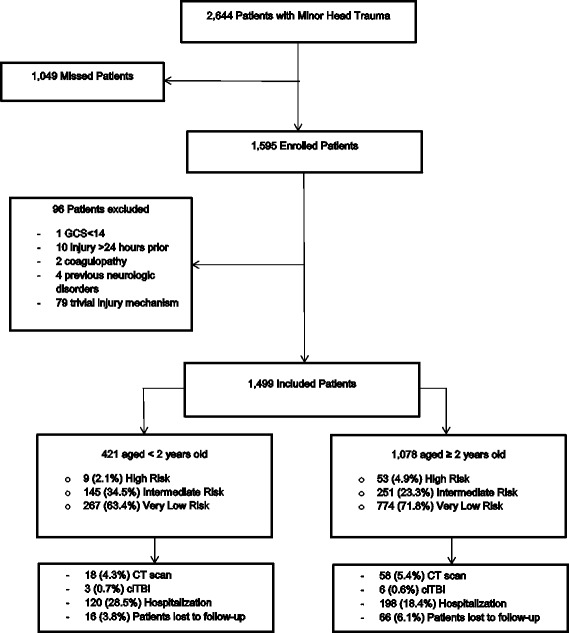
We conducted a multicenter, prospective, non-interventional cohort study of patients with minor head trauma who presented to three emergency departments in France. We enrolled patients younger than 16 years of age seeking a consultation within 24 h of head trauma with Glasgow Coma Scale scores of 14-15.
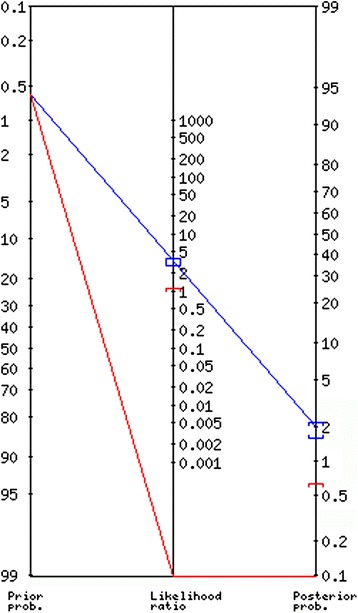
During the study period, we included 1499 children of which 421 (28 %) were under 2 years of age, and 955 (64 %) were male. A cranial computed tomography (CT) scan was performed on 76 patients (5.1 %). Of the 1499 included patients, 9 children (0.6 %) had a clinically-important traumatic brain injury, and none were classified as very low risk by the PECARN rule. In our study, the sensitivity of this clinical decision rule was 100 % (95 % CI 66.4 to 100 %), the specificity was 69.9 % (95 % CI 67.5 to 72.2 %) and the negative predictive value was 100 % (95 % CI 99.7 to 100 %).
Our study confirmed the good predictive performances of the PECARN clinical decision rule for minor head trauma in children. The PECARN rule performed similarly to our study and to its internal validation study.
We conducted an external validation study of the PECARN clinical decision rule for the detection of clinically-important traumatic brain injuries in children with minor head trauma, according to the methodological standards. The PECARN rule successfully identified all patients with clinically-important traumatic brain injuries, with a limited use of CT scans. Conducting a broad validation study with a large cohort is a prerequisite to provide sufficient statistical power before authorizing its implementation and generalization.
This study has been registered in ClinicalTrials.gov with identifier number: NCT02752711 on April 27, 2016.
迄今为止,儿科急诊护理应用研究网络(PECARN)用于识别轻度头部创伤后临床上重要的创伤性脑损伤风险极低儿童的规则,尚未在独立人群中进行前瞻性验证。我们的目标是在法国儿科人群的多个临床环境中评估PECARN临床决策规则的诊断性能。
我们对法国三家急诊科的轻度头部创伤患者进行了一项多中心、前瞻性、非干预性队列研究。我们纳入了年龄小于16岁、在头部创伤后24小时内寻求会诊且格拉斯哥昏迷量表评分为14 - 15分的患者。
在研究期间,我们纳入了1499名儿童,其中421名(28%)年龄在2岁以下,955名(64%)为男性。76名患者(5.1%)进行了头颅计算机断层扫描(CT)。在1499名纳入患者中,9名儿童(0.6%)有临床上重要的创伤性脑损伤,且根据PECARN规则无一人被归类为极低风险。在我们的研究中,该临床决策规则的敏感性为100%(95%可信区间66.4至100%),特异性为69.9%(95%可信区间67.5至72.2%),阴性预测值为100%(95%可信区间99.7至100%)。
我们的研究证实了PECARN临床决策规则对儿童轻度头部创伤具有良好的预测性能。PECARN规则的表现与我们的研究及其内部验证研究相似。
我们根据方法学标准对PECARN临床决策规则进行了外部验证研究,以检测轻度头部创伤儿童临床上重要的创伤性脑损伤。PECARN规则成功识别了所有有临床上重要创伤性脑损伤的患者,CT扫描的使用有限。在授权实施和推广之前,进行大规模队列的广泛验证研究是提供足够统计效力的前提。
本研究已在ClinicalTrials.gov注册,标识符为:NCT02752711,注册时间为2016年4月27日。