van den Berg Jana, Haslbauer Jasmin D, Stalder Anna K, Romanens Anna, Mertz Kirsten D, Studt Jan-Dirk, Siegemund Martin, Buser Andreas, Holbro Andreas, Tzankov Alexandar
Department of Hematology, University Hospital Basel, Basel, Switzerland.
Department of Pathology, Institute of Medical Genetics and Pathology, University Hospital Basel, Basel, Switzerland.
Res Pract Thromb Haemost. 2023 May;7(4):100182. doi: 10.1016/j.rpth.2023.100182. Epub 2023 May 18.
COVID-19 is accompanied by a hypercoagulable state and characterized by microvascular and macrovascular thrombotic complications. In plasma samples from patients with COVID-19, von Willebrand factor (VWF) levels are highly elevated and predictive of adverse outcomes, especially mortality. Yet, VWF is usually not included in routine coagulation analyses, and histologic evidence of its involvement in thrombus formation is lacking.
To determine whether VWF, an acute-phase protein, is a bystander, ie, a biomarker of endothelial dysfunction, or a causal factor in the pathogenesis of COVID-19.
We compared autopsy samples from 28 patients with lethal COVID-19 to those from matched controls and systematically assessed for VWF and platelets by immunohistochemistry. The control group comprised 24 lungs, 23 lymph nodes, and 9 hearts and did not differ significantly from the COVID-19 group in age, sex, body mass index (BMI), blood group, or anticoagulant use.
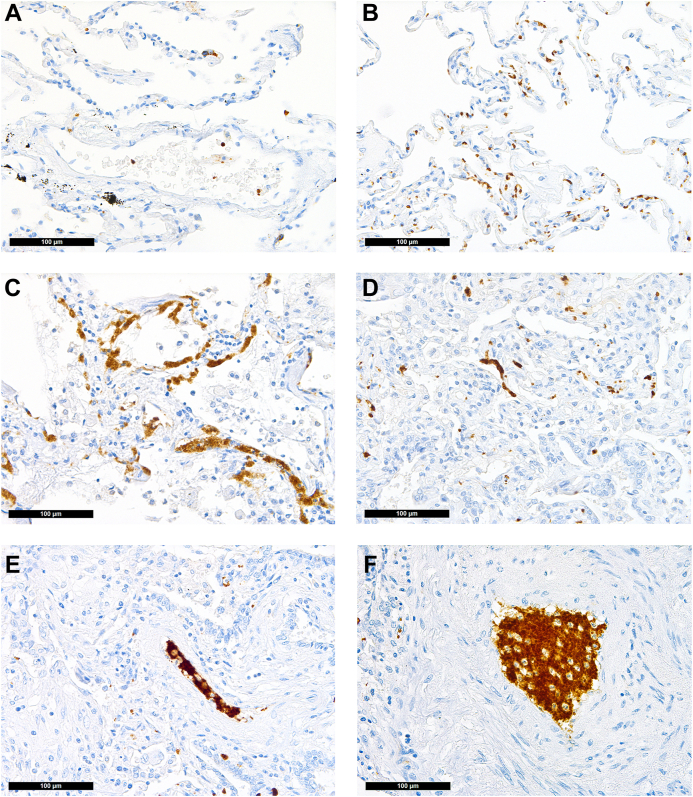
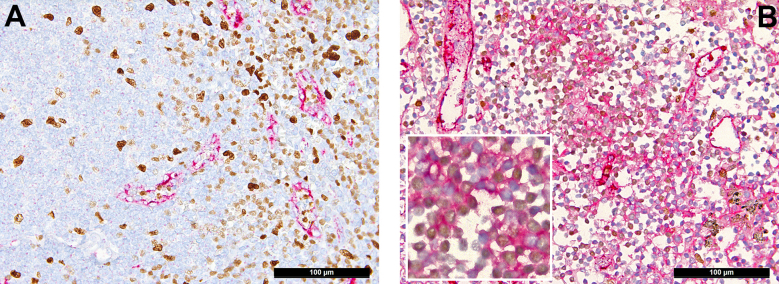
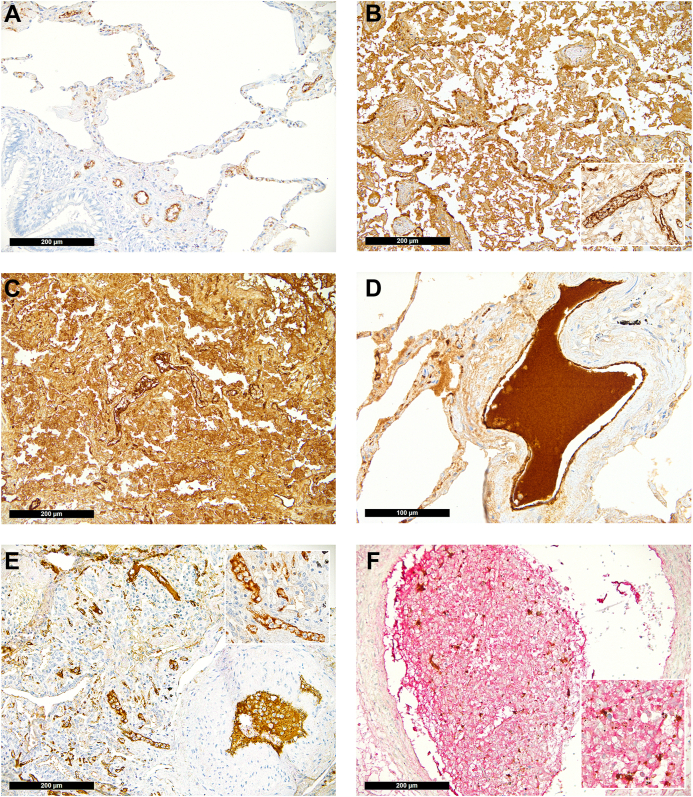
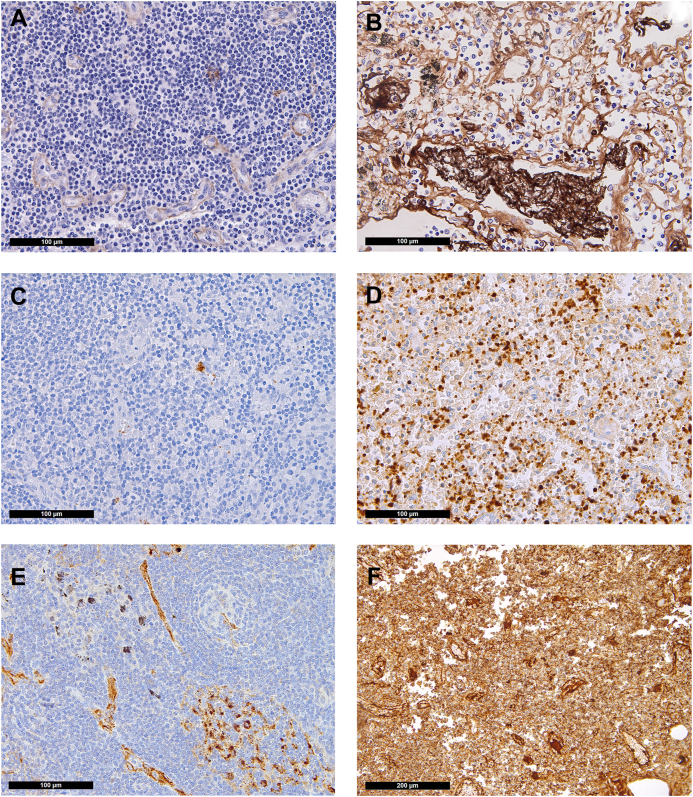
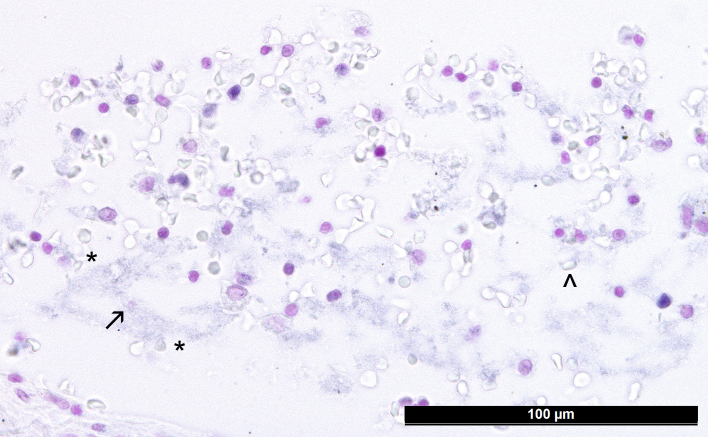
In lungs, assessed for platelets by immunohistochemistry for CD42b, microthrombi were more frequent in patients with COVID-19 (10/28 [36%] vs 2/24 [8%]; = .02). A completely normal pattern of VWF was rare in both groups. Accentuated endothelial staining was found in controls, while VWF-rich thrombi were only found in patients with COVID-19 (11/28 [39%] vs 0/24 [0%], respectively; < .01), as were NETosis thrombi enriched with VWF (7/28 [25%] vs 0/24 [0%], respectively; < .01). Forty-six percent of the patients with COVID-19 had VWF-rich thrombi, NETosis thrombi, or both. Trends were also seen in pulmonary draining lymph nodes (7/20 [35%] vs 4/24 [17%]; = .147), where the overall presence of VWF was very high.
We provide evidence of VWF-rich thrombi, likely attributable to COVID-19, and suggest that VWF may be a therapeutic target in severe COVID-19.
新型冠状病毒肺炎(COVID-19)伴有高凝状态,其特征为微血管和大血管血栓形成并发症。在COVID-19患者的血浆样本中,血管性血友病因子(VWF)水平显著升高,且可预测不良结局,尤其是死亡率。然而,VWF通常不包括在常规凝血分析中,且缺乏其参与血栓形成的组织学证据。
确定急性期蛋白VWF是旁观者,即内皮功能障碍的生物标志物,还是COVID-19发病机制中的致病因素。
我们将28例死于COVID-19的患者的尸检样本与匹配的对照组样本进行比较,并通过免疫组织化学系统评估VWF和血小板。对照组包括24个肺、23个淋巴结和9个心脏,在年龄、性别、体重指数(BMI)、血型或抗凝剂使用方面与COVID-19组无显著差异。
通过针对CD42b的免疫组织化学评估肺中的血小板,COVID-19患者的微血栓更常见(10/28 [36%] 对比2/24 [8%];P = .02)。两组中VWF完全正常的模式都很罕见。对照组中发现内皮染色增强,而仅在COVID-19患者中发现富含VWF的血栓(分别为11/28 [39%] 对比0/24 [0%];P < .01),富含VWF的中性粒细胞胞外诱捕网(NETosis)血栓也是如此(分别为7/28 [25%] 对比0/24 [0%];P < .01)。46%的COVID-19患者有富含VWF的血栓、NETosis血栓或两者皆有。在肺引流淋巴结中也观察到了这种趋势(7/20 [35%] 对比4/24 [17%];P = .147),其中VWF的总体存在率非常高。
我们提供了可能归因于COVID-19的富含VWF的血栓的证据,并表明VWF可能是重症COVID-19的治疗靶点。