Pin Jacopo Norberto, Leonardi Letizia, Nosadini Margherita, Cavicchiolo Maria Elena, Guariento Chiara, Zarpellon Anna, Perilongo Giorgio, Raffagnato Alessia, Toldo Irene, Baraldi Eugenio, Sartori Stefano
Department of Women's and Children's Health, Paediatric Neurology and Neurophysiology Unit, University Hospital of Padua, Padova, Italy.
Master in Pediatrics and Pediatric Subspecialties, University Hospital of Padua, Padova, Italy.
Front Pediatr. 2023 Jun 2;11:1189478. doi: 10.3389/fped.2023.1189478. eCollection 2023.
Evidence-based data on treatment of neonatal status epilepticus (SE) are scarce. We aimed to collect data on the efficacy and safety of ketamine for the treatment of neonatal SE and to assess its possible role in the treatment of neonatal SE.
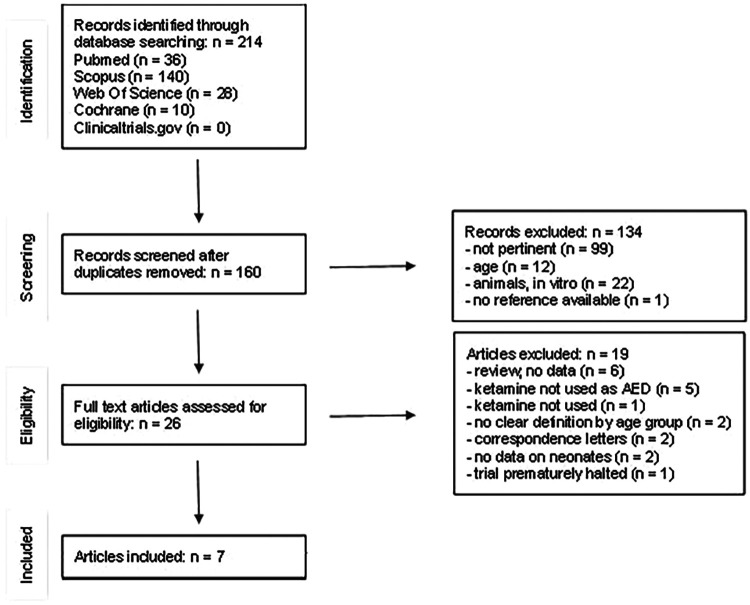
We described a novel case and conducted a systematic literature review on neonatal SE treated with ketamine. The search was carried out in Pubmed, Cochrane, Clinical Trial Gov, Scopus and Web of Science.
Seven published cases of neonatal SE treated with ketamine were identified and analyzed together with our novel case. Seizures typically presented during the first 24 h of life (6/8). Seizures were resistant to a mean of five antiseizure medications. Ketamine, a NMDA receptor antagonist, appeared to be safe and effective in all neonates treated. Neurologic sequelae including hypotonia and spasticity were reported for 4/5 of the surviving children (5/8). 3/5 of them were seizure free at 1-17 months of life.
Neonatal brain is more susceptible to seizures due to a shift towards increased excitation because of a paradoxical excitatory effect of GABA, a greater density of NMDA receptors and higher extracellular concentrations of glutamate. Status epilepticus and neonatal encephalopathy could further enhance these mechanisms, providing a rationale for the use of ketamine in this setting.
Ketamine in the treatment of neonatal SE showed a promising efficacy and safety profile. However, further in-depth studies and clinical trials on larger populations are needed.
关于新生儿癫痫持续状态(SE)治疗的循证数据稀缺。我们旨在收集氯胺酮治疗新生儿SE的疗效和安全性数据,并评估其在新生儿SE治疗中的可能作用。
我们描述了一个新病例,并对氯胺酮治疗的新生儿SE进行了系统的文献综述。检索在PubMed、Cochrane、Clinical Trial Gov、Scopus和Web of Science中进行。
共识别出7例已发表的用氯胺酮治疗的新生儿SE病例,并与我们的新病例一起进行分析。癫痫发作通常出现在出生后的头24小时内(6/8)。癫痫发作平均对五种抗癫痫药物耐药。氯胺酮,一种NMDA受体拮抗剂,在所有接受治疗的新生儿中似乎都是安全有效的。4/5的存活儿童(5/8)报告有包括肌张力减退和痉挛在内的神经后遗症。其中3/5在1至17个月大时无癫痫发作。
由于GABA的反常兴奋作用导致兴奋性增加、NMDA受体密度更高以及细胞外谷氨酸浓度更高,新生儿大脑更容易发生癫痫发作。癫痫持续状态和新生儿脑病可能会进一步增强这些机制,这为在这种情况下使用氯胺酮提供了理论依据。
氯胺酮治疗新生儿SE显示出有前景的疗效和安全性。然而,需要对更大规模人群进行进一步深入研究和临床试验。