Center for Hypothalamic Research, Department of Internal Medicine, University of Texas Southwestern Medical Center, Dallas, TX, United States.
Division of Endocrinology, Department of Internal Medicine, University of Texas Southwestern Medical Center, Dallas, TX, United States.
Front Endocrinol (Lausanne). 2023 Jun 2;14:1181856. doi: 10.3389/fendo.2023.1181856. eCollection 2023.
Recurrent episodes of insulin-induced hypoglycemia in patients with diabetes mellitus can result in hypoglycemia-associated autonomic failure (HAAF), which is characterized by a compromised response to hypoglycemia by counterregulatory hormones (counterregulatory response; CRR) and hypoglycemia unawareness. HAAF is a leading cause of morbidity in diabetes and often hinders optimal regulation of blood glucose levels. Yet, the molecular pathways underlying HAAF remain incompletely described. We previously reported that in mice, ghrelin is permissive for the usual CRR to insulin-induced hypoglycemia. Here, we tested the hypothesis that attenuated release of ghrelin both results from HAAF and contributes to HAAF.
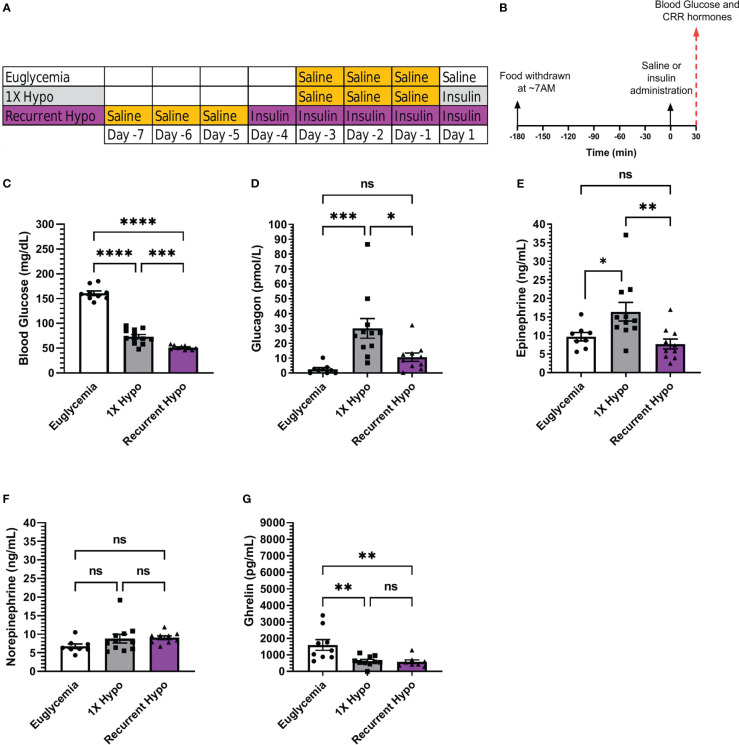
C57BL/6N mice, ghrelin-knockout (KO) + control mice, and GhIRKO (ghrelin cell-selective insulin receptor knockout) + control mice were randomized to one of three treatment groups: a "Euglycemia" group was injected with saline and remained euglycemic; a 1X hypoglycemia ("1X Hypo") group underwent a single episode of insulin-induced hypoglycemia; a recurrent hypoglycemia ("Recurrent Hypo") group underwent repeated episodes of insulin-induced hypoglycemia over five successive days.
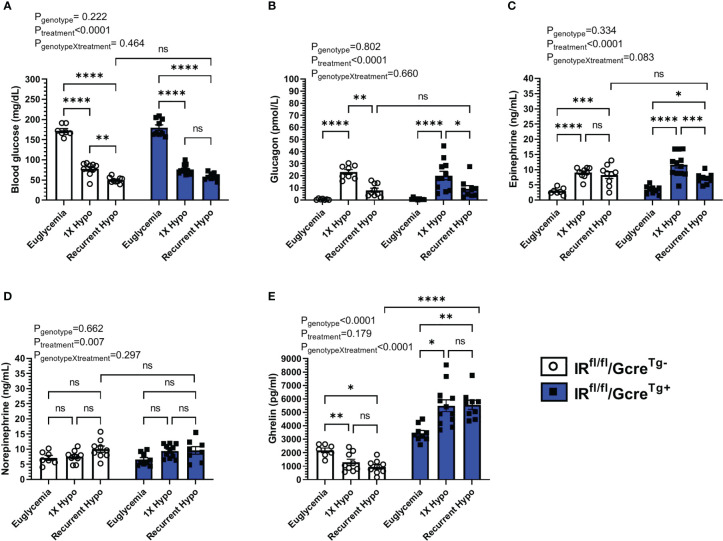
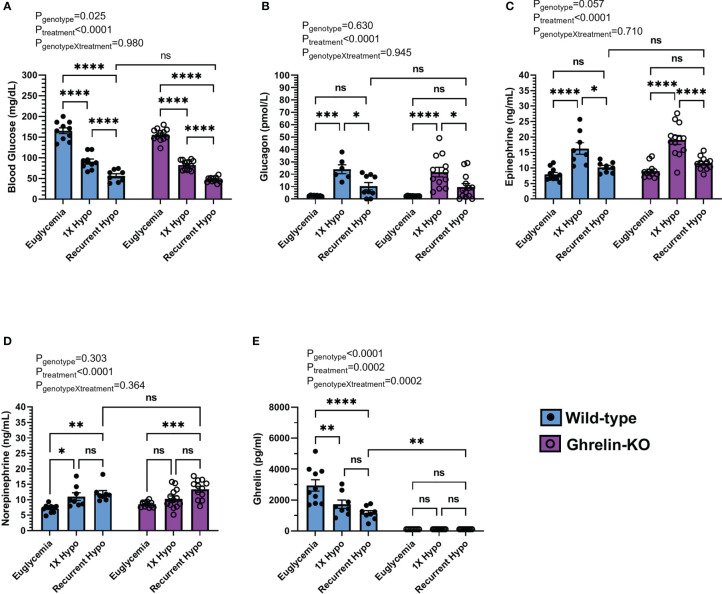
Recurrent hypoglycemia exaggerated the reduction in blood glucose (by ~30%) and attenuated the elevations in plasma levels of the CRR hormones glucagon (by 64.5%) and epinephrine (by 52.9%) in C57BL/6N mice compared to a single hypoglycemic episode. Yet, plasma ghrelin was equivalently reduced in "1X Hypo" and "Recurrent Hypo" C57BL/6N mice. Ghrelin-KO mice exhibited neither exaggerated hypoglycemia in response to recurrent hypoglycemia, nor any additional attenuation in CRR hormone levels compared to wild-type littermates. Also, in response to recurrent hypoglycemia, GhIRKO mice exhibited nearly identical blood glucose and plasma CRR hormone levels as littermates with intact insulin receptor expression (floxed-IR mice), despite higher plasma ghrelin in GhIRKO mice.
These data suggest that the usual reduction of plasma ghrelin due to insulin-induced hypoglycemia is unaltered by recurrent hypoglycemia and that ghrelin does not impact blood glucose or the blunted CRR hormone responses during recurrent hypoglycemia.
糖尿病患者反复发作的胰岛素诱导性低血糖可导致低血糖相关自主神经衰竭(HAAF),其特征是代偿性激素反应(CRR)和低血糖意识丧失对低血糖的反应受损。HAAF 是糖尿病发病率的主要原因,常阻碍血糖水平的最佳调节。然而,HAAF 的分子途径仍描述不完整。我们之前报道过,在小鼠中,ghrelin 允许对胰岛素诱导的低血糖产生通常的 CRR。在这里,我们测试了这样一个假设,即 HAAF 既导致了 ghrelin 释放的减弱,也导致了 HAAF。
C57BL/6N 小鼠、ghrelin 敲除(KO)+对照小鼠和 GhIRKO(ghrelin 细胞选择性胰岛素受体敲除)+对照小鼠被随机分为三组治疗组之一:“血糖正常”组注射生理盐水并保持血糖正常;单次低血糖(“1X Hypo”)组经历单次胰岛素诱导的低血糖发作;复发性低血糖(“Recurrent Hypo”)组在连续五天内经历多次胰岛素诱导的低血糖发作。
与单次低血糖发作相比,复发性低血糖使 C57BL/6N 小鼠的血糖降低幅度增加(约 30%),并使 CRR 激素胰高血糖素(降低 64.5%)和肾上腺素(降低 52.9%)的血浆水平升高幅度降低。然而,在“1X Hypo”和“Recurrent Hypo”C57BL/6N 小鼠中,血浆 ghrelin 水平同样降低。Ghrelin-KO 小鼠与野生型同窝仔鼠相比,既没有对复发性低血糖的血糖反应过度,也没有任何 CRR 激素水平的进一步降低。此外,在复发性低血糖时,GhIRKO 小鼠的血糖和血浆 CRR 激素水平与具有完整胰岛素受体表达的同窝仔鼠(floxed-IR 小鼠)几乎相同,尽管 GhIRKO 小鼠的血浆 ghrelin 水平较高。
这些数据表明,由于胰岛素诱导的低血糖导致的血浆 ghrelin 通常减少不受复发性低血糖的影响,并且 ghrelin 不会影响复发性低血糖期间的血糖或减弱的 CRR 激素反应。