Aging Research Center, Department of Neurobiology, Care Sciences and Society, Karolinska Institutet and Stockholm University, Stockholm, Sweden.
Department of Psychiatry and Behavioral Sciences, University of California, San Francisco, San Francisco, CA, USA.
J Alzheimers Dis. 2023;94(2):585-595. doi: 10.3233/JAD-230041.
Evidence suggests that sensory impairment is linked to dementia; however, the role of social network and leisure activity in this relationship is unclear.
Examine the association of hearing and visual impairment with dementia, and whether a rich social network and leisure activity moderates this association.
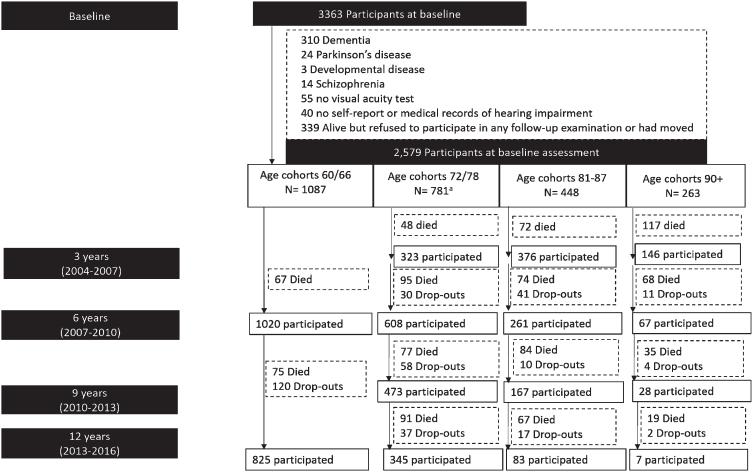
Dementia-free older adults from the Swedish National Study on Aging and Care in Kungsholmen (n = 2,579) were followed up for up for a median of 10 years (interquartile range = 6). Visual impairment was assessed with a reading acuity test, and hearing impairment was ascertained via self-report and medical records. Dementia was diagnosed following international criteria. Data on social network and leisure activity was collected via self-report. Hazard ratios (HRs) of dementia risk were derived from Cox regression models.
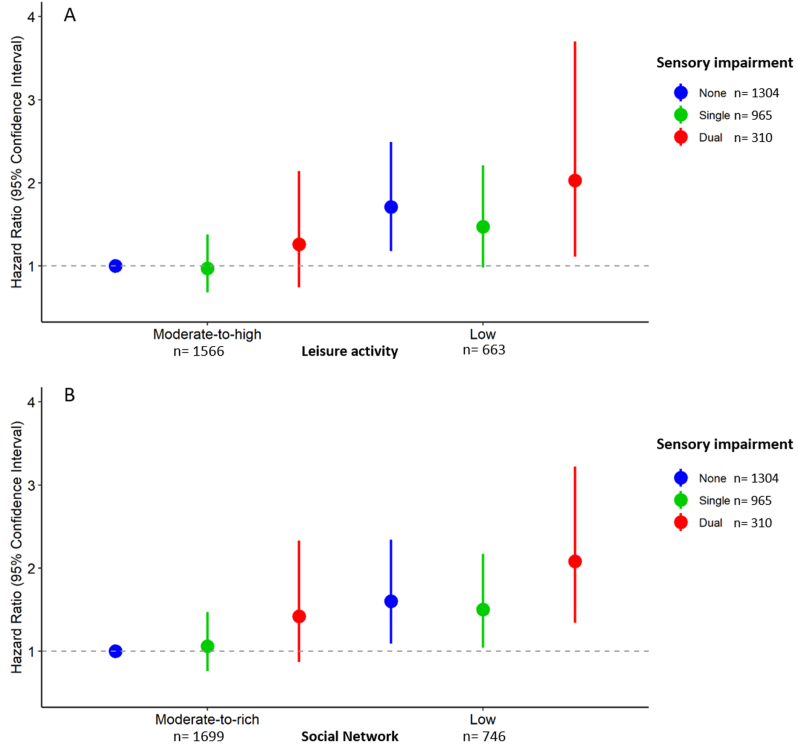
Dual impairment, but not single impairment in hearing and vision was associated with a higher risk of dementia (HR: 1.62, 95% CI: 1.16 to 2.27). Compared to participants with no sensory impairment and a moderate-to-rich social network, those with dual impairment and low social network or leisure activity had higher dementia risk (HR: 2.08, 95% CI: 1.43 to 3.22; HR: 2.08, 95% CI: 1.43 to 3.22, respectively), whereas participants with dual impairment with a moderate-to-rich social network or leisure activity did not have significantly higher dementia risk (HR; 1.42, 95% CI: 0.87 to 2.33; HR; 1.42, 95% CI: 0.87 to 2.33, respectively).
A richer social network and participation in stimulating activities may mitigate the higher dementia risk in older adults with dual impairment in vision and hearing.
有证据表明,感觉障碍与痴呆有关;然而,社会网络和休闲活动在这种关系中的作用尚不清楚。
研究听力和视力障碍与痴呆的关系,以及丰富的社会网络和休闲活动是否会调节这种关系。
来自瑞典 Kungsholmen 老龄化和护理全国研究(n=2579)的无痴呆老年人随访中位数为 10 年(四分位距=6)。使用阅读视力测试评估视力障碍,通过自我报告和医疗记录确定听力障碍。根据国际标准诊断痴呆。通过自我报告收集社会网络和休闲活动的数据。使用 Cox 回归模型得出痴呆风险的危害比(HR)。
双重障碍,而不是听力和视力的单一障碍与痴呆风险增加相关(HR:1.62,95%CI:1.16 至 2.27)。与无感觉障碍且社会网络中等至丰富的参与者相比,双重障碍且社会网络或休闲活动较少的参与者痴呆风险更高(HR:2.08,95%CI:1.43 至 3.22;HR:2.08,95%CI:1.43 至 3.22),而具有中等至丰富的社会网络或休闲活动的双重障碍参与者痴呆风险没有显著增加(HR:1.42,95%CI:0.87 至 2.33;HR:1.42,95%CI:0.87 至 2.33)。
丰富的社会网络和参与刺激活动可能会降低视力和听力双重障碍的老年人痴呆风险。