Wolters Fabian, van Middendorp Henriët, Van den Bergh Omer, Biermasz Nienke R, Meijer Onno C, Evers Andrea Wm
Health, Medical and Neuropsychology Unit, Faculty of Social Sciences, Leiden University, Leiden, Netherlands.
Leiden Institute for Brain and Cognition, Leiden University, Leiden, Netherlands.
JMIR Res Protoc. 2023 Jun 19;12:e38087. doi: 10.2196/38087.
The hormone cortisol plays important roles in human circadian and stress physiology and is an interesting target for interventions. Cortisol varies not only in response to stress but also as part of a diurnal rhythm. It shows a particularly sharp increase immediately after awakening, the cortisol awakening response (CAR). Cortisol can be affected by medication, but it is less clear whether it can also be affected by learning. Animal studies have consistently shown that cortisol can be affected by pharmacological conditioning, but the results in humans have been mixed. Other studies have suggested that conditioning is also possible during sleep and that the diurnal rhythm can be conditioned, but these findings have not yet been applied to cortisol conditioning.
The objective of our study was to introduce a novel avenue for conditioning cortisol: by using the CAR as an unconditioned response and using scent conditioning while the participant is asleep. This study investigates an innovative way to study the effects of conditioning on cortisol and the diurnal rhythm, using a variety of devices and measures to make measurement possible at a distance and at unusual moments.
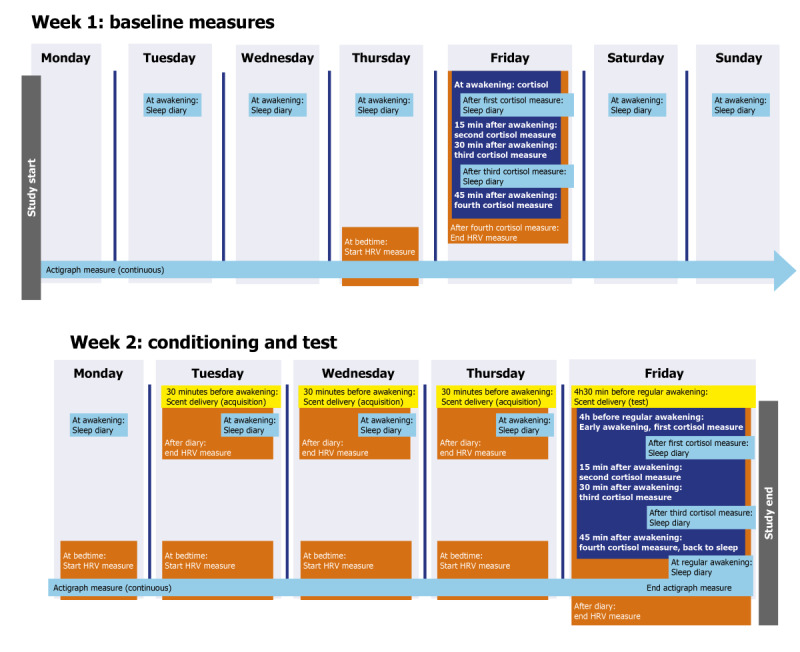
The study protocol takes 2 weeks and is performed from the participant's home. Measures in week 1 are taken to reflect the CAR and waking under baseline conditions. For the first 3 nights of week 2, participants are exposed to a scent from 30 minutes before awakening until their normal time of awakening to allow the scent to become associated with the CAR. On the final night, participants are forced to wake 4 hours earlier, when cortisol levels are normally low, and either the same (conditioned group) or a different (control group) scent is presented half an hour before this new time. This allows us to test whether cortisol levels are higher after the same scent is presented. The primary outcome is the CAR, assessed by saliva cortisol levels, 0, 15, 30, and 45 minutes after awakening. The secondary outcomes are heart rate variability, actigraphy measures taken during sleep, and self-reported mood after awakening. To perform manipulations and measurements, this study uses wearable devices, 2 smartphone apps, web-based questionnaires, and a programmed scent device.
We completed data collection as of December 24, 2021.
This study can provide new insights into learning effects on cortisol and the diurnal rhythm. If the procedure does affect the CAR and associated measures, it also has potential clinical implications in the treatment of sleep and stress disorders.
Netherlands Trial Register NL58792.058.16; https://trialsearch.who.int/Trial2.aspx?TrialID=NL7791.
INTERNATIONAL REGISTERED REPORT IDENTIFIER (IRRID): DERR1-10.2196/38087.
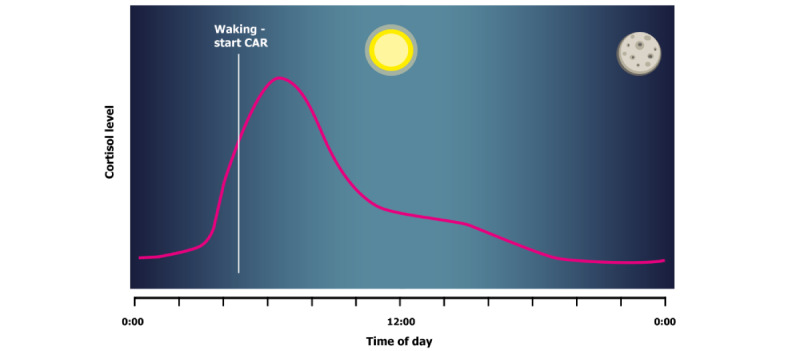
激素皮质醇在人体昼夜节律和应激生理学中发挥着重要作用,是一个有趣的干预靶点。皮质醇不仅会因应激而变化,也是昼夜节律的一部分。它在醒来后会立即出现特别明显的升高,即皮质醇觉醒反应(CAR)。皮质醇会受到药物的影响,但它是否也会受到学习的影响尚不清楚。动物研究一直表明皮质醇会受到药理条件作用的影响,但人类研究的结果却参差不齐。其他研究表明,睡眠期间也可能发生条件作用,并且昼夜节律也可以被条件化,但这些发现尚未应用于皮质醇条件作用。
我们研究的目的是引入一种调节皮质醇的新途径:将CAR用作非条件反应,并在参与者睡眠时使用气味条件作用。本研究调查了一种创新方法,以研究条件作用对皮质醇和昼夜节律的影响,使用各种设备和测量方法,以便在远距离和不寻常的时刻进行测量。
研究方案为期2周,在参与者家中进行。第1周进行测量以反映基线条件下的CAR和清醒状态。在第2周的前3个晚上,参与者从醒来前30分钟到正常醒来时间暴露于一种气味中,以使该气味与CAR相关联。在最后一晚,参与者被迫提前4小时醒来,此时皮质醇水平通常较低,在这个新时间前半小时呈现相同(条件作用组)或不同(对照组)的气味。这使我们能够测试呈现相同气味后皮质醇水平是否更高。主要结局是通过醒来后0、15、30和45分钟时的唾液皮质醇水平评估的CAR。次要结局是心率变异性、睡眠期间的活动记录仪测量结果以及醒来后的自我报告情绪。为了进行操作和测量,本研究使用了可穿戴设备、2个智能手机应用程序、基于网络的数据收集问卷和一个程控气味装置。
截至2021年12月24日,我们完成了数据收集。
本研究可以为学习对皮质醇和昼夜节律的影响提供新的见解。如果该程序确实会影响CAR及相关测量结果,那么它在睡眠和应激障碍的治疗中也具有潜在的临床意义。
荷兰试验注册编号NL58792.058.16;https://trialsearch.who.int/Trial2.aspx?TrialID=NL7791。
国际注册报告识别码(IRRID):DERR1-10.2196/38087。