Department of Neurology and Brain Tumor Center, University Hospital Zurich and University of Zurich, Zurich, Switzerland.
Division of Antibody-Based Immunotherapy, Department of Internal Medicine II, University Hospital Schleswig-Holstein, Campus Kiel, Kiel, Germany.
Neuro Oncol. 2023 Nov 2;25(11):2001-2014. doi: 10.1093/neuonc/noad108.
Chimeric antigen receptor (CAR) T cell therapy has proven to be successful against hematological malignancies. However, exploiting CAR T cells to treat solid tumors is more challenging for various reasons including the lack of suitable target antigens. Here, we identify the transmembrane protein CD317 as a novel target antigen for CAR T cell therapy against glioblastoma, one of the most aggressive solid tumors.
CD317-targeting CAR T cells were generated by lentivirally transducing human T cells from healthy donors. The anti-glioma activity of CD317-CAR T cells toward various glioma cells was assessed in vitro in cell lysis assays. Subsequently, we determined the efficacy of CD317-CAR T cells to control tumor growth in vivo in clinically relevant mouse glioma models.
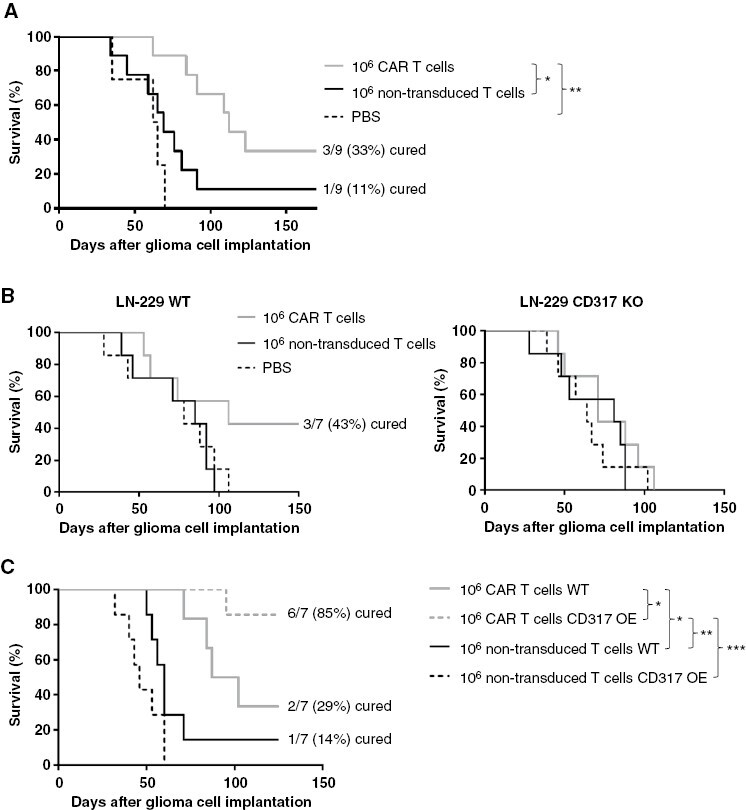
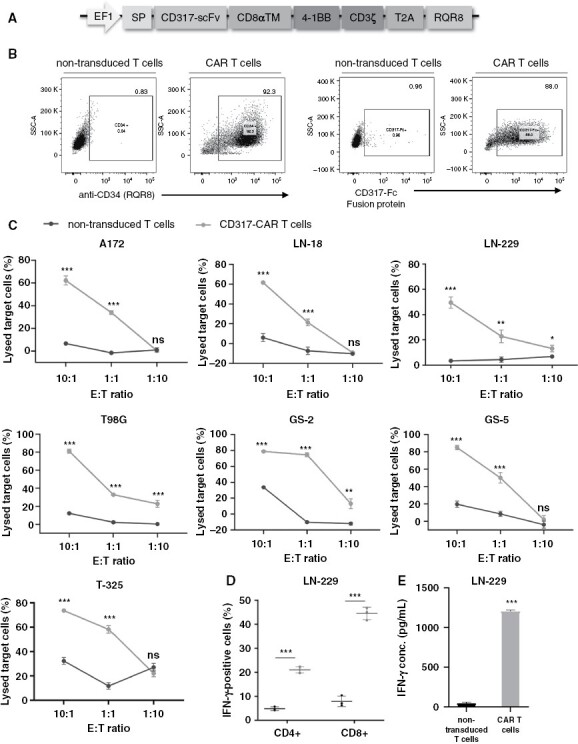
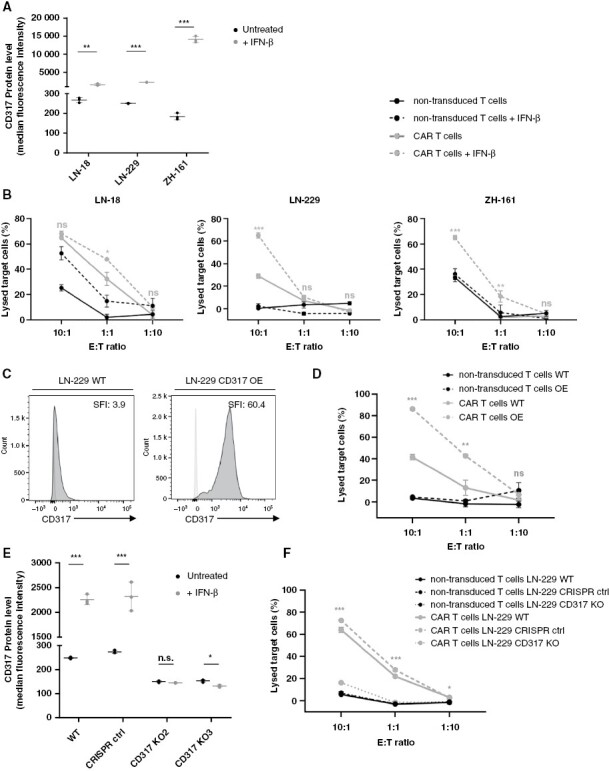
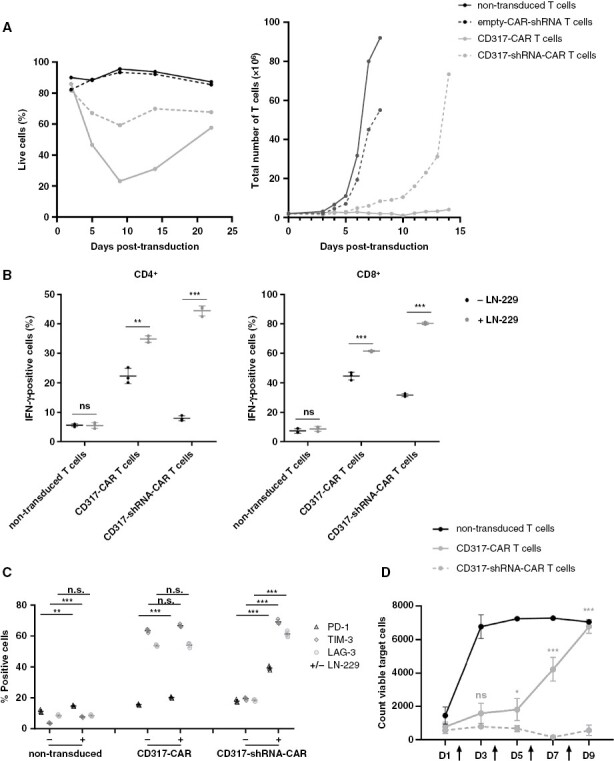
We generated CD317-specific CAR T cells and demonstrate strong anti-tumor activity against several glioma cell lines as well as primary patient-derived cells with varying CD317 expression levels in vitro. A CRISPR/Cas9-mediated knockout of CD317 protected glioma cells from CAR T cell lysis, demonstrating the target specificity of the approach. Silencing of CD317 expression in T cells by RNA interference reduced fratricide of engineered T cells and further improved their effector function. Using orthotopic glioma mouse models, we demonstrate the antigen-specific anti-tumor activity of CD317-CAR T cells, which resulted in prolonged survival and cure of a fraction of CAR T cell-treated animals.
These data reveal a promising role of CD317-CAR T cell therapy against glioblastoma, which warrants further evaluation to translate this immunotherapeutic strategy into clinical neuro-oncology.
嵌合抗原受体(CAR)T 细胞疗法已被证明对血液恶性肿瘤有效。然而,由于缺乏合适的靶抗原等各种原因,利用 CAR T 细胞治疗实体瘤更具挑战性。在这里,我们确定跨膜蛋白 CD317 为针对胶质母细胞瘤(最具侵袭性的实体瘤之一)的 CAR T 细胞治疗的新靶抗原。
通过慢病毒转导来自健康供体的人 T 细胞来生成针对 CD317 的 CAR T 细胞。在体外细胞溶解测定中评估 CD317-CAR T 细胞对各种神经胶质瘤细胞的抗神经胶质瘤活性。随后,我们确定 CD317-CAR T 细胞在体内临床相关的小鼠神经胶质瘤模型中控制肿瘤生长的功效。
我们生成了针对 CD317 的 CAR T 细胞,并在体外证明了针对几种神经胶质瘤细胞系以及具有不同 CD317 表达水平的原发性患者来源细胞的强烈抗肿瘤活性。CRISPR/Cas9 介导的 CD317 基因敲除可保护神经胶质瘤细胞免受 CAR T 细胞溶解,证明了该方法的靶向特异性。通过 RNA 干扰沉默 T 细胞中的 CD317 表达可减少工程化 T 细胞的自噬并进一步改善其效应功能。使用原位神经胶质瘤小鼠模型,我们证明了 CD317-CAR T 细胞的抗原特异性抗肿瘤活性,这导致了 CAR T 细胞治疗的一部分动物的存活时间延长和治愈。
这些数据揭示了 CD317-CAR T 细胞疗法在胶质母细胞瘤中的应用前景,值得进一步评估,以便将这种免疫治疗策略转化为临床神经肿瘤学。