Clinical Sciences, GSK, Rockville, Maryland, USA.
Biostatistics, GSK, Rockville, Maryland, USA.
Clin Infect Dis. 2023 Nov 11;77(9):1238-1246. doi: 10.1093/cid/ciad361.
There is growing consensus that coronavirus disease 2019 booster vaccines may be coadministered with other age-appropriate vaccines. Adding to the limited available data supporting coadministration, especially with adjuvanted vaccines, could enhance vaccine coverage in adults.
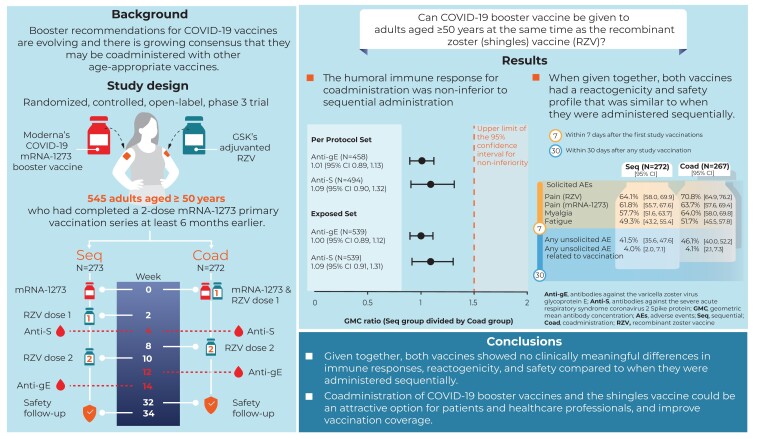
In this phase 3, randomized, open-label study, eligible adults aged ≥50 years were randomly assigned (1:1) to receive mRNA-1273 (50 µg) booster vaccination and a first dose of recombinant zoster vaccine (RZV1) 2 weeks apart (Seq group) or concomitantly (Coad group). The second RZV dose (RZV2) was administered 2 months post-RZV1 in both groups. Primary objectives were noninferiority of anti-glycoprotein E (gE) and anti-spike protein antibody responses in the Coad group compared to the Seq group. Safety and further immunogenicity assessments were secondary objectives.
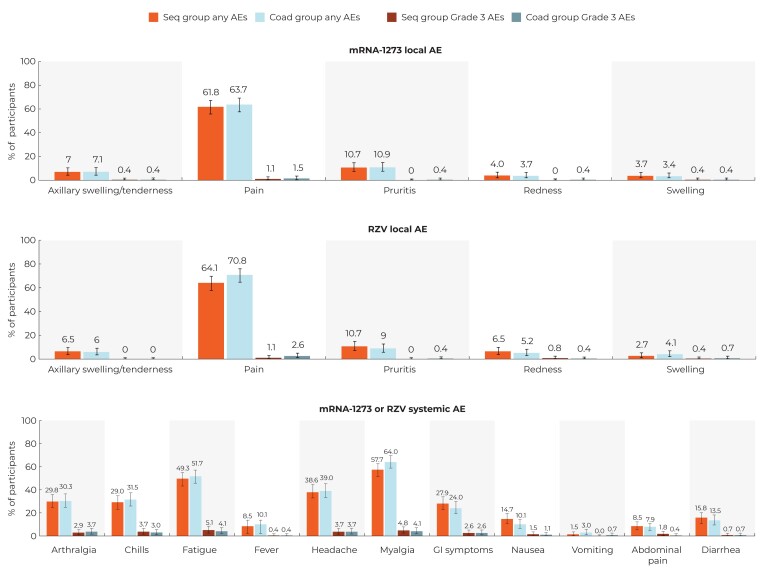
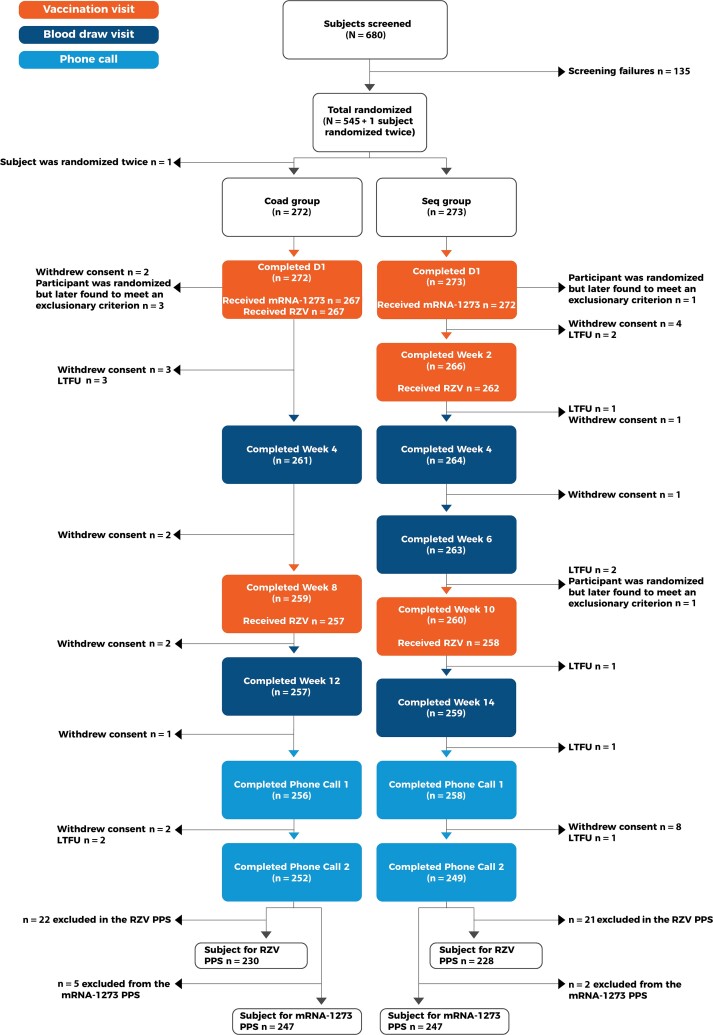
In total, 273 participants were randomized to the Seq group and 272 to the Coad group. Protocol-specified noninferiority criteria were met. The adjusted geometric mean concentration ratio (Seq/Coad) was 1.01 (95% confidence interval [CI], .89-1.13) for anti-gE antibodies 1 month post-RZV2, and 1.09 (95% CI, .90-1.32) for anti-spike antibodies 1 month post-mRNA-1273 booster. No clinically relevant differences were observed in overall frequency, intensity, or duration of adverse events between the 2 study groups. Most solicited adverse events were mild/moderate in intensity, each with median duration ≤2.5 days. Administration site pain and myalgia were the most frequently reported in both groups.
Coadministration of mRNA-1273 booster vaccine with RZV in adults aged ≥50 years was immunologically noninferior to sequential administration and had a safety and reactogenicity profile consistent with both vaccines administered sequentially. Clinical Trials Registration. NCT05047770.
越来越多的人认为,2019 年冠状病毒病(COVID-19)加强疫苗可能与其他适龄疫苗同时使用。增加对支持同时使用疫苗的有限数据的了解,特别是对佐剂疫苗的了解,可以提高成年人的疫苗接种率。
在这项 3 期、随机、开放性标签研究中,符合条件的年龄≥50 岁的成年人被随机分配(1:1)接受 mRNA-1273(50μg)加强疫苗接种和重组带状疱疹疫苗(RZV1),间隔 2 周(Seq 组)或同时(Coad 组)接种。两组均在接种 RZV1 后 2 个月接种第二剂 RZV(RZV2)。主要目的是比较 Coad 组和 Seq 组的抗糖蛋白 E(gE)和抗刺突蛋白抗体反应的非劣效性。安全性和进一步的免疫原性评估是次要目标。
共有 273 名参与者被随机分配到 Seq 组,272 名参与者被随机分配到 Coad 组。符合方案规定的非劣效性标准。RZV2 接种后 1 个月,抗 gE 抗体的调整几何平均浓度比(Seq/Coad)为 1.01(95%置信区间 [CI],0.89-1.13),mRNA-1273 加强接种后 1 个月,抗刺突抗体的调整几何平均浓度比为 1.09(95%CI,0.90-1.32)。两组之间总体不良事件的发生频率、强度或持续时间无临床相关差异。大多数不良事件为轻度/中度,每种不良事件的中位持续时间均≤2.5 天。两组中最常报告的是接种部位疼痛和肌痛。
在年龄≥50 岁的成年人中,同时接种 mRNA-1273 加强疫苗和 RZV 在免疫原性上不劣于序贯接种,且安全性和反应原性与序贯接种两种疫苗一致。临床试验注册。NCT05047770。