Koç University, School of Nursing, Public Health Nursing, Istanbul, Turkey.
Koç University, School of Medicine, Department of Public Health, Istanbul, Turkey; Koç University İşbank Center for Infectious Diseases (KUISCID), Istanbul, Turkey.
Vaccine. 2023 Jul 12;41(31):4586-4593. doi: 10.1016/j.vaccine.2023.06.022. Epub 2023 Jun 9.
During the coronavirus disease (COVID-19) pandemic, vaccination of healthcare workers (HCWs) has a critical role because of their high-risk exposure and being a role model. Therefore, we aimed to investigate vaccine hesitancy and the role of mandatory polymerase chain reaction (PCR) testing and education for vaccine uptake.
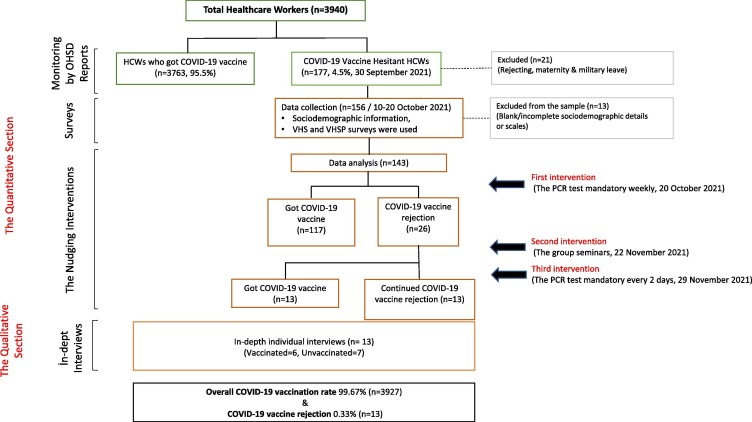
We conducted an explanatory sequential designed observational mixed-methods study, including quantitative and qualitative sections consecutively in two different pandemic hospitals between 15 September 2021 and 1 April 2022. The characteristics of vaccinated and unvaccinated HCWs were compared. The vaccine hesitancy scales were applied, and the effect of nudging, such as mandatory PCR and education, were evaluated. In-depth interviews were performed to investigate the COVID-19 vaccine hesitancy among HCWs according to Health Belief Model.
In total, 3940 HCWs were included. Vaccine hesitancy was more common among males than females, the ancillary workers than other health professions, and nonmedical departments than other departments. After the mandatory weekly PCR request nudge, 83.33 % (130/156) vaccine-hesitant HCWs were vaccinated, and 8.3 % (13/156) after the small group seminars and mandatory PCR every two days. The rate of COVID-19 vaccination was raised from 95.5 % to 99.67 % (3927/3940). At the end of in-depth interviews (n = 13), the vaccine hesitancy determinants were distrust, fear of uncertainty, immune confidence and spirituality, the media effect, social pressure, and obstinacy.
The nudging interventions such as mandatory PCR testing and small group seminars helped raise the rate of COVID-19 vaccination; the most effective one is mandatory PCR.
在冠状病毒病(COVID-19)大流行期间,由于医护人员(HCWs)面临高风险暴露且充当榜样,因此对其进行疫苗接种具有重要作用。因此,我们旨在研究疫苗犹豫以及强制性聚合酶链反应(PCR)检测和疫苗接种教育的作用。
我们进行了一项解释性序贯设计的观察性混合方法研究,包括在 2021 年 9 月 15 日至 2022 年 4 月 1 日期间在两家不同的大流行医院连续进行的定量和定性部分。比较了已接种和未接种疫苗的 HCWs 的特征。应用了疫苗犹豫量表,并评估了推动作用,例如强制性 PCR 和教育。根据健康信念模型对 HCWs 的 COVID-19 疫苗犹豫进行了深入访谈。
共纳入 3940 名 HCWs。与女性相比,男性、辅助工作人员比其他卫生专业人员、非医疗部门比其他部门的疫苗犹豫更为普遍。在强制性每周 PCR 请求推动之后,83.33%(130/156)的疫苗犹豫 HCWs 接种了疫苗,在小型小组研讨会和每两天强制性 PCR 之后有 8.3%(13/156)接种了疫苗。COVID-19 疫苗接种率从 95.5%提高到 99.67%(3927/3940)。在深入访谈结束时(n=13),疫苗犹豫的决定因素包括不信任、对不确定性的恐惧、免疫信心和精神信仰、媒体效应、社会压力和固执。
强制性 PCR 检测和小组研讨会等推动干预措施有助于提高 COVID-19 疫苗接种率;最有效的方法是强制性 PCR。