Verghote Flor, Van Praet Charles, De Maeseneer Daan, Berquin Camille, Vanneste Ben, De Visschere Pieter, Verbeke Sofie L J, Fonteyne Valérie
Department of Radiation Oncology, Ghent University Hospital, Ghent, Belgium.
Department of Human Structure and Repair, Ghent University, Ghent, Belgium.
Cancer Manag Res. 2023 Jun 14;15:511-521. doi: 10.2147/CMAR.S407031. eCollection 2023.
Pronounced underuse of radiotherapy (RT) in muscle-invasive bladder cancer (MIBC) is reported. This study aims to assess the awareness about the role of RT in different MIBC settings and see whether this has increased since 2017.
We reviewed the bladder cancer guidelines of the EAU, ESMO, NCCN, NICE, and AUA/ASCO/ASTRO/SUO, focusing on the role of RT in MIBC. In 2017, we evaluated the use of RT in MIBC in Belgium. This raised awareness about the indications of RT in different MIBC settings. Here, we present a retrospective pattern of care analysis of the RT use for MIBC patients at our center from January 2012 until December 2021. Frequency of RT use, patient, disease and treatment characteristics were compared between two 5-year periods (2012-2016 and 2017-2021).
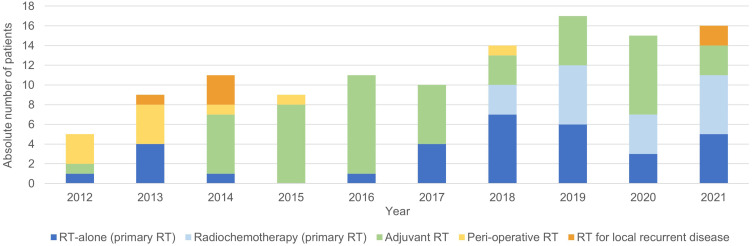
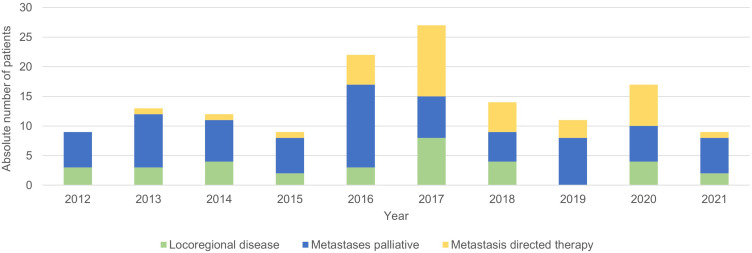
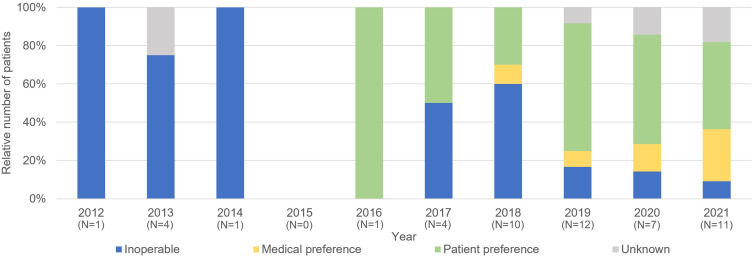
Review of the guidelines suggested that RT can be used as a treatment option in most MIBC settings. However, differences between guideline recommendations existed and high-level evidence was often lacking. Overall, 221 unique MIBC patients received RT at our center. RT use for MIBC was 39% higher in the second 5-year period (Between the same periods, the number of new MIBC registrations increased with 26%). The most pronounced increase, ie, 529%, was observed in the primary setting and was in parallel with patient preference becoming the main indication for RT. Participation in clinical trials seems to have had an important impact on the frequency of RT use in the adjuvant and metastatic setting.
We provide a critical overview of the RT indications in MIBC as recommended by the international guidelines. Increased awareness about RT as a treatment option in MIBC seems to have an impact on the treatment choice in clinical practice, as was observed in our tertiary center.
据报道,肌肉浸润性膀胱癌(MIBC)患者对放射治疗(RT)的使用明显不足。本研究旨在评估对RT在不同MIBC情况下作用的认识,并观察自2017年以来这种认识是否有所提高。
我们回顾了欧洲泌尿外科学会(EAU)、欧洲肿瘤内科学会(ESMO)、美国国立综合癌症网络(NCCN)、英国国家卫生与临床优化研究所(NICE)以及美国泌尿外科学会/美国临床肿瘤学会/美国放射肿瘤学会/美国泌尿外科学会(AUA/ASCO/ASTRO/SUO)的膀胱癌指南,重点关注RT在MIBC中的作用。2017年,我们评估了比利时MIBC患者中RT的使用情况。这提高了对RT在不同MIBC情况下适应证的认识。在此,我们呈现了对2012年1月至2021年12月期间我们中心MIBC患者RT使用情况的回顾性治疗模式分析。比较了两个5年期间(2012 - 2016年和2017 - 2021年)RT使用频率、患者、疾病和治疗特征。
指南回顾表明,在大多数MIBC情况下,RT可作为一种治疗选择。然而,指南建议之间存在差异,且往往缺乏高级别证据。总体而言,我们中心有221例独特的MIBC患者接受了RT治疗。在第二个5年期间,MIBC的RT使用率提高了39%(同期,新的MIBC登记病例数增加了26%)。在初始治疗情况下观察到最显著的增加,即增加了529%,这与患者偏好成为RT的主要适应证同时出现。参与临床试验似乎对辅助治疗和转移治疗情况下RT的使用频率产生了重要影响。
我们对国际指南推荐的MIBC中RT适应证进行了批判性概述。正如我们在三级中心所观察到的,对RT作为MIBC治疗选择的认识提高似乎对临床实践中的治疗选择产生了影响。