The Center for Applied Genomics, Children's Hospital of Philadelphia, Philadelphia, Pennsylvania, USA.
Department of Epidemiology, Harvard T.H. Chan School of Public Health, Boston, Massachusetts, USA.
Clin Transl Med. 2023 Jun;13(6):e1291. doi: 10.1002/ctm2.1291.
While polygenic risk scores hold significant promise in estimating an individual's risk of developing a complex trait such as obesity, their application in the clinic has, to date, been limited by a lack of data from non-European populations. As a collaboration model of the International Hundred K+ Cohorts Consortium (IHCC), we endeavored to develop a globally applicable trans-ethnic PRS for body mass index (BMI) through this relatively new international effort.
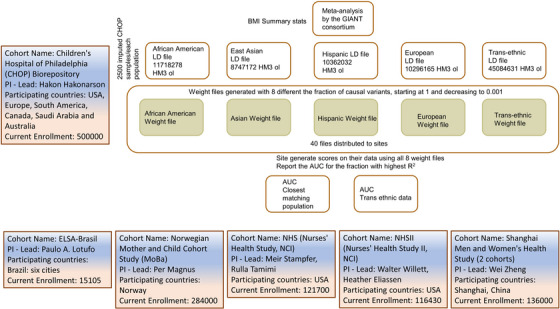
The polygenic risk score (PRS) model was developed, trained and tested at the Center for Applied Genomics (CAG) of The Children's Hospital of Philadelphia (CHOP) based on a BMI meta-analysis from the GIANT consortium. The validated PRS models were subsequently disseminated to the participating sites. Scores were generated by each site locally on their cohorts and summary statistics returned to CAG for final analysis.
We show that in the absence of a well powered trans-ethnic GWAS from which to derive marker SNPs and effect estimates for PRS, trans-ethnic scores can be generated from European ancestry GWAS using Bayesian approaches such as LDpred, by adjusting the summary statistics using trans-ethnic linkage disequilibrium reference panels. The ported trans-ethnic scores outperform population specific-PRS across all non-European ancestry populations investigated including East Asians and three-way admixed Brazilian cohort.
Here we show that for a truly polygenic trait such as BMI adjusting the summary statistics of a well powered European ancestry study using trans-ethnic LD reference results in a score that is predictive across a range of ancestries including East Asians and three-way admixed Brazilians.
虽然多基因风险评分在估计个体患肥胖等复杂特征的风险方面具有重要意义,但迄今为止,由于缺乏非欧洲人群的数据,其在临床中的应用受到限制。作为国际百万人队列联盟(IHCC)合作模式的一部分,我们努力通过这一相对较新的国际努力,为体重指数(BMI)开发一种全球适用的跨种族多基因风险评分(PRS)。
PRS 模型由费城儿童医院(CHOP)应用基因组学中心(CAG)开发、培训和测试,该模型基于 GIANT 联盟的 BMI 荟萃分析。经过验证的 PRS 模型随后分发给参与的站点。各站点在其队列上本地生成分数,并将汇总统计数据返回 CAG 进行最终分析。
我们表明,在缺乏来自跨种族 GWAS 的良好加权标记 SNP 和 PRS 效应估计的情况下,可以使用 LDpred 等贝叶斯方法从欧洲血统 GWAS 生成跨种族评分,通过使用跨种族连锁不平衡参考面板调整汇总统计数据。跨种族评分在包括东亚人和三种混合巴西队列在内的所有非欧洲血统人群中均优于特定人群的 PRS。
在这里,我们表明,对于 BMI 等真正的多基因特征,使用跨种族 LD 参考调整强大的欧洲血统研究的汇总统计数据,可以得出一种在包括东亚人和三种混合巴西人在内的一系列血统中具有预测性的评分。